

Can You Align Your Car's Tires Yourself, Or Is Going To A Shop Better?

There are a couple of services you can get done next time you take your car in for maintenance, and you can bet wheel alignment is one of them. It's one of the easiest and less costly services you can get for your car to keep it running smoothly. And, if you're up for it, you can perform a wheel alignment yourself in the comfort of your own driveway. However, it's pretty complicated, and taking your vehicle to an auto mechanic professional is advisable.
Various components of your car can wear down if the wheels are misaligned, and that includes the longevity of your wheels. Unfortunately, not everyone has the time to go to the mechanic, but for DIY mechanics, that's not a problem. With a few basic tools, you can align the wheels of your car at home. However, it can be quite the headache. Don't say we didn't warn you.
DIY wheel alignment terms

There are four things you need to understand before we get into this: camber, caster, toe, and tie rod. The camber is the angle of the wheels, inward or outward, in reference to how level it is with the road. You want to aim for this angle to be zero, but sometimes, negative camber wheels can be a good thing.
The caster refers to the steering axis and whether it looks tilted to the front or the rear from a side view. This affects how well the car centers itself following a turn. Toe is whether the front and rear wheels are pointing inward or outward. You can get a good idea of this if you can get above the car and see it from a bird's eye view. A tie rod is a component attached to the steering knuckle of the wheel and the rack and pinion gear of the steering system.
Are you following so far? To check for all of these, all we really need is a long piece of string, a ruler, some jack stands, and a balancing weight. You can also use measuring tape in place of string, but for this, you will need a friend, and honestly, the string method is more sound. You'll see why in a moment.
DIY wheel alignment setup
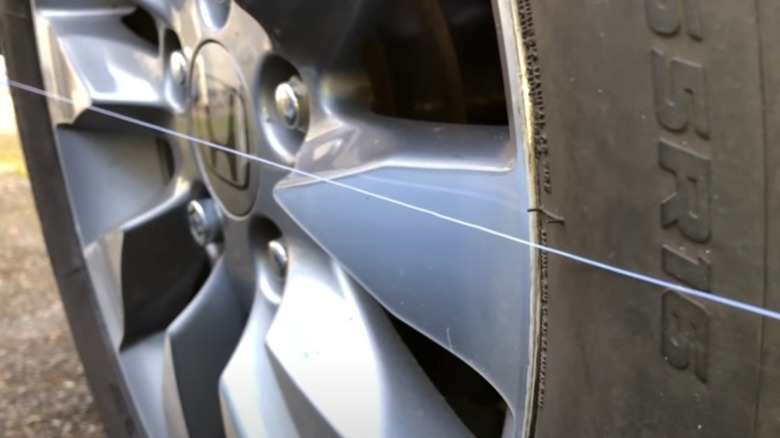
Home alignment is an auto repair you'll want to learn if in a pinch. First, let's set up our work space correctly. After parking the car on an even and level surface, we're good to go. Feel free to bounce the car a few times to get the suspension settled. If the camber isn't zero, we suggest getting towed to the nearest mechanic before driving like this.
Turn the car on slightly, so the steering wheel can freely turn, but the engine doesn't turn on. Position the steering wheel so that it is in the center, and the wheels should (in theory) be perfectly straight. This will help us with measuring the caster. By adjusting the steering wheel, we can find out if the wheels are correctly aligned. If the wheels are not straight, but the steering wheel is, then we know they are not aligned correctly.
Next, place a jack stand at each corner of the car. Ideally, they should be 2 to 4 inches from each tire, while also being at the corner of the front and rear of the vehicle. The reasoning behind this is that we're then going to take a string and make a rectangle around the car. The string will be stretched and rest in each jack stand. To keep it tight, you'll need some balancing weights or bungee cords.
DIY wheel alignment steps
Now that we have our space setup and the car in position, it's time to start checking the wheel alignment. Break out a steel ruler for this one.
Adjust the jack stands to make sure the height of the string is directly in the center of the front and rear axles. We can check the toe of the wheels by getting up on a ladder and view the wheels from above, but it's much easier to use a ruler and measure the distance between the front and rear edges of each wheel rim to the string. If the distance between each isn't the same, then the wheels are tilted. If your tires seem to always wear out unevenly, this could be the reason why.
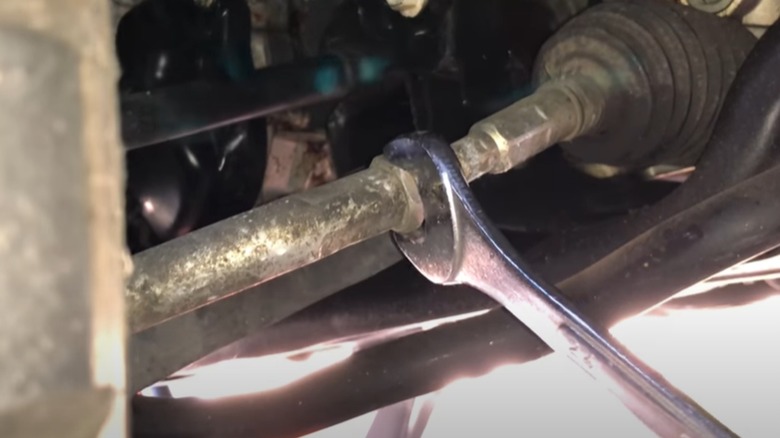
Look at the angle of your tires and their distance to the string. If the front of the tire is pointing away from the string, then you will need to tighten the tire rod. However, if the front of the tire is pointing towards the string, then you need to loosen the tire rod. You'll need to first loosen the nut that connects the inner and outer tire rods together. You're most likely going to need a jack to lift the car. Otherwise, you need to be thin enough to get under the car so you can adjust the tie rod and tighten or loosen the jam nuts.
Lower the car back down and bounce it again a few times. Double-check the measurement. If the distance is now equal for the front and rear of the tire, congratulations; you finished adjusting one tire. Now, repeat the steps for the other three.