

Here's How Much Horsepower Boeing's T50 Engines Can Have
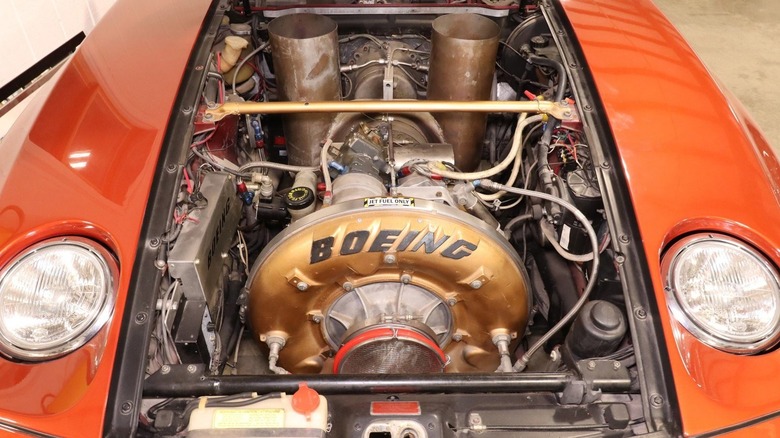
Recently, a Boeing T50 turboshaft-powered Porsche 928 has been making waves on the internet, including here at Jalopnik. Under the hood of the "Risky Business"-era P-car, the T50 powerplant is said to make about 300 horsepower, but where does that stand in terms of Boeing T50 horsepower potential? As it turn out, certain versions of the T50 can make even more power than the unit in the unholy Porsche mashup, while others can't even summon half that amount.
Before we get ahead of ourselves, what is the Boeing T50, anyway? It's biggest claim to fame is being the first turboshaft engine to ever power a helicopter. Prior to the early 1950s when the T50 turboshaft was released, helicopters were typically powered by piston engines.
Turboshafts are similar to turbofan jet engines, except that instead of producing thrust like a turbofan, the turboshaft uses energy to turn, well, a shaft to drive machinery. During its career, the T50 was used mostly in the Gyrodyne QH-50 Drone Anti-Submarine Helicopter (DASH), which served during the 1960s, including in the Vietnam War.
Boeing T50 horsepower escalated quickly
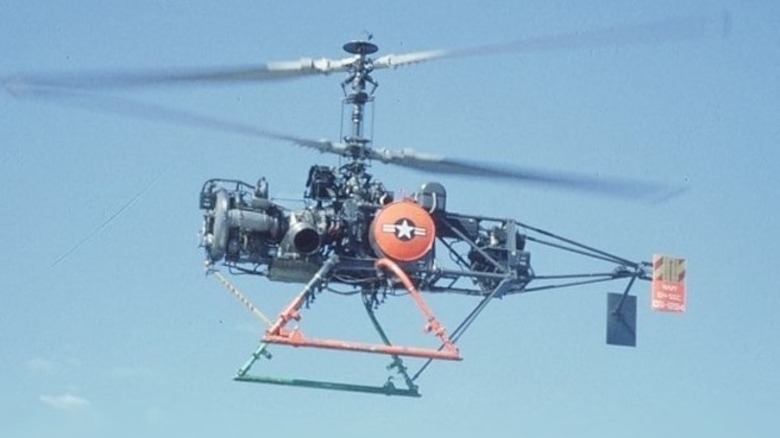
We've been referring to this engine by its catchall T50 military moniker, but Boeing had internal three-digit codes for these engines, sometimes followed by an alphanumeric, which are much more specific. For example, the Boeing 502 was an extremely early version of the turboshaft circa 1950 that produced 120 horsepower at the shaft. A slightly later effort, the 502-10C, doubled the older turboshaft's output to 240 horsepower. By the mid-1960s, rapidly advancing technology led to the 502-10VC, capable of up to 300 horsepower.
Discussing all of the dozens of variations under the Boeing T50 umbrella is beyond this article's scope, but as installed in the QH-50 DASH, approximately 300 horsepower is the figure typically bandied about. However, the top dog of the military Boeing T50 engines is the T50-B0-10, with 330 horsepower on a power-robbing 90-degree day in the U.S Navy's QH-50C DASH. According to the Vertical Flight Society, civilian versions of the Boeing T50 also exist, such as the Boeing Model 550, rated at 425 horsepower with the potential for modification into the 500-horsepower range.
Back on the automotive front, numerous manufacturer-supported turbine-powered cars existed from the 1950s all the way into the 1970s, like this General Motors Firebird II. Ultimately, the innovation failed as a result of high fuel consumption, poor throttle response, and high cost. So nowadays, you'll have to make your own turbine car, just like the owner of our Porsche 928 or this 1976 Bradley GT.