

Long Before The U.S. Air Force Existed, The Army Used Planes Made By The Wright Brothers
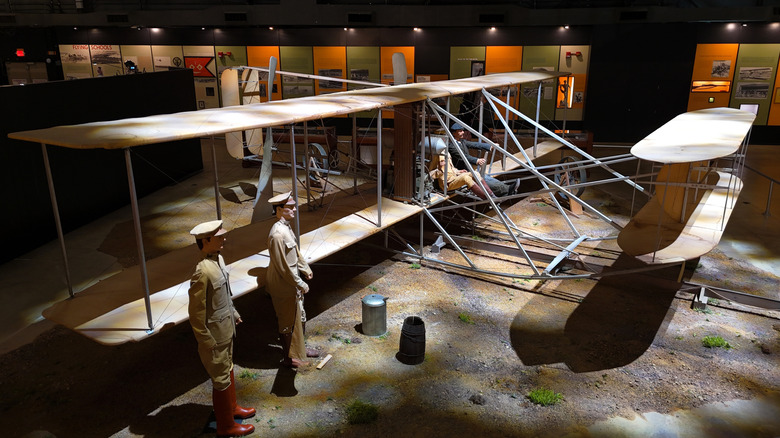
With how ubiquitous commercial air travel is today it's easy to overlook how astonishingly rapid early aircraft development was. There were only 24 years between the maiden flight of the Wright Flyer in 1903 and Charles Lindbergh made the first solo transatlantic flight in 1927. However, military thinkers were even quicker to realize the potential of powered flight on the battlefield. The U.S. Army purchased a Wright Military Flyer in 1909 for use as an observation aircraft. The first heavier-than-air military aircraft served as the spark that eventually led to creation of the U.S. Air Force, but it wasn't an unmitigated success.
The tactical advantage of holding the higher ground had been known for centuries, but aircraft opened up an entirely new dimension. Initially, it was hot air balloons taking to the wild blue yonder. During the Civil War, the Union Army fielded a balloon corps to perform reconnaissance and scout Confederate Army positions. The corps wouldn't last long with then-General Ulysses S. Grant dissolving the unit in August 1863.
The U.S. Army decided to revive this reconnaissance role when opening bidding for a two-seat observation aircraft in 1908. According to the U.S. Department of Defense, the Wright Military Flyer reached an altitude of 400 feet while averaging a speed of 42.5 miles per hour during its final ten-mile qualifying flight in July 1909. The service would purchase a single Wright Military Flyer for $30,000 next month. The sum would be $1.1 million today when adjusted for inflation.
A Wright U.S. Army demonstration flight led to the first fatal plane crash
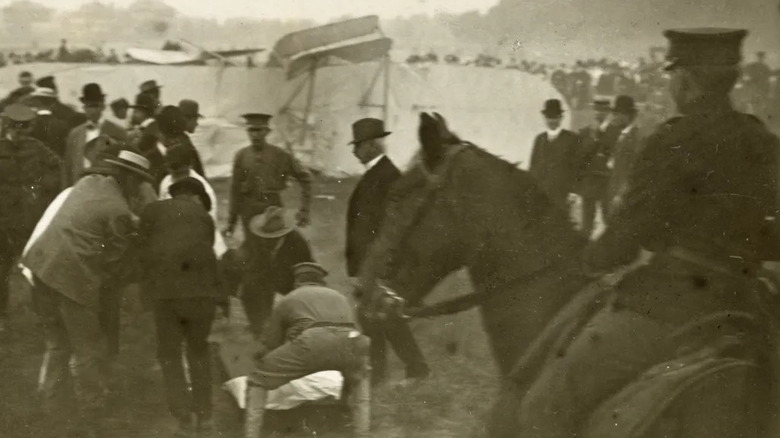
The demonstration campaign that convinced the U.S. Army Signal Corps to open its checkbooks wasn't flawless. Orville Wright would bring a Wright Model A plane to Fort Myer near Arlington National Cemetery in 1908. The younger Wright brother flew dignitaries on brief flights around the Fort's drilling grounds in front of over 2,000 people.
The spectacle was going perfectly until First Lieutenant Thomas Selfridge climbed abroad as a passenger. He had been the first U.S. Army officer to fly a plane just months earlier. According to Air & Space Magazine, Model A suffered a propeller failure while flying at 40 mph at an altitude of at least 100 feet. The twin-propeller wood and canvas biplane tumbled out of control and plummeted to the ground. Wright was seriously injured, but the crash killed Selfridge.
In the crash's aftermath, a distraught Wright believed that he could've landed the plane safely if he had "a few feet more" of altitude. He returned to Fort Myer with an upgraded plane the next year and secured the sale to the Signal Corps. The Wright Military Flyer would never see combat, but it's easy to see how the early aircraft would've been vulnerable to machine gun fire from the ground with such a low maximum altitude. It wouldn't be the U.S. Army's last foray into experimental aircraft. The service would dabble in early drone warfare less than a decade later.