

The US Army Was Using Drones Way Before Most People Realize
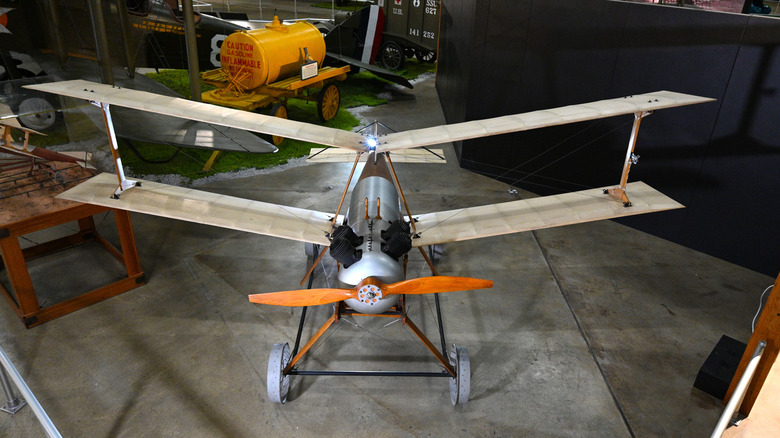
The collective image of drone warfare moves around, shifting between an MQ-9 Reaper firing a Hellfire missile from 20,000 feet and a DJI drone jerry-rigged with an artillery shell flying into a Russian conscript in Ukraine. While those sorts of ideas might seem relatively modern, the truth is that the U.S. Army was experimenting with armed unmanned aerial vehicles as early as World War I.
For the duration of the Great War, the Entente feared that the German Empire would grind its war effort to a halt with strategic Zeppelin bombing raids and U-boat naval blockades. And that fear was inherited by the United States when the country entered the conflict. An inventor in Dayton, Ohio, seemingly had a solution for the Entente's problems: the Kettering Aerial Torpedo.
The brainchild of Charles F. Kettering, nicknamed the Bug, was basically a pilotless wooden biplane with close to a 15-foot wingspan. According to the National Museum of the U.S. Air Force, the weapon was propelled by a 40-horsepower 4-cylinder engine built by the Detroit-based De Palma Manufacturing Company, founded by 1915 Indy 500 winner Ralph DePalma. For its one-way sortie, the Bug would be loaded with 180 pounds of high explosive. The weapon was then placed onto a four-wheeled dolly, where it would launch into the sky off a portable rail track.
The Bug never saw combat
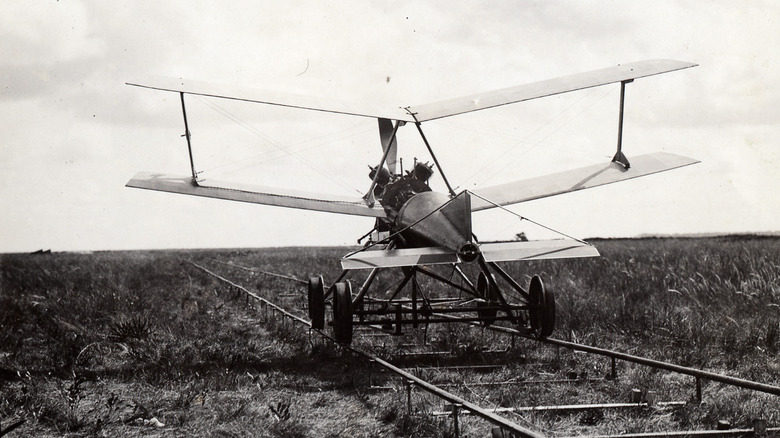
While the Kettering Aerial Torpedo had a range of 75 miles and could reach a top speed of 120 mph, actually guiding the plane to its target was incredibly difficult. According to the National Air and Space Museum, the Bug used a gyro to maintain stable flight and a barometer to hold level at a specific altitude. The weapon could theoretically fly in a straight line and plow into the side of a Zeppelin, like a torpedo in the sky. For surface targets, the wings could be released on a timer. Ground crew would estimate speed and distance to calculate when the Bug should plummet from above.
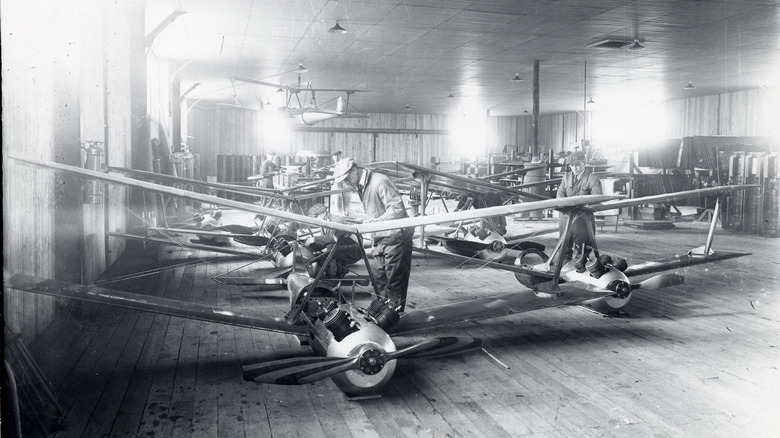
The Bug had all the ingredients to transform combat during World War I, but it couldn't make it out of testing. During a demonstration flight in Dayton, the Aerial Torpedo flew off-course and nearly crashed into the reviewing stand filled with U.S. Army brass. Regardless, the officers were impressed enough to fund development and continue testing. The Dayton-Wright Airplane Company built fewer than 50 Bugs before the Armistice in November 1919, but none were ever used on the Western Front.
The scale of aerial warfare dramatically increased during the Bug's lifespan
It's important to note that powered heavier-than-air flight was still a new concept in 1917. The Wright Flyer made its maiden flight just 14 years earlier. What would become the U.S. Air Force was still merely the Aviation Section of the U.S. Army Signal Corps. During WWI, the aerial warfare unit would evolve into the U.S. Army Air Service, a component multiple orders of magnitude larger than the old section. When the Bug's development was shelved in the 1920s, Air Service officers were already pushing Congress to create an Air Force independent of the Army.
The Bug's failings didn't impact Kettering's reputation as an engineering genius, though. Before the Aerial Torpedo, he revolutionized the automotive industry by inventing the electric starter and battery ignition at Delco. General Motors acquired both Delco and Dayton-Wright in 1918 and appointed Kettering its head of research in 1920. He pioneered the use of leaded gasoline while at GM, which should have hurt his reputation, but the General Motors Institute was still renamed Kettering University in 1998 to honor him.