

Way Before Ducati's Desmo, The Company Started With Puppies
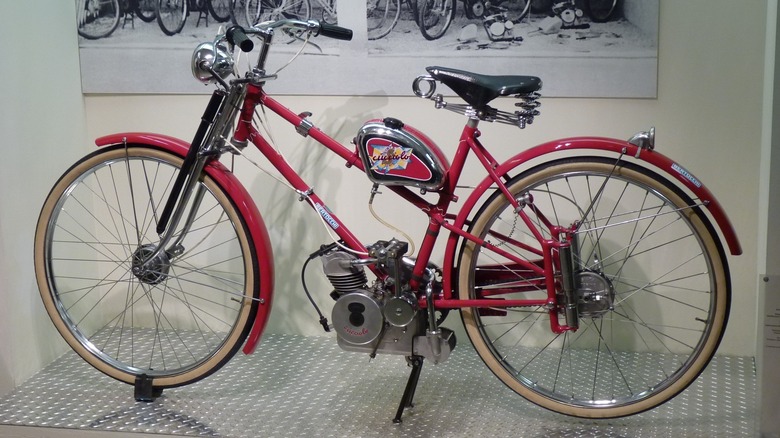
There are few pairings in the motorcycle world more notable than Ducati and Desmo. The famed Italian company is known for making some of the most desirably fast bikes, and so happens to be leading the MotoGP World Championship as of this writing. None of that would be possible, if it weren't for the company's puppies — or rather its Cucciolo engines.
In the midst of World War II, before Vespa began selling its own purpose-built machines to the Italian public to get the country back on the road, Ducati was already in the throes of doing the same. At this time, Ducati was known for its machining and radios, but had decided to try its hand at making an engine. It created a tiny prototype four-stroke cycle engine, paired with a little two-speed gearbox, intended to be affixed to a bicycle to simply give riders a boost of power. The engine's supposed barking-like noise helped inspire its name, Cucciolo, which in Italian means "puppy."
Hearing the "puppy" in action, it doesn't sound much like a puppy. Although the engines demonstrated in these running videos are upwards of 60-80 years old, so they sound like old puppies.
From outsourcing engines to making the first Ducati motorcycle
According to Ducati's history, the original Siata factory where the Cucciolo was made had been damaged in the war, and a new factory would open in 1945 to get production rolling. Siata, lastly known as Societa Italiana Applicazioni Tecniche Auto-Aviatorie, did make automobiles, and was tapped to produce Ducati's Cucciolos. In just months demand had outpaced Siata's production capabilities, making at least 240 engines a day, and Ducati moved to take on manufacturing itself.
The Cucciolo would go through three different iterations of the engine, the T2 was a sportier version that had an output of nearly 2 hp and could reach top speeds upwards of 37 mph. The T3 arrived in 1948, featuring a three-speed gearbox. Molto bene!
All of these engines were meant to be installed and mounted onto other bicycles, but Ducati began to see the benefits of doing the same in-house. In 1949, Ducati worked with the airplane manufacturer Caproni to make a tube frame, that could then be paired with the Cucciolo T3 for Ducati's first fully produced motorized bike. Yet the Italian brand's first true complete motorcycle would be the Ducati 60, launched in 1950. It's tiny 60cc engine was another step towards Ducati's famed motorcycle history. Power output was rated for 2 hp at 4500 rpm, with the bike weighing in at 100 pounds. Of course, much like Vespa and Piaggio, Ducati wasted no time in getting into racing and entered its 60 into competition.
Ducati's brief Cucciolo-Desmodromic parallel timeline
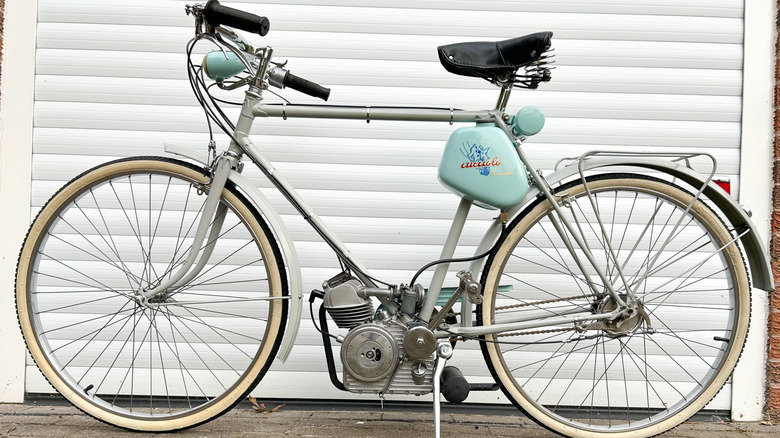
Production of Cucciolo engines didn't cease with the making of the 60, but the manufacturing may have changed hands. This 1953 Ducati Cucciolo Rocher Mark IV, on auction with Iconic Motorbikes, was built a few years after the introduction of the Ducati 60. Ducati at this point had allowed other companies to makes its engines, but the Ducati and Cucciolo names remained.
Iconic's particular example was made by Rocher, who according to the auction site, had "built high-end cyclomotors with unique and often extravagant designs. They manufactured Ducati Cucciolo engines with the best materials and cast parts in aluminum rather than using Ducati's inferior high silicon content alloys. This means that damage to Rocher engines can be repaired through welding, which is not possible with Ducati's engines." The switch on Rocher's part makes for an amusing reminder of Ducati's reputation of having engines some individuals believe are difficult to maintain, i.e. the notorious Desmo jokes.
Just a few years after the 60 was created, in 1956, Ducati introduced its first desmodromic valvetrain by putting it into a 125 Grand Prix racing motorcycle. Today its unique but endearing build is featured on many of Ducati's bikes, including most recently, its newly minted motocross bikes. Yet these impressive chariots of speed and the notorious Desmo wouldn't be here, had it not been for the original "puppy."