

Are End-Of-Year Car Sales Actually A Good Time To Buy?

Maybe you don't pay close attention to local car commercials. That's understandable, especially when it comes to the ads where the owner drags out their dog and grandkids. But if you do notice them, you'll see that in December or a little earlier, dealers start touting their deep year-end discounts and special pricing. Maybe you've even heard your friends say that the end of the year is a good time to buy a car — but is that true?
It can be. Dealers do, in fact, run special year-end deals in order to move inventory. They have to make room on their lots and meet annual sales quotas. In addition to discounts, they'll add incentives to sweeten the deal. It's a good time to buy used cars, as well. We say this because the availability of deals has been seen statistically to increase during December. But it shouldn't be seen as a hard-and-fast rule for every year, since there could be factors like supply-chain shortages that affect the price of cars.
Of course, the prevalence of deals is not a substitute for thorough research. Nor does it mean you don't need to try to negotiate. Don't assume just because you're car shopping in December that you're going to automatically walk into a great clearance deal on the car of your dreams. After all, end-of-year deals don't apply to every model. But as times to buy, the end of the year is a good one.
'Tis the season for discounts

December is typically the month a dealership will offer its highest discounts. How much those discounts are higher than other months can vary year by year. Edmunds did a month-over-month comparison of discount percentages dating back to the beginning of 2023. December held the highest months in all three complete years in the report.
The discounts in December of 2023, at 3.1% of manufacturer's suggested retail price, were much higher than the lowest discount of that year, which was 0.6% in January. The differences between December's discounts and the lowest of the year were less drastic in 2024 and 2025, however. In 2024, they were 4.2% in December and 3% in January. In 2025, they were 4.7% in December and 3.9% in April (the month with the lowest discounts that year). This year, we've already found you five new cars with deep, deep discounts.
Why all the discounts in December? New cars from the latest model year gradually start arriving at the dealership as they are released during the previous calendar year. In other words, 2027 models have been arriving at many dealerships for a few months now. That means the dealer has to get rid of last year's models to make room for the new model year. The biggest push generally happens in December. According to Consumer Reports, customers who bought 2024 models as 2025 models were rolling out could have saved over $2,000.
Discounts aren't the whole story
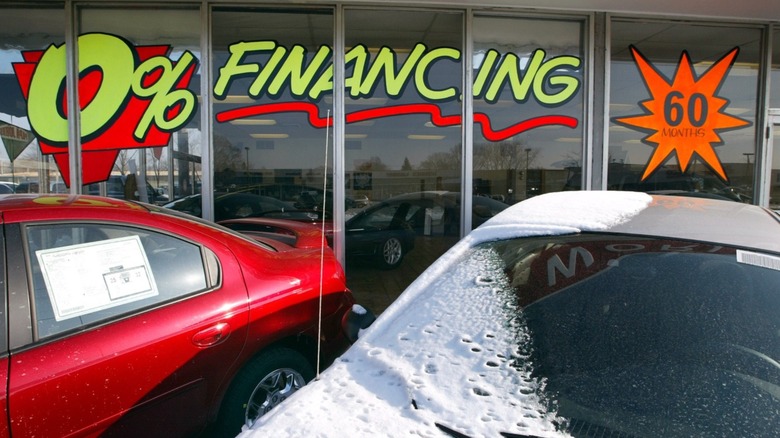
Discounts aren't the only trick dealerships have up their sleeves to entice you to buy a new car. There are other incentives, like rebates and finance deals. These incentives are typically more generous in December, as well. Some incentives are tied to holidays and, as you may be aware, there happens to be a holiday in December, and it's kind of a big deal.
Cox Automotive looked at the statistics and noted that in 2025, incentives were at their highest in December, rising to 7.5% of the average transaction price (ATP). That's an 11% increase over the previous month, which saw incentives at 6.7% of ATP. The average price paid for a vehicle also went up that month, so it may seem that discounts and other incentives weren't that big a deal. However, that factor is skewed by the fact that more luxury cars are sold at the end of the year, raising the average price paid.
The fact is, dealerships are motivated to offer year-end discounts, rebates, and other incentives by more than just the need to move inventory. They often have annual quotas that need to be met. December offers the opportunity for a final push before that deadline. Automakers also want to clear the way for their newest models, which is why they often offer their own incentives at the end of the year.
The pros and cons, but mostly pros, of buying the outgoing model
Taking advantages of discounts and incentives at the end of the year often means you're buying a car from the outgoing model year. But maybe you buy new because you want the latest model, especially if there's an updated design or new generation. Buying the outgoing model might mean you'll be driving off the lot in a car that already looks dated. How embarrassing! Seriously, though, if the new generation offers new features, you might be missing out on them. And then there's the fact that a car from the outgoing model year will likely depreciate faster than one from the incoming year.
Remember, however, that buying a model as soon as it comes out means you're probably going to be paying the highest price it will ever be offered for. Eventually, it's going to be discounted to make way for the next year's model. And the first model year is typically the worst year of any generation in terms of flaws, bugs, and defects that need to be worked out. Expect a few trips to the dealership for some warranty repairs, possibly along with some recalls.
A generation's last model, on the other hand, is often its most reliable. And considering how much you could save buying the outgoing model year, it seems like a much better deal to us.
It's a good time to buy used cars, too
December isn't just the best month to buy a new car. It's a great time to buy used, too. In fact, it might be even better for buying used. The folks at iSeeCars did a detailed comparison of different times of the year for finding deals on used cars, defining a "deal" as a car offered for at least 10% less than market value.
On an average day throughout the year, the site found, a car shopper has an 11.5% chance of landing a deal. In December, however, the possibility increased to 46.2% more deals than average. The good news is that you have some flexibility if you miss the December deals. January isn't far behind December with a 44.1% chance above average of finding a deal on a used car. In fact, the best months are November through February, though December and January are the clear winners.
Their report also broke the numbers down by holidays. Martin Luther King Jr. Day is the best day to shop for used cars, as shoppers are 52.7% more likely than average to find a deal on that day. Right behind are New Year's Eve/New Year's Day and Christmas Eve. And it turns out Black Friday is a good day to find a deal on a used car, not just the next PlayStation.
You still need to be smart about buying

So now you know December is a good time to buy a car. The problem is that dealers know you know this, and the smart ones lean into it. They'll advertise about how they're slashing prices because they're desperate to make room for new inventory. You believe them, and walk onto the lot believing you're taking advantage of their plight by exploiting their year-end deals. But thanks to hidden fees, unwanted add-ons, bait-and-switch tactics, and high-interest financing, you may end up paying as much for your new car as you would have in mid-July. You can't drop your guard just because it's the end of the year.
Did you see an ad promoting a really good deal? Great. Before you drive to the dealer, verify over the phone that the car is actually on its lot and available at the advertised price. Compare prices for that same car to be sure it really is a good deal. Call multiple dealerships and get their out-the-door price in writing. Take the lowest one into another dealership and get an even lower out-the-door price.
Get pre-approved for financing. If the dealer can beat your interest rate, cool. If not, you know you have options. Don't even talk about your trade-in until you have that out-the-door price. And check out our guide on other things not to say at a dealership. December is a good time to buy a car — just be smart about it.