

Put To The Test, Those Special Engine Cleaning Oils Do Some Lifting
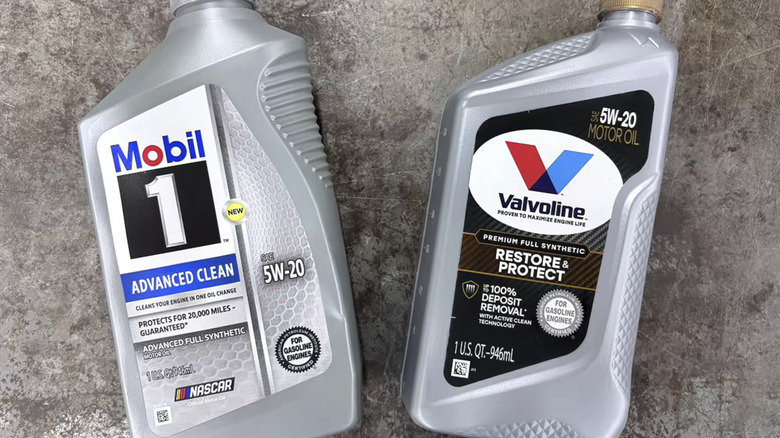
Motor oil naturally helps to flush out common contaminants, and there's a whole supply of products specifically made to keep the mechanical parts of a vehicle clean and running. From Top Tier gasoline complete with detergents to some types of engine motor oil — these treatments and additives are designed and marketed to you, the consumer, to keep things clean internally so your car lasts. Do they really do what they claim to do, though? The Motor Oil Geek on YouTube put those "cleaning" oils to the test to see if they do make a difference.
The Motor Oil Geek is Lake Speed Jr., of SPEEDiagnostix, known for its used oil analysis services. Speed himself is a Certified Lubrication Specialist and OIl Analyst who used that expertise to help Joe Gibbs Racing for 12 years — a testing ground sometimes more brutal than the testing cars go through in-house.
Using those skills, he put three "cleaning" motor oils up to the test: Mobil 1 Advanced Clean, Valvoline Restore & Protect, and Pennzoil Ultra Platinum. There's actually a fourth oil, Valvoline Premium Blue Restore Gen2 — but that's a separate, yet important test, also included in the video. The results didn't match what real in-engine testing produced, but even in this comparable bench testing scenario, these oils managed to clean up expectations.
Testing to come clean
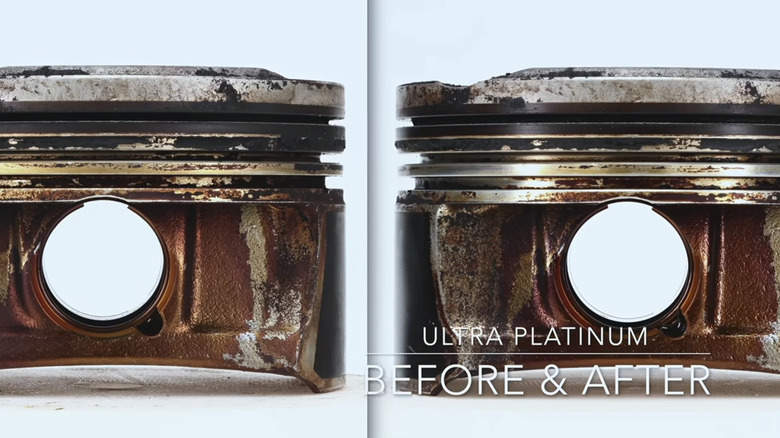
The Motor Oil Geek put the three oils through what's called an ASTM sequence IIIH test, which is a standard test used to evaluate engine oils at high temperatures and high speeds. Typically, these tests are conducted in an actual running engine for 90 total hours, broken down into four 20-hour test segments and one 10-hour segment. For bench test purposes, Speed ran the oils for 168 hours with varying temperatures from room temperature to 150 degrees Celsius, to better emulate real-time conditions of an engine from cold runs to high-speed performance.
He used pistons with considerable deposits from a turbocharged Mini Cooper engine, each marked with a letter code to track which one was tested in what oil. Those pistons were sent off to be professionally rated before the test, as well as after, to measure improved "cleanliness."
Three of those pistons were then hung separately from a device so they could soak in an oil in 1000 mL beakers over a magnetic stirring hot plate. It's a way to control the important aspects of the test concerning time, temperature, and agitation (movement), so Speed could focus on the concentration and cleaning. The fourth piston was soaked in the Valvoline Premium Blue Restore Gen2, which claimed it could clean parts just soaked in the oil.
In the end, all four oils cleaned some of the deposits on the pistons. The most improved was the fourth piston that soaked in the oil, which The Motor Oil Geek explained contains an agent called Ester, also used in two-stroke oils to keep things clean. And keep in mind, they perform even better in a running engine. So, if you're at all worried about buildup slowing you down, these cleaning oils might actually do the trick.