

Why Gas Pumps Can't Pump Any Faster Than 10 Gallons A Minute
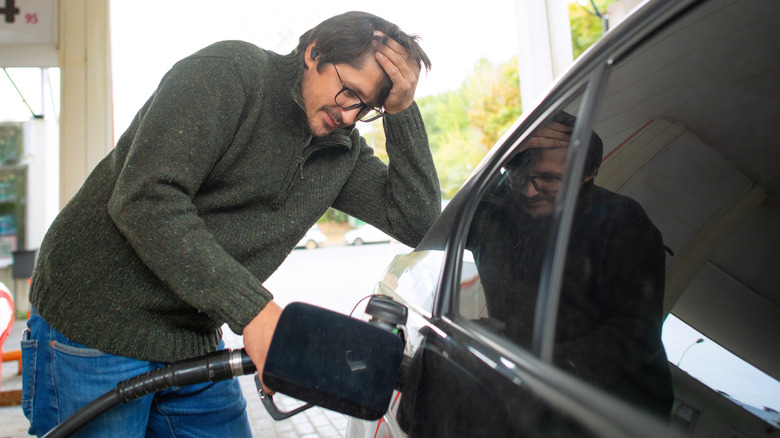
You know why fuel tanks shouldn't run low, so you head to your friendly neighborhood gas station. Let's hope you're not in a hurry, though, because sometimes gas pump speeds feel not so speedy at all. There's a reason for that. Several, in fact, and, sadly, none we can control.
The most likely cause is a mechanical issue, and it's "pick your part": the dispenser leak detector tripped, the fuel pump is clogged, the equipment is old, and so on. But before any fuel is dispensed, the flow has already been set to no faster than 10 gallons per minute (gpm). That's due to a federal rule dating back to the 1900s, as the kids would say. Or 1993 in adult years.
The purpose of establishing a fuel-dispensing rate was to improve performance of onboard vapor recovery systems as well as reduce the chances of spillage during refueling. This doesn't apply to every gas station across the U.S., however. Commercial facilities such as truck stops are exempt, because volume (and sales) matter.
Why is 10 the magic number?
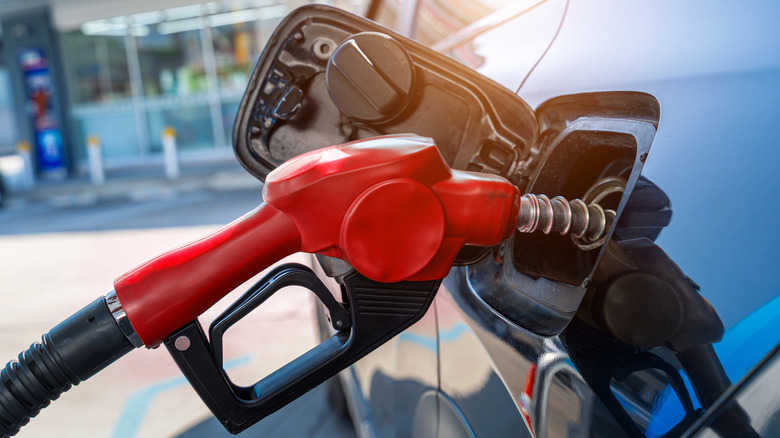
The rule went into effect in 1996, and the 10 gpm figure isn't a stab in the gas tank dark. In a technical report released in 1987, the EPA stated that an investigation conducted by the American Petroleum Institute (API) found dispensing rates of the time were generally between 6 and 12 gpm, but that the average hovered around 8 to 10 gpm.
The main contributing factors to the varied rates was equipment type and age. Older and smaller stations likely used a suction pump, which kept rates around 8 to 9 gpm. Newer and high-volume stations were using submersible turbine pumps that delivered rates of 10 to 12 gpm. There were outliers. The API found rates as low as 6.5 gpm at full-service stations, while a self-serve location operated at high as 15 gpm.
In the end, the 10-gallon figure was settled upon partly because it matched the higher end of the existing dispensing-rate scale. Another consideration supporting the 10 spot was to ensure vehicle certification testing and dispensing rates remained compatible. Because fuel pumps were already delivering at 10 gpm, the vapor capture system of future vehicles would have little issue managing that speed. It was also a safeguard against splashback incidents.
Why truck stops are exempt from the slow-flow rule
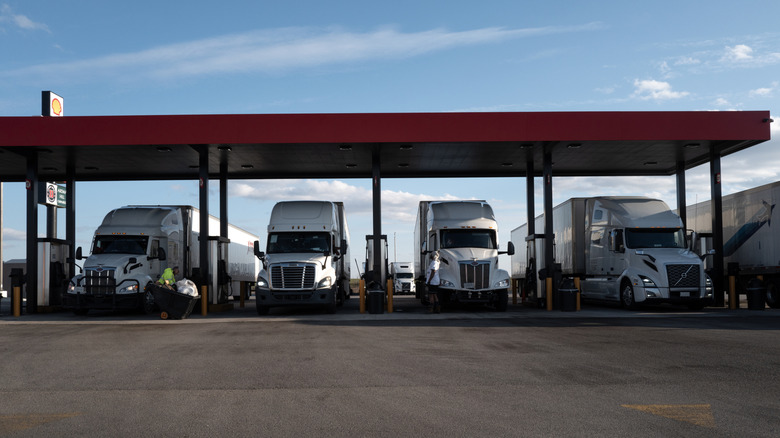
According to the EPA, fueling facilities that exclusively cater to boats, airplanes, and heavy-duty vehicles (that is, big rigs) are exempt from the slow-flow rule. For commercial fuel centers, pumping at a 10-gpm rate makes little sense.
Semi-trucks have fuel tanks varying in size from 100 to 150 gallons, and some carry two of those. For everyday commuter cars and trucks, 10 gpm means a couple minutes to fill-up, at most. Even the gargantuan 50-gallon gas tub of a Ram 2500/3500 Heavy Duty will be topped off faster than your bathroom break.
Can you imagine filling up a big rig's reservoir at 10 gallons per minute, though? Who has the time when you're long-hauling large loads? Instead, truck stops are equipped with high-flow dispensers capable of pumping up to 50 gpm. Otherwise, you're looking at refueling bottlenecks for truckers and lost revenue for rest stop operators. And it won't matter if you're driving the world's fastest semi-truck if you're stuck waiting at the pump or in line to wait.