

Mazda Miata Engine Swaps Ranked Best To Worst (For Your Budget And Your Patience)
Jalopnik has long maintained that the Mazda Miata is the answer to every question. What's the best affordable convertible? Miata. What if you want a fun commuter that's reliable and sips fuel? You should consider a Miata. What if you want a car to take off-road? Surprisingly, the Miata is the answer again. Emme Hall won her class in a Baja race with her off-road modified Miata. It's an excellent sports car, relatively cheap, abundant, and just plain fun. Over four generations, the only only real critique of the venerable roadster is that it's never been particularly quick in a straight line.
But Miata enthusiasts are a crafty bunch, and over the nameplate's 37-year history, their quest for more power has driven the development of camshafts, turbochargers, and, of course, engine swaps. Swaps are not for the faint of heart – they often consume a lot of time and capital — but they are a great way to add power without the complexities of a forced induction setup on the factory engine.
Not all swaps are created equal, though. For example, transplanting an engine from a newer Miata will be easier and cheaper than shoehorning a V8 into the engine bay. However, the V8 will net you way more power for the extra effort and money. There are so many Miata swaps out there — from Honda K24 four-cylinders to Toyota V12s — so we have compiled a helpful a list of engines that go in Miatas, organized from the cheapest and easiest to the most difficult and expensive.
Put another Mazda engine in it
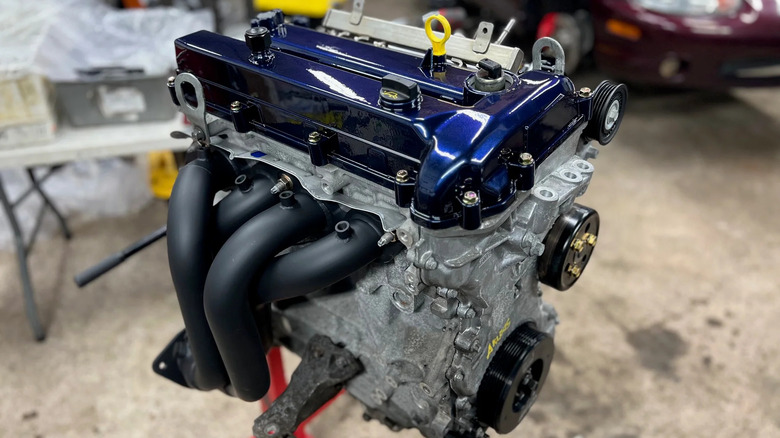
The easiest Miata swaps involve upgrading to a larger Mazda motor within the same engine family. Early first-generation Miatas (1990 to 1993) were equipped with a 1.6-liter four-cylinder. Its output was a tepid 116 horsepower. Luckily, later first-generation cars (1994 to 1997) and all second-generation cars (1999 to 2005) came with a more powerful 1.8-liter four-cylinder that will bolt up to the factory transmission. Flyin' Miata sells an affordable kit that makes the swap to the 1994-to-1997 engine essentially plug-and-play. The later engines make more power, but they still require some effort to work in the 1.6 cars. To get the most power for your money and effort, look for a 2001-to-2005 Miata engine donor. They have variable valve timing and provide 142 horsepower .
Similarly, third-generation Miatas (2006 to 2015) have an easy path to more displacement and power. A 2.5-liter Duratec four-cylinder engine from a Ford Fusion, Mazda3, Mazda6, or Mercury Milan fits in place of the Miata's 2.0-liter four-cylinder with minimal effort. The larger engine is plentiful in junkyards and can be had for as cheap as $350. The swap isn't completely plug-and-play — the Miata's lower intake manifold needs to be modified to fit the 2.5 — but most of the 2.0-liter's accessories fit the larger engine without issue. A stock 2.5 makes about 10 more horsepower and 35 more pound-feet of torque over the factory Miata engine. But with upgraded cams and a freer-flowing exhaust, Grassroots Motorsports made 196 hp at the wheels with its 2.5 swap.
Try a four cylinder from another manufacturer
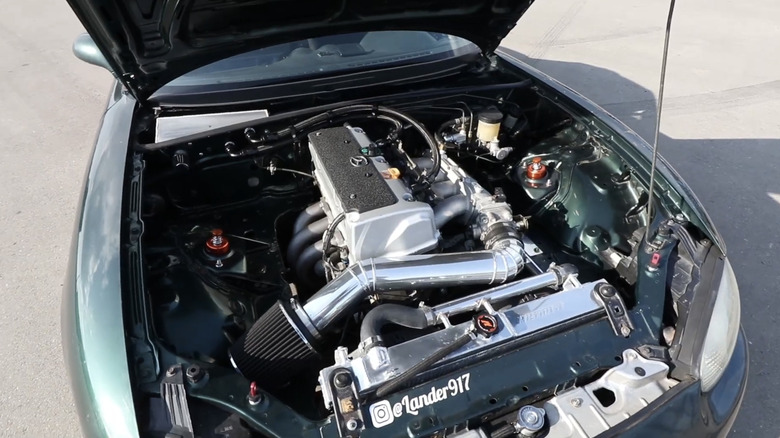
Under the hood, the Miata has never had much more than an economy-car four-cylinder turned sideways. By contrast, when Honda decided to make a roadster of its own, the automaker equipped it with the F20C four-cylinder — an engine with a 9,000-rpm redline that held the title for the most naturally aspirated horsepower per liter until the Ferrari 458 came along. Intrepid engine swappers may think a Miata with an F20C could be a good way to create a low-buck, bootleg S2000. But S2000 engines aren't exactly affordable or easy to come by.
However, there is another Honda option that can rev almost as high as the F20C and makes similar power. Enter the K24, the budget friendly and readily available alternative. The K24, like its name might suggest, is a 2.4-liter four-cylinder with dual-overhead camshafts and Honda's i-VTEC system. The high performance variants of the engine found in the Acura TSX and Honda Civic Si make around 200 horsepower in factory trim. But the aftermarket for the engine is immense, and with the right combination of parts, the K24 has the potential to make nearly 300 hp without boost.
Although it was only available in front- and all-wheel-drive cars, tuners like KPower Industries recognized the engine's potential for rear-wheel-drive applications. As such, KPower Industries makes kits to swap a K24 into all four generations of Miatas. It's not a simple or cheap swap. Bits like a transmission adapter plate and a standalone ECU are needed to make it all work, and the most comprehensive kits start at around $6,000. But for a powerful, lightweight engine that doesn't mess with the balance of the Miata chassis, the juice is worth the squeeze.
Fly like a V6
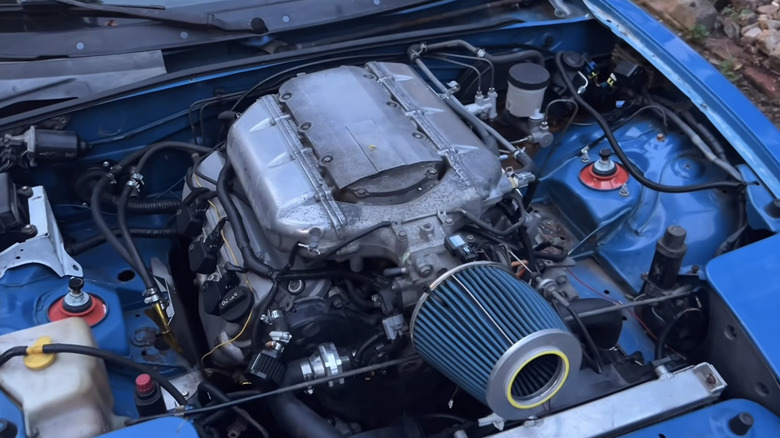
The next rung on the Miata-swap ladder is the V6. A V6 swap is an exercise in more — more cylinders, more power, more effort, and more money. There are three V6 engines that have readily available Miata swap kits: the 3.5-liter Honda J35 found in the Odyssey and various Acuras, the direct-injected 3.6-liter GM LFX found in the Chevy Camaro and Cadillac CTS, and the 3.0-liter Jaguar AJ30 V6 found in the S-type and XJ. Each option has an aluminum block and heads, and depending on the variant, outputs roughly 40 to 100 more horsepower than a stock K24.
No matter what engine you choose, the kits are not cheap. Luckily, with a kit, you don't have to fabricate your own front subframe, motor mounts, and other swap-related parts. The Honda J35 kit from Mini Tec is the most affordable at $3,350, and it utilizes the factory Miata transmission and differential. But that doesn't include any provisions for the cooling, power steering, and fueling systems. The next kit on the list is the $7,260 GM LFX V6 conversion from V8Roadsters, which requires a Camaro transmission and other GM donor parts. This adds more complexity to the swap, but the GM parts are more durable than the factory Miata stuff. Rocketeer Cars takes the most comprehensive approach to V6 swaps. It will sell you everything you need for the conversion, including a refreshed Jaguar AJ30 V6. But that will set you back roughly $22,040. If you are going to spend all of that money on a V6, you might as well go for the gusto and consider our next swap option.
LS Swap it, bro
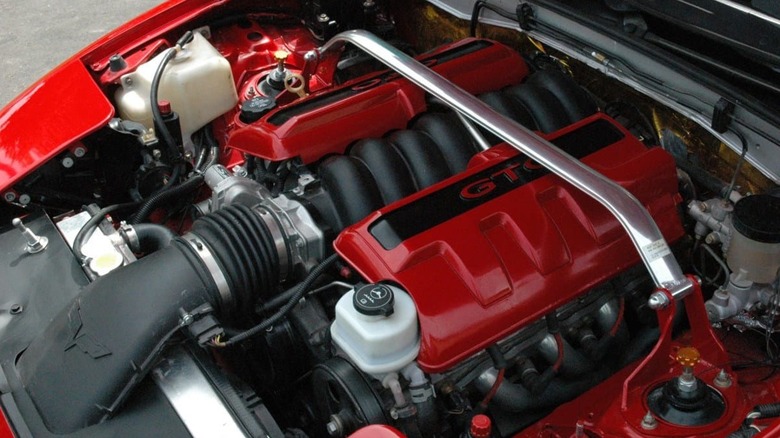
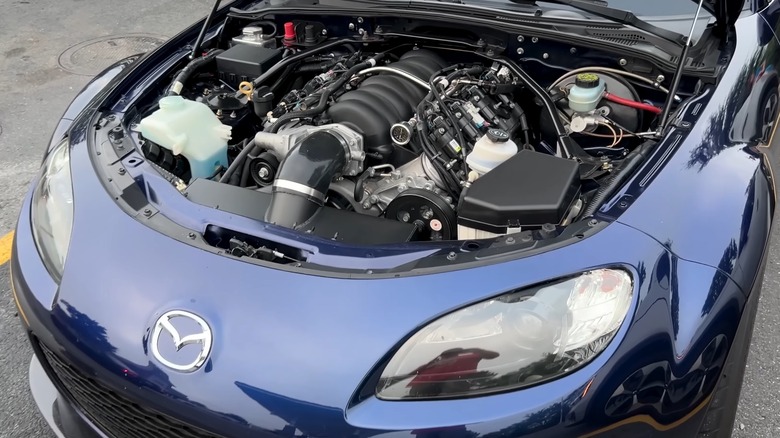
If the Miata is the universal answer to any sports car question, the Chevy LS is the the answer for any engine swap inquiry. The V8 LS-series engines are still such a popular swap for a reason. They're compact, powerful, readily available in junkyards, and have massive aftermarket support. The LS engine is available in many configurations, from 4.8-liter truck engines to 7.0-liter sports car screamers. Even the wimpiest 4.8-liter LS can make 400 horsepower without much effort. That type of power is a tantalizing prospect for those looking to make a modern version of a Shelby Cobra with a Miata. Fortunately, for those with enough capital and bravery, the big V8 can be stuffed into every generation of Miata. Although Colorado-based tuner Flyin' Miata stopped doing V8 swaps years ago, other manufactures like Monster Miata and V8Roadsters will sell you the parts to roll your own.
There are many tradeoffs involved in putting an LS in a Miata, first of which is the car's balance. Monster Miata says the weight distribution moves from a perfect 50/50 to a nose-heavy 53/47 with a big V8 under the hood. Also, the rest of the Miata's driveline can't hold up to V8 power, so it needs to be swapped as well. You'll need parts like a T-56 six-speed transmission, new driveshaft, and a differential from a fith-gen Camaro. Costs are highly variable depending on which engine you choose, but they generally fall somewhere around $20,000 for the average completed swap.
Too many cylinders
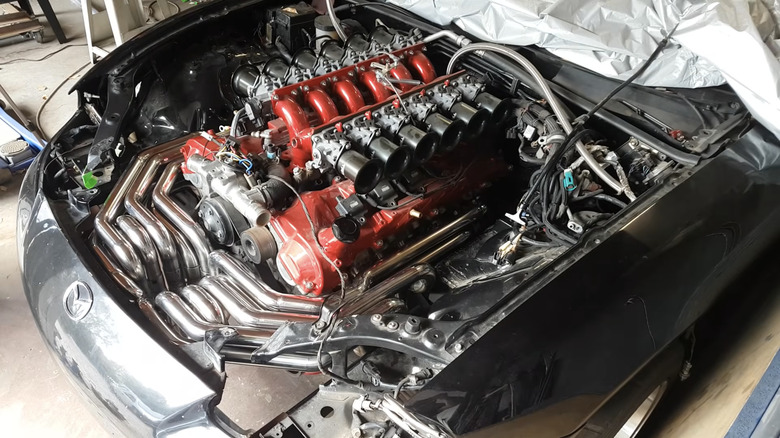
A Miata with more than eight cylinders is like an automotive cryptid. There's evidence that it exists, but it can only be found in the murky depths of internet forums and YouTube. During our dive into the internet swamps, we found a Miata with a Viper V10, one with a Jaguar V12, and another with a Toyota 1GZFE V12 from a Toyota Century.
The efficacy of these swaps is questionable, as there are no off-the-shelf kits for them. And more cylinders means more weight over the nose of the Miata, even further messing up the roadster's weight distribution compared to an LS. Plus, an LS can make just as much power or more power than the engines above. The LS also fits in the engine bay a whole lot better. The guy who did the Jaguar V12 swap said he had to cut the firewall and move it 6 inches back. But if you're crazy enough to try one of these swaps, you'll certainly have the only Miata at the Cars and Coffee with more than eight cylinders.