

BYD Is Combining Solar Energy Storage, Five-Minute Flash Charging, And Robotic Arms For Its New Charging Stations
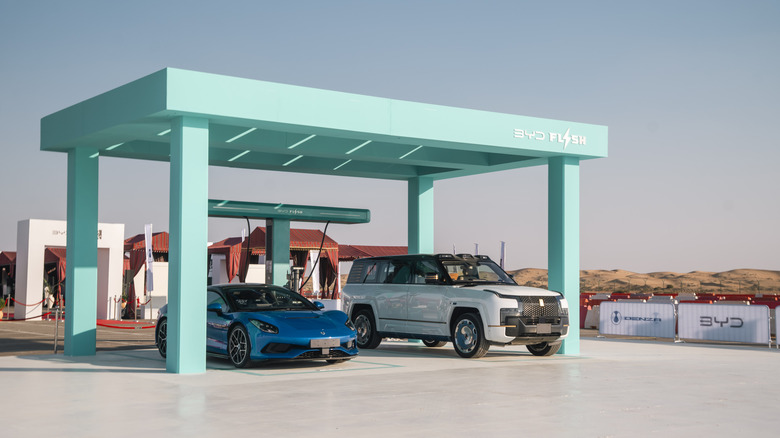
Despite not selling any cars in the U.S., China's BYD is quietly taking over the EV world. It has surpassed Tesla as the world's largest electric carmaker by global sales, and it's also been hard at work trying to dethrone Tesla as the provider of the world's most advanced EV charging network. Now it's announced the latest big step toward that goal. On Tuesday, BYD announced that it will combine clean solar power, its proprietary Flash Charging tech that uses local energy storage, and robotic arms into one EV charging system.
The core of this system is BYD's Flash Charging, which draws power from the grid like any other EV charging station. Unlike others, though, it stores the electricity in two on-site 185-kilowatt batteries. That stored energy can then be pumped into your EV way quicker than it would be if it were drawing from the grid directly, BYD says.
Each Flash Charger has two connectors, capable of up to 1,500 kW charging if only one is in use, or 1,000 kW if two cars are sharing. For context, Tesla's new V4 Superchargers top out at 500 kW, regular superchargers hit 250 kW, and the fastest DC chargers from Electrify America can do 350 kW. BYD's quoted charge times are 10% to 70% in five minutes, 10% to 97% in nine minutes, and in cold weather, 20% to 97% in 12 minutes given an ambient temperature of minus 30 degrees Fahrenheit.
Solar-powered arms race
BYD is now incorporating solar generation into the equation, drawing power from the sun to those same local 185-kW batteries, presumably via solar panels placed on top of the charging station's canopy. This means the system is less reliant on the grid, which is huge in remote, sun-soaked regions like, say, the desert in the United Arab Emirates where BYD launched all this.
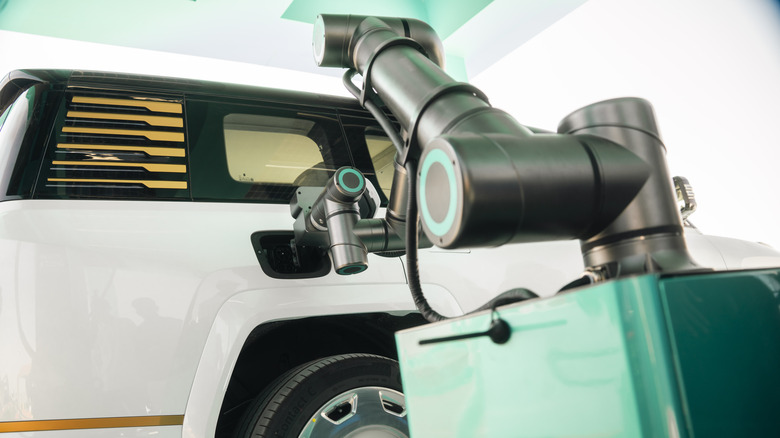
Then there are the robotic arms. The idea is far from new or original — Tesla promised them a decade ago, and EV makers like Volkswagen, Hyundai, and China's Xiaomi have since built their own renditions. It's a simple premise: A robotic arm locates your car's charging port, opens the cover, and inserts the connector automatically.
BYD plans to install 6,000 Flash Charging stations worldwide by the end of next year. Don't expect all or even most of them to get solar power or the robot arms initially, but if BYD can actually normalize five-minute charging with solar and robot arms sometime in the next couple of years, we might be looking at the new charging network king.