

IIHS Founder Warned Drivers About The Dangers Of Speed Almost A Decade Before He Started The Organization: What's Streaming
Not long before the Insurance Institute for Highway Safety was informing drivers of how dangerous or safe a car was, James S. Kemper was on a mission to improve road safety. Kemper worked in the insurance world in his first job out of high school. He was an "office boy" for Central Mutual Insurance according to his New York Times obituary, but he went on to produce his own driver safety materials: educational films.
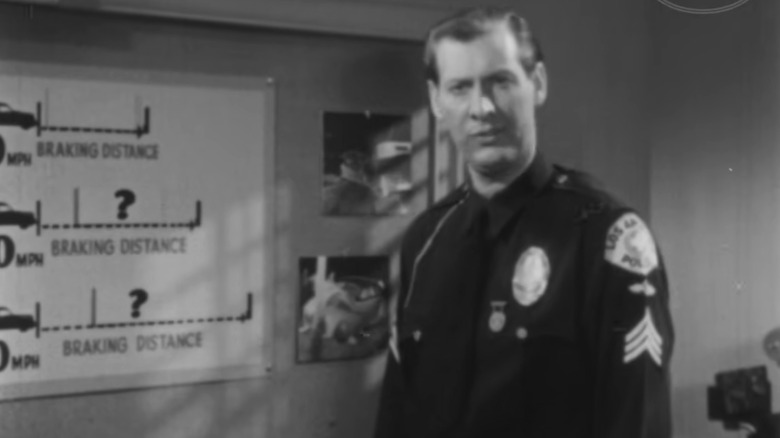
The films were made by Kemper's personal insurance company, Lumbermen Mutual Casualty, and in partnership with the LAPD and Traffic Safety Films Inc. The LAPD connection helped bring "Sergeant Bruce" to the films, who starred on-camera several times as the presenter of important safety lessons — each video with its own specific theme. Maybe it's Sgt. Bruce's personality, or maybe it's a cop-thing, but he also delivers a pseudo 1950s-version of scared straight energy with every specific dangerous driving situation.
Join me as I introduce a new(er), sometimes nostalgic video worth adding to your Watch Later lists. Leave a note in the comments if you find an older or interesting film you'd like to see featured.
Death haunts every wrong move on the road
In "Speed, The Accident Multiplier," a film restored and posted by 16mm Time Machine on YouTube, the on-camera narrator, Sergeant Bruce of the LAPD, explains to viewers that speed is dangerous. He uses charts and figures to show how faster speed increases stopping distances. The biggest takeaway is that the faster you go, the longer it takes to brake, and the more likely the damage to whatever the car hits will be catastrophic. That same messaging carried over into the IIHS organization decades later.
Sgt. Bruce ended the film in a familiar way that you'll find with most of these films: A message about how engaging with these dangers will lead to death. In "Speed," he tells viewers, "Speeding is a two-edged sword. It makes an accident more probable, and at the same time, it makes death more certain." He went on to explain that one out of every three fatal accidents involved a speeding driver, "which means in one out of three cases, a driver took a chance with death and lost."
There are a couple more films Kemper and his organizations had made in 1950 that are also available on YouTube. The next two, or rather four, were uploaded by PeriscopeFilm — specifically, they're two short double-features. The first pairs "Following Too Close" and "Driver Irritations," with the second pairing including "Child Safety" and "Driver or Pedestrian" — with the latter admittedly sounding more like a dangerous game, and that was likely the point. The opening to "Driver or Pedestrian" doesn't mess around either. Within the first minute, a camera follows a man driving a car as Sgt. Bruce tells viewers, "This is a driver..." before cutting to a tombstone, where Sgt. Bruce adds, "...who was a pedestrian. This is how it happened." Quite a way to set the scene.
Kemper's legacy for safety and taking care of the insured
Nine years later, Kemper's company joined forces with another two insurance companies to form the IIHS. Another decade after that, the IIHS would become its own scientific research organization, conducting studies to better understand road safety and finding ways to help improve it. By that point, IIHS had begun to do its own vehicle safety testing, as well. Those tests — although they have changed some as vehicles have evolved quite a bit since the 1960s — still provide consumers with important information regarding the safety of their vehicles today, like its latest look into the safety of heavy-duty trucks and cargo vans.
Kemper's work in insurance also helped push mutual insurance to the forefront in the U.S., which, if you're unfamiliar, it means the insurance company is owned by policyholders. There are no stock shareholders to appease. He was adamant about ensuring people were paid for their claims. In his New York Times obituary, he's quoted saying, "I made up my mind that this company was going to settle claims for cash in the shortest time possible. I did not see then and do not see now the value of contesting claims you know you will settle." Anyone feel like a few insurance companies could take some notes? Kemper's legacy endures with his insurance company over a century later, which now exists as Kemper Insurance, and the place where he left the biggest mark — in his role establishing the IIHS.