

What Are The Differences Between The NHTSA And IIHS Safety Tests?
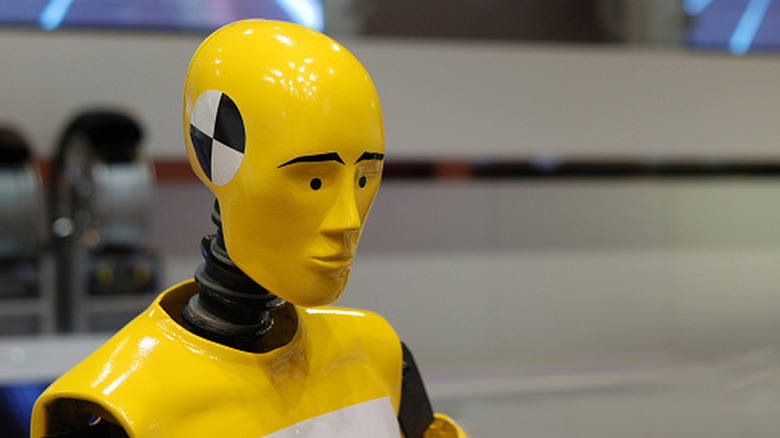
Crashing cars very carefully on purpose is a serious and expensive affair, which is why your favorite car review website or automotive journalist likely leans on formal third-party crash test results for a data-driven perspective on the safety of specific vehicles. That information typically comes from one of two sources. The National Highway Traffic Safety Administration (NHTSA) is an agency within the U.S. Department of Transportation — a government body, in other words. It delivers its verdict in the form of vehicle safety ratings between one and five stars. The Insurance Institute for Highway Safety (IIHS) is an independent nonprofit — i.e., not a government agency — that was born of the auto insurance industry and delivers its own ratings such as Good, Acceptable, Marginal, and Poor. It also crowns top-performing vehicles with the IIHS Top Safety Pick designation.
As we'll cover in a moment, these two organizations are generally trying to get at the same information and largely follow similar approaches in how they get there. In theory, the government has a vested interest in protecting its citizens, and the insurance industry has an obvious incentive to understand how the vehicles they insure hold up in a crash, not to mention how well they protect the premium-paying policyholders inside. Still, the data can be complex, and the results of individual tests even within one testing organization can feel contradictory. So while it's tempting to stop caring and go watch crash tests of Maybachs and Range Rovers you've never seen smashed before, maybe read on and we can try to make some sense of it all.
The frontal crash tests simulate different kinds of crashes
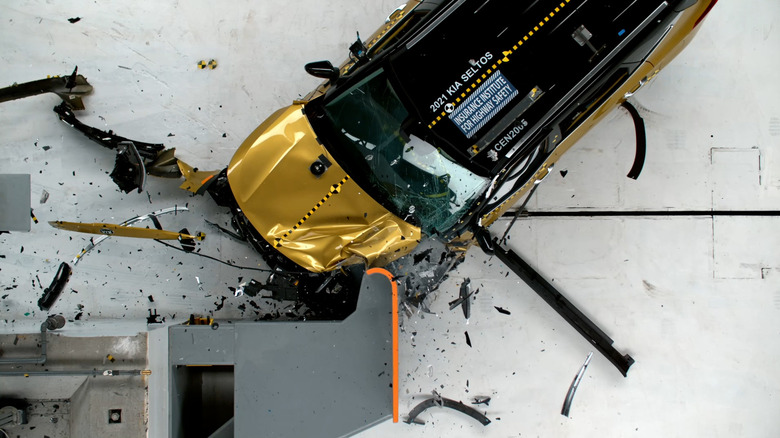
Both NHTSA and IIHS smash cars head-on, but they don't do it the same way, with each approximating a slightly different real-world crash scenario. NHTSA directs cars at 35 miles per hour into a fixed barrier, which simulates two vehicles of similar size and weight colliding head-on. IIHS conducts its test on an offset at 40 miles per hour, indicative of what happens in a less direct collision with another vehicle or with a fixed obstacle like a pole – and yes, this means two cars are crashed, one on the driver's side and the other on the passenger's side.
While NHTSA and IIHS don't generally come to wildly different conclusions, the differences in the test mechanics can make certain strengths and weaknesses jump out at you as you're shopping. For example, both NHTSA and IIHS agree that the 2024 Honda CR-V earns top marks in safety, and IIHS even named it a Top Safety Pick. Yet IIHS also gave the CR-V a Poor rating in its updated moderate-overlap front test, where rear-passenger protection dragged down the result. That doesn't make one set of ratings right and the other wrong. It shows why looking at the individual tests can tell you things that an overall score or award won't.
They don't use the same side-impact test, either
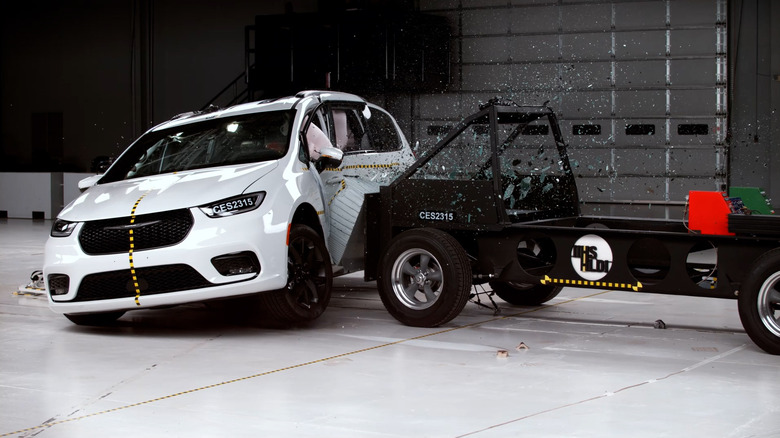
The differences continue when the impact is coming in from the side. NHTSA has two tests for this. The "side barrier" crash test takes a 3,000-pound barrier with a level of give comparable to a car and slams it at 38.5 miles per hour into the vehicle being tested, simulating you getting T-boned in an intersection (for example). It also does a "side pole" crash test, where the tested vehicle moves at 20 miles per hour and hits a pole with a diameter just under 10 inches at an angle of 75 degrees. By tightly controlling the collision variables, NHTSA creates an apples-to-apples comparison from test to test.
IIHS uses a single side-impact test, with a 4,200-pound "striking rig" that, like the NHTSA barrier, simulates another vehicle. The rig mimics the front end of an SUV and strikes the car being tested at 37 miles per hour. This is an updated approach implemented after IIHS determined that prior tests were not accurately reflecting the severity of real-world crash scenarios.
Each organization also interprets its tests differently. NHTSA evaluates what happens to crash test dummies inside the vehicle and determines a star rating based on the likelihood of serious injury, ranging from one star for a chance of serious injury greater than 40% to five stars for a chance of serious injury less than 10%. IIHS also has dummies and focuses its evaluation on whether the vehicle crumples in ways that make hard things come into contact with soft people. That data is then translated into the Good-Acceptable-Marginal-Poor spectrum we talked about before.
NHTSA specifically tests rollover resistance
There's one key area NHTSA covers that IIHS doesn't, and it's a big part of why windshield pillars on modern cars got so thick that they're now a genuine safety risk. We're talking about the rollover portion of the New Car Assessment Program.
Part of the assessment is just a math problem: taking the width of the vehicle's track as compared to the height of its center of gravity. That's the Rollover Static Test. The potentially dicey portion here is the Dynamic Rollover Resistance Test, where a highly controlled "fishhook" maneuver abruptly upsets steering to see if the vehicle tips up on two wheels. NHTSA isn't just cranking the wheel and watching cars do barrel rolls across the lab, but rather collecting a data point that, taken together with the static test, translates into an estimate of overall rollover risk.
This part of the rating is interesting not because it speaks to how well a vehicle will fare in a rollover, but because it identifies how likely it is that it will show the sky its undercarriage in the first place. Considering that an instinctive swerve to avoid a road squirrel can send a vehicle off the pavement and into a rollover, this is something you might want to know. And if you do want to know, NHTSA is the one to give you an answer.
IIHS rates several safety areas NHTSA's crash tests don't cover the same way
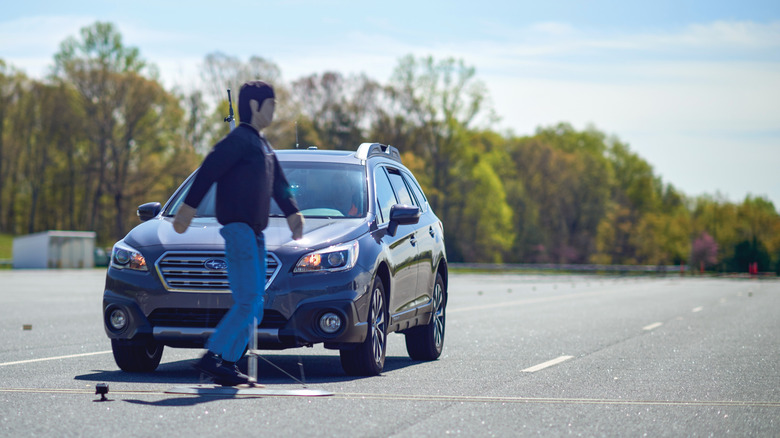
Hearing that, you might give the nod to NHTSA on rollover resistance, but there are some elements of testing where IIHS takes the edge. The IIHS ratings are quite granular and evaluate headlights, vehicle-to-vehicle front crash prevention, pedestrian crash prevention, seat belt reminders, and ease of use for the LATCH car seat installation system. At this point we're getting down into the weeds of specific systems and scenarios in ways that might help your individual shopping considerations.
Surely you're not thinking through whether you're a small-overlap type of dude or a side-impact kinda girl. You might, however, be a city dweller concerned about pedestrian safety, absent-minded to the point of prioritizing seat belt reminders, or willing to pay any price for a vehicle that doesn't make installing car seats a living nightmare. For those scenarios, plus a few more, IIHS has your data points.
These individual ratings might not speak to crashworthiness, but could contribute to avoiding a wreck in the first place. Or, as in the case of LATCH or seat belt reminders, they can be a good way to make sure you're getting the best possible use out of the equipment that's already there.
Five stars and a Top Safety Pick don't mean the same thing

Unless you're a Department of Transportation enthusiast or an insurance industry groupie, you probably don't have super strong feelings about the work of IIHS or NHTSA, and for most of us, seeing a superlative rating from one or the other on a window cling or a vehicle's web page is usually a good enough endorsement. Five stars from NHTSA or a Top Safety Pick from IIHS simply reflect an excellent showing across the categories each organization uses for that designation.
For NHTSA, you're looking at an overall score that combines front, side, and rollover ratings. With IIHS, it's a matter of a vehicle meeting specific requirements across crash performance and mitigation, seat belts, child restraints, and other categories. Oh, and IIHS is going to further confuse the matter by making you wonder about the difference between an IIHS Top Safety Pick and a Top Safety Pick+ (spoiler: plus means better).
Ultimately, there isn't a super satisfying answer to whether NHTSA or IIHS offers the "better" safety rating. They crash vehicles differently, measure the resulting carnage differently, and put different levels of importance on different elements of crash protection, crash avoidance, and secondary safety systems. There is one upside, though: there aren't a lot of people out there crashing cars and writing on clipboards, so you can get most of the available data from two browser tabs.