

This Mid-90s Austrian Car Company Cobbled Together A Lineup With A Lightly Rebadged Ford, Mercury, Saturn And Dodge
Sauber isn't a strange way to say Saab, also a defunct auto brand. Nor is it in any way related to the Sauber racing team that finally closed shop in 2025, giving way for Audi to take a seat at the Formula 1 table. The Sauber we are talking about today was an extremely short-lived Austrian car brand that existed from 1993-1995, solely to import American cars to Austria to sell them under the Sauber name. Well, it was a little more complicated than that. Its relative obscurity sent YouTuber corsicar on one of the most amusing missions of discovering what exactly the brand was, and more importantly, "why?"
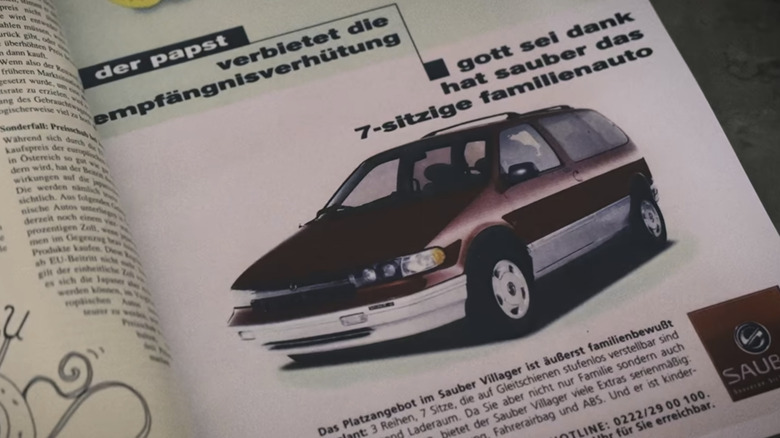
Prior to corsicar's deep dive into this mysterious car company, knowledge on Sauber had been little to none. It seemed to have made it into the curious car chasm in 2025 via TheTruthAboutCars, and an Autopost article done shortly after. One simply cannot internet search Google themselves into a hole for hours taking in information on Sauber otherwise. Coriscar, however, found a newspaper ad for a vehicle called a Sauber Villager. It looks strangely similar to Mercury's Villager. Almost identical, because it is the same vehicle. This gets the whole search rolling.

The Sauber brand was established by a married couple in Austria in 1993. After getting things situated in Austria, the owners founded another company in the U.S., in Florida, Sauber Automobiles USA, Inc. This was likely to get around import laws and accruing unwanted taxes.
According to a review Coriscar found of the Sauber Villager in Auto Revue magazine, the Florida office was used to purchase American vehicles that would then be registered in the U.S. From there, it could export those vehicles to Austria, where they'd get a light facelift to make changes to meet Austrian regulations, and with a little rebadging, they'd officially be "Sauber" cars, as demonstrated by the ads found and shared in the video.
In life you have to try everything at least once
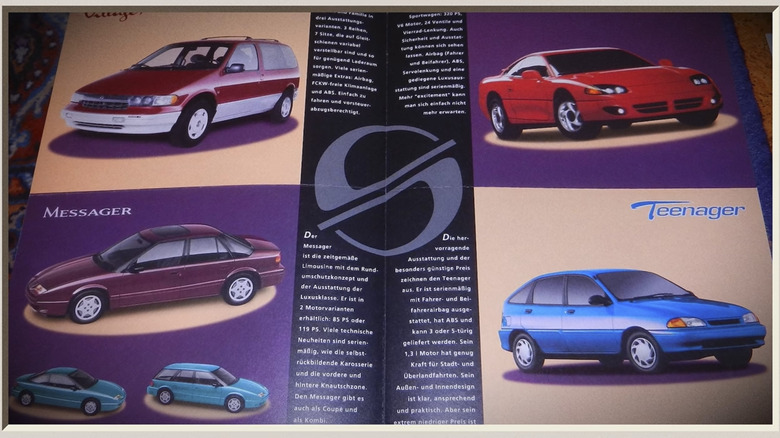
The company essentially tried to make a complete lineup of in-demand or soon-to-be in-demand vehicles using different American market models. There was the family hauler, minivan or MPV Sauber Villager, which was the Mercury Villager, a Ford product, which was also a Nissan product. Sauber's mid-size sedan, coupe and or wagon, the Messager, was General Motors' Saturn S-class sedan, 2-door coupe, and wagon. The entry-level econo-car was the unfortunately named Sauber Teenager, or a Ford Aspire. And the sporty car was the Sauber S1, which was a Dodge Stealth or Mitsubishi 3000GT.
Sauber models went on sale in 1994 with 12 existing dealers. The hope was to expand to 30 by mid-year. At those dealers, interested buyers could consider the cheaper, poorly named Teenager at around $14,500 (in 1994), the Messager at $22,000, the base Villager at $41,600, its top-of-the-line First Class trim level cost around $54,700, and the S1 offered at $76,100. Just for kicks, to give you an idea of how much that costs today with inflation, the Teenager would start at $33,000 and the top of the line, sporty S1 would be just shy of $175,000.
To get the attention of potential buyers, Sauber really played with the Austrian sense of humor. One ad shown in the video reads (in Austrian) "In life you have to try everything at least once. A test drive in a Sauber doesn't hurt either." Pictured below the text was a Sauber Villager (or basically edited Mercury Villager), and above the text, a pair of boxing gloves, cigars, and a leather crotch harness for you know exactly what.
The company that dissolved into nothing
It seems the ads were not funny enough because in May 1995 documents show the Commercial Court of Vienna rejected the car company's intent to declare bankruptcy, and instead officially declared the company dissolved. Sauber was so broke, it had nothing to help pay off debtors in a bankruptcy. What ruined it isn't clear. Importing cars from another country is an expensive endeavor. Buying a car to then make costly adjustments to them to meet regulations likely didn't help either. The whole model doesn't feel very viable. It also happens that a new tax introduced in 1994 — the Austrian Value-Added Tax Act — would have subjected those imports to heavier taxation.
Also, spending $100,000 (today) on a minivan is outrageous. I can't imagine the pricing did them any favors when there were plenty of vehicles in Europe, as well as imported for a price that was much more palatable for European families.
The whole thing almost doesn't seem real, but coriscar prudently shared every bit of archived paperwork, magazines, and ads he finds to verify that Sauber was indeed real, including a 1994 review of the Villager in Austria's Auto Revue. He actually bought almost all of the Auto Revues he could find just to find this one real-life review.
Corsicar was also able to find out through extensive research that the brand had maybe sold 28 cars in that time. In reality, it's still more real than Tesla's lastest Roadster might ever be.
If you do have any bit of a soul, the last part of corsicar's video will tug at your heartstrings. The YouTuber looked into how many of these nearly extinct relics had stayed on the road by looking at Sauber registrations in Austria. The last one on the road was in 2018. By 2019, not a single Sauber remained in motion — at least in Austria. If one has survived, we'll only know if you post a photo of it in the comments.