

Why Pontiac Paid The SCCA $5 For Every Trans Am It Built
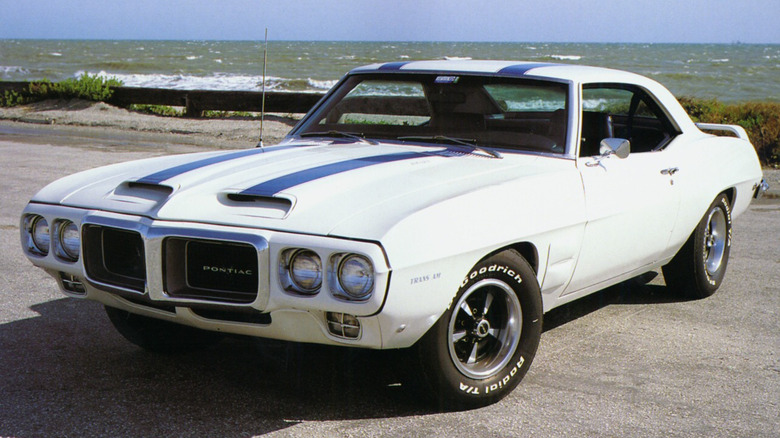
Pontiac had helped launch the muscle-car era in 1963 — when it debuted the GTO package for its 1964 Pontiac Tempest LeMans coupe — and the brand followed that up with the Firebird pony car in 1967. In 1969, both saw iconic variants take the stage. The former began courting customers with a new GTO trim called The Judge, while the latter hatched the Firebird Trans Am.
Only, it wasn't called the Trans Am at first. The brand had originally tried out a variety of different ideas on the public, with "Sebring" coming out on top –- inspired, no doubt, by the country's oldest road-racing circuit, Sebring International Raceway in Sebring, Florida. Yet, when Pontiac went to register the name, it discovered Chrysler had gotten there first.
The public's next-most-popular names were "Formula" and "Trans Am," so Pontiac snapped up both. Trans Am was reserved for the most powerful member of the Firebird family, which was actually a little odd. General Motors was already running Camaros in the Sports Car Club of America's Trans Am series. Moreover, Pontiac's decision ran into a roadblock anyways. It turns out that the brand didn't have permission from the SCCA to use that moniker, at least not at first. Once the lawyers got involved, Pontiac agreed to pay the organization $5 for every Firebird Trans Am it produced.
Now, finding the exact amount forked over isn't easy, but in 1979 alone, for instance, enthusiast sites say that Pontiac made more than 117,000 Tran Ams. Royalties-wise, that works out to a non-negligible total of $585,000, which is equivalent to about $2.7 million today. Some sources say that — during some seasons — the Pontiac royalty check was all that kept the SCCA out of bankruptcy.
What you got with those first Firebird Trans Ams
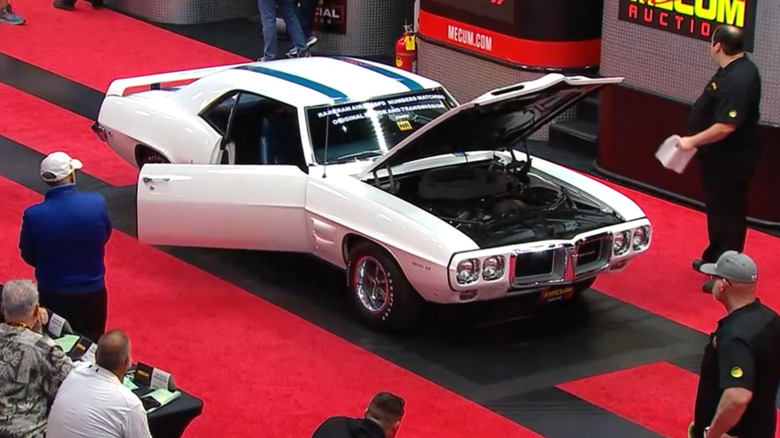
One of the reasons Pontiac didn't put up a fuss about the royalty deal was that it didn't think it would actually sell that many. The SCCA apparently didn't realize what was going on until 1970 or 1971, and the brand had only produced 697 Trans Ams during the model's first partial year on the market — it went on sale in April of 1969. For some context, the entire Firebird lineup, in what was considered a down year, was worth 87,709 sales during 1969.
But one of the main reasons the Trans Am was introduced was to boost demand for the Firebird family. Helping to attract enthusiast customers was a pretty comprehensive package of upgrades that would set you back $724.60 (for a total Trans Am base price that opened at about $3,600). The highlight was under the hood, where Pontiac placed a standard 400-cubic-inch V8 with a Ram Air III intake system good for 330 bhp. As an alternative, buyers could opt for a more powerful setup with 345 bhp. It's backed by the same displacement, plus high-lift cams and upgraded valves/pistons. Additionally, there were standard dynamic details such as front/rear spoilers, functional hood scoops, a ride-and-handling package, high-effort variable-ratio power steering, high-effort power front disc brakes, and dual exhaust. Of course, when it comes to exhaust outlets, two isn't always better than one.
All '69 Trans Ams were then wrapped in a Cameo White exterior accented by Tyrol Blue racing stripes. One thing that did set some apart, however, was the body style. The majority of the first-year cars – 689 -– were hardtops, but 8 were convertibles.
Does the Trans Am series still race?
Currently presented by Pirelli — and originally known as the Trans American Sedan Championship — the series was just about to wrap up its 60th-anniversary season at the Circuit of the Americas when this article was written. The very first race was held in 1966, and in an interesting coincidence, it was at Sebring.
The first years of the series might have been its golden era, too. That's when it was a high-performance playground for pony cars such as the Camaro Z/28, Mustang Boss 302, Dodge Challenger T/A, and AMC Javelin. But what's ironic is that the 1969 Pontiac Firebird Trans Am, the one that first borrowed the Trans Am name from the SCCA, never raced in the series because its engine was too big for the rulebook. That said, the occasional Pontiac Trans Am did show up in the series' record books. The highlight? Sports-car master Elliot Forbes-Robinson drove his Trans Am racecar to five victories and the series championship in 1982.
There were some big names on hand as well. That first Trans Am race at Sebring was won by Jochen Rindt, who would go on to claim the 1970 Formula 1 driver's championship. The likes of A.J. Foyt, Jacky Ickx, Richard Petty, and Mark Donohue also competed in the series' early seasons. Meanwhile, after a few decades with a more international focus – Jaguar, for one, scored multiple driver's and manufacturer's championships in the early 2000s — Trans Am racing has returned to American muscle in recent years, and that's even though some folks don't think muscle cars have to be American. The 2026 field is packed with Chevrolet Camaros and Ford Mustangs.