

Well, Someone 3D-Printed A Whole Engine And It Actually Ran (Sort Of)
You've probably sat around a campfire at some point in your life and figured out firsthand that plastic and heat don't mix. Whether you threw an empty soda bottle or marshmallow bag in and watched it shrivel up, or propped your sandals up on the stones around the fire and witnessed your soles melting, you get it.
Plastic is a pretty good insulator, but it has a pretty low melting point. ABS has a melting point of around 440 degrees Fahrenheit, while most available PLAs melt at 340-ish degrees. If you've spent any time looking at your engine's oil or coolant temperature gauges, you'll know that a running engine is pretty stable in the low 200-degree range, but the combustion chamber can get up to 2,500 degrees during the peak of the power stroke. Plastic doesn't stand a chance, which is why most engines are crafted from cast iron or aluminum.
We've already seen what happens when you try to use a 3D-printed cylinder head; the results aren't pretty. With the kind of heat an engine sees, plastic just isn't the preferred material to work with. There are certainly some engines that have made extensive use of plastic, including the Torlon-based engines from Polimotor Research in the 1970s and 80s, but there isn't a high-enough-heat plastic to manage combustion chamber heat spikes, so a blend of metal and plastic is necessary.
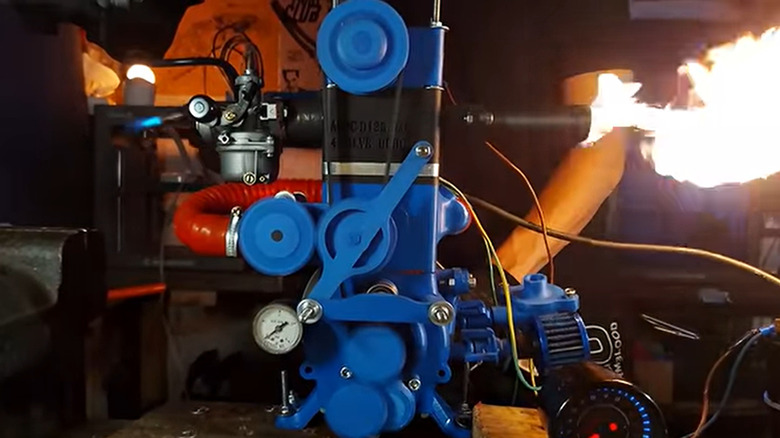
YouTuber and mad scientist Alexander's Laboratory recently built and ran a pair of 3D-printed plastic engines, a single-cylinder and a parallel twin. We'll talk through both engines and their unique challenges in a second. First, we should take a step back and think about the implications of potentially building real working 3D-printed engines as prices come down and the technology both improves and becomes commonplace.
Will you ever drive a car with a 3D-printed plastic engine?
Have you ever built (or rebuilt) an engine for one of your project cars? There are just so many pieces and parts you have to buy, and there's so much measuring and clearance-checking to be done before the parts can all get bolted together. It's time-consuming and expensive, but the longest time you'll spend working on it is the shipping time to get all of the parts. Imagine if, someday, every engine in every car shared interchangeable components that could be stocked at any local auto parts store, and the rest could be 3D-printed at home. Wouldn't that be cool?
There are certainly still components that would need to be made out of metal, of course. The obvious first step would be to use metal for the combustion chamber, cylinder head, pistons, and crankshaft. You would also need to figure out a bearing system that works for the crankshaft and camshafts. Then there are things like the valves, valve springs, hardware, water pump components, and the accessory drive pullies.
Alexander is able to make most of his engines out of plastic, including the water pump and drive gears, but I'd go with metal for those on a full-scale engine, purely for longevity's sake. In the end, if you could make it work, you would have an engine significantly lighter than a comparable aluminum cylinder head and engine block unit. Recent research indicates swapping from a metal component to a 3D-printed plastic replacement cuts weight by 30% and costs by 15%. With enough research, you could add structural lattice inside some areas of components to make it even lighter, or allow better coolant flow to critical heat spots. Now this is exciting!
What does it take to make a 3D-printed engine run?
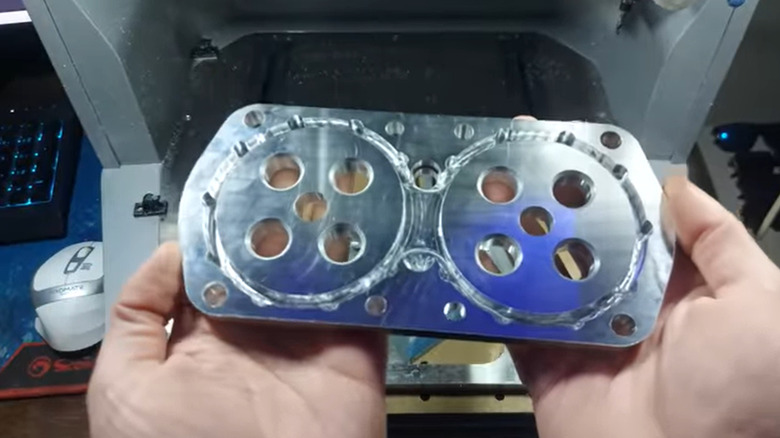
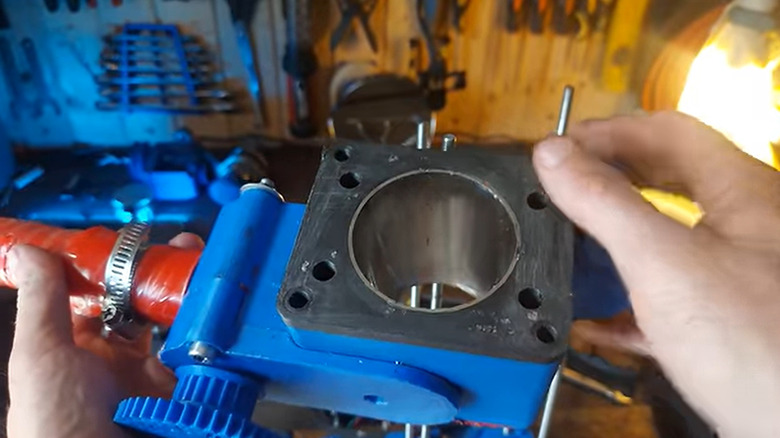
If you wanted to build a 3D-printed plastic engine, what steps would you need to take so it would run for more than a few seconds? As mentioned above, some metal is needed to keep it alive. Alexander strategically used machined steel for both the cylinder walls and the combustion chamber surface. This is smart, as it allows a sealing surface for the metal valves and the ability to thread in a common spark plug. The crankshaft is also metal, as is the surface of the pistons, but pretty much everything else comes straight off the printer.
In the single-cylinder-engine video above, Alexander had some issues with sparks and grounding. It's harder to get everything to ground out properly when the engine is non-conductive, of course. Once it gets running, though, it sure sounds like a pretty normal single-cylinder four-stroke engine, the kind you might find in a lawnmower or go-kart. After getting everything dialed in, Alexander piles on the throttle until the engine decides to eat itself. We don't get an indication of how long it ran, but eventually the carbon-reinforced plastic connecting rod gives up the ghost and shoots through the side of the plastic block.
Trying again with a more balanced twin-cylinder engine, Alexander might actually be on to something. Using some beefed-up components, a little more metal, and better heat management, this little 250-cc twin seems, in the video anyway, to run and work as a standard small motorcycle or scooter engine would. With a better-built engine and more care taken in its running, the twin just keeps on chugging. Maybe it's time to start developing open-source plastic engines that can run with just a few off-the-shelf components. It could be cool.