

Conventional Vs. Transit Design: Why Some School Buses Have Flat Fronts
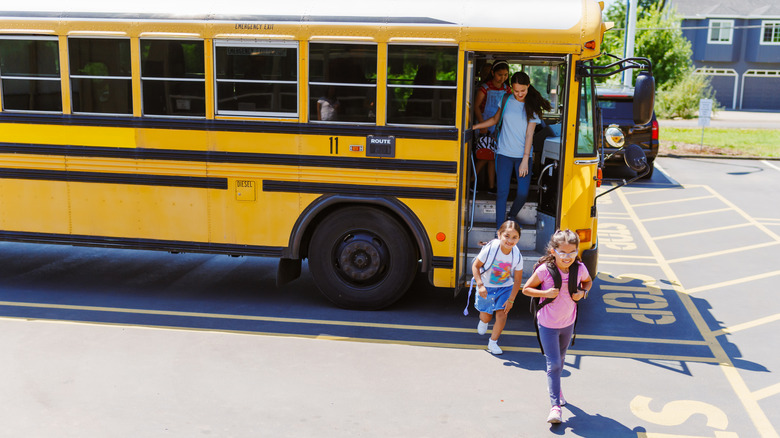
School buses haven't changed much since 1939, but they came a long way before then. Some of the first vehicles used to take kids to school were simply horse-drawn wagons. It wasn't until the start of World War I that the first motorized buses seem to have appeared in this country. That's when a company called Wayne Works introduced a model in 1914. It was built on a long-wheelbase Model T chassis, so its engine was in the traditional location, under the hood up front.
Fast-forward a few years and we find Crown Coach evolving the concept of motorized school buses even further. Crown was a major commercial-vehicle manufacturer, founded in 1903 to sell business wagons to businessmen. It would survive all the way up to 1990 by building not only buses, but also hearses, fire trucks, bakery trucks, ambulances, and even airplanes.
Crown brought some notable innovations to the bus field as well. For example, it introduced the forward-control school bus in 1932. This wasn't the first forward-control bus of any type in the country, though. A firm called Twin Coach has that honor. The company had already been building flat-faced delivery trucks, and during the Depression, it brought the layout to its small buses — including some meant for municipal transit.
The head start for flat-faced city buses meant that when flat-faced school buses became popular, folks looked back to the first application to name the second. The new wave of so-called transit-style school buses gave school districts a new way to transport kids, with both new advantages and new drawbacks compared to conventional school buses.
Pros and cons of flat-face buses vs. conventional models
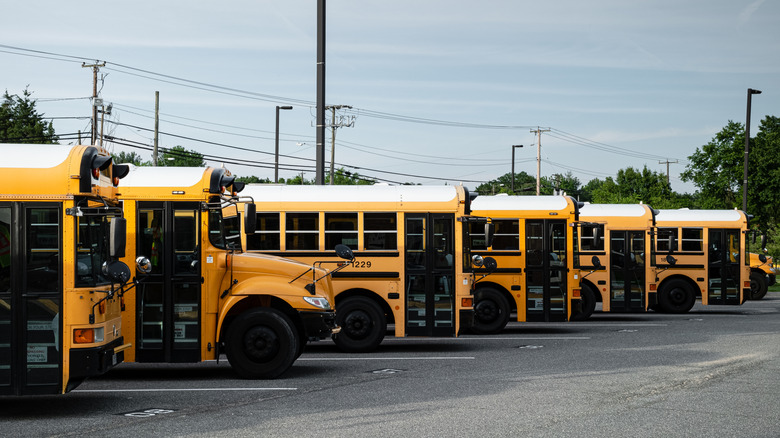
First off, let's deal with their industry classifications: Class C buses are conventional buses, with engines in front and the main exit/entrance located behind the front wheels. The flat-front buses are in Class D and can theoretically have their engines anywhere from beside the driver to the very back of the bus. In the real world, positioning the motor at the rear is a big-time benefit to driver and students alike. That way, they face less noise, heat, and air pollution.
The transit-style layout also improves the driver's vision, since there's no massive hood to see over and around. Conventional buses are more like those big pickups with huge frontal blind spots that just keep getting larger as the years go by. Additionally, the flat-face setup maximizes how many passengers can fit in a given footprint. The difference isn't huge, but the flat-face buses can generally fit up to 90 passengers while conventional versions max out at about 77 to 83.
For their part, the traditional buses tend to be more maneuverable than their alternatives. This is partly due to their different wheelbases and how they can change a vehicle's handling. Looking at data from the Bureau of Transportation, Class C conventional buses with a recommended wheelbase of about 21.3 feet have noticeably shorter turning radii than Class D transit-style models, with recommended wheelbases of 23 feet. Lower maintenance costs are another strong suit of the conventional buses, as it's much easier to access their engines.
In the end, the reason you'll see conventional buses in some places and transit-style versions elsewhere is a matter of local preference. But neither class is likely to save kids from traumatic school bus stories.