

This Is The Only Road In The US That Closes For Snakes
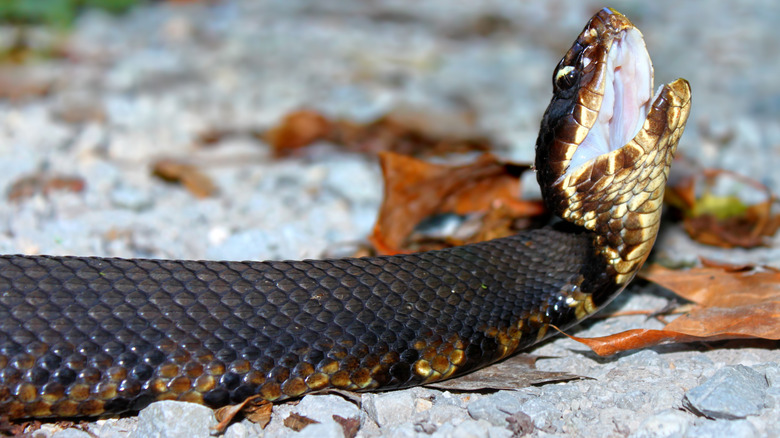
Street takeovers are a menace. Heck, the disruptive crime has jurisdictions like Compton installing new medians to prevent takeovers. This, however, isn't that kind of takeover. Twice a year, thousands of snakes take over a small road in Illinois. It's the sort of thing that would be enough to make Indiana Jones ditch his motorcycle, drop his whip, and head for the hills. Now, before you conjure mental images of "Raiders of the Lost Ark" and a writhing tangle of venomous vipers, this is all part of nature. Though there are still thousands of slithery critters on the so-called "Snake Road," a few of which are venomous.
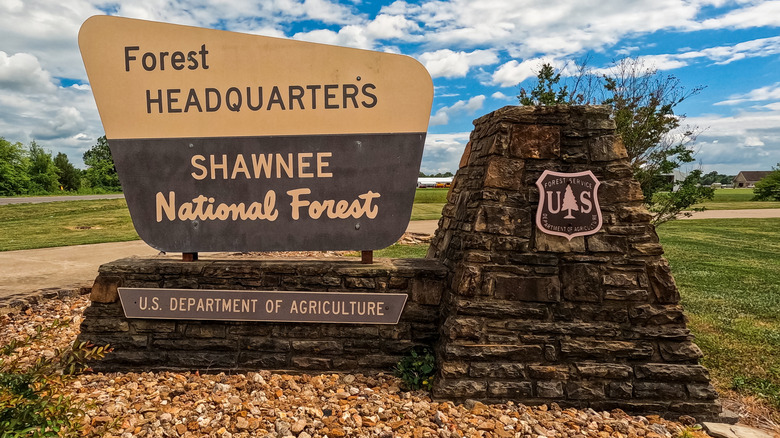
It's enough to shut down the road that runs through part of the Shawnee National Forest in southern Illinois. Every year, the little road closes to vehicle traffic due to the influx of scaly travelers. Not once, but twice every trip around the sun. In fact, it's the only known road in the United States to shut down in observance of a reptile migration. The shutdown isn't meant to protect the national forest's human visitors, either – it's to make sure the road-going snakes can complete their journey unharmed.
'Snake Road' closes down every year for thousands of snakes, other reptiles, and amphibians
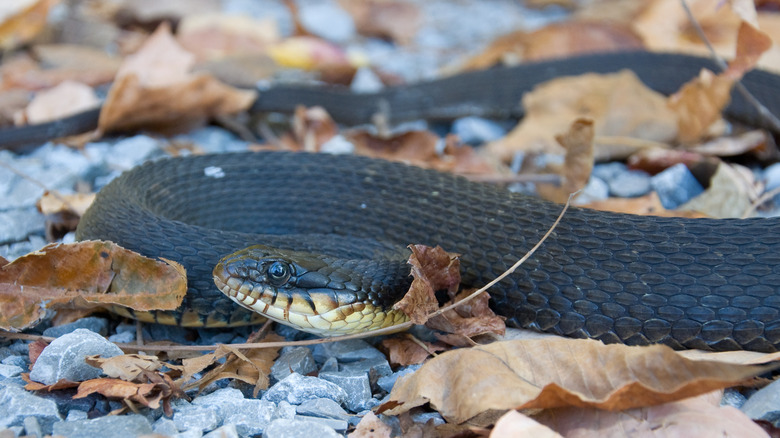
Shawnee National Forest is a biodiverse landscape spanning 289,000 acres between the Mississippi River and the Ohio River. It's home to around 35 migratory species of snakes and 23 species of migrating amphibians. Twice a year, those critters make the trek between the national forest's limestone bluffs and the LaRue Swamp. In the spring, the reptiles and amphibians travel from the bluffs to the swamp. In the fall, the ectothermic excursionists do the trip in reverse order, returning to the bluffs from the LaRue Swamp. Be it a slither, crawl, or hop, these reptiles and amphibians are on a mission.
The adventure takes the animals right across Forest Service Road 345, also known as LaRue Road. "We call it Snake Road," Forest Service Enforcement Officer Anderson Harris told CBS Evening News. It's a fitting name, too. The Forest Service closes the road because of snake, reptile, and amphibian migrations from March 15 to May 15 and September 1 to October 30 every year. "That protects animals from being incidentally killed by vehicles running over them," Officer Harris added. "It's the only road in the U.S., to my knowledge, that we close for migrations of the amphibians and reptiles."
At first, locals weren't so pleased with the idea of closing the road for four months of the year. Some of the more cruel motorists made a game of killing as many snakes as they could on the road. Eventually, they came around to the idea of closing the road. Best to leave the reptilian travelers in peace, even if you're curious.
Some of the visiting vipers are venomous
Before you ask, yes, you can go check out the cold-blooded crossers for yourself. While the road is closed to cars, it's open to visitors on foot. That said, you might want to pay close attention to where you step. Of the snakes that migrate through Shawnee National Forest's Snake Road, at least three are venomous. For starters, there's the timber rattlesnake, a pit viper with a maraca for a tail. There's also the cottonmouth, also known as the water moccasin. Finally, the eastern copperhead, which can average up to three feet in length.
Again, you might want to steer clear of Snake Road if you have a bad case of ophidiophobia. If herpetoculture is your hobby of choice, it might be worth checking out. That said, collecting the snakes as they cross the road is against the law. Of course, if you're looking for something viper-esque, a clean Ram SRT-10 might be a charming enough snake. Frankly, you'd probably rather a series of snakes choose to shut down a little service road in Illinois than find a giant snake nestled in your engine bay. That is, unless Steve Irwin is your kindred spirit or something. If you're more like Indiana Jones, you'd be more likely to curse, "Why did it have to be snakes?"