

Why China's GAC Tried Developing A 4-Cylinder Engine That Ran On Ammonia
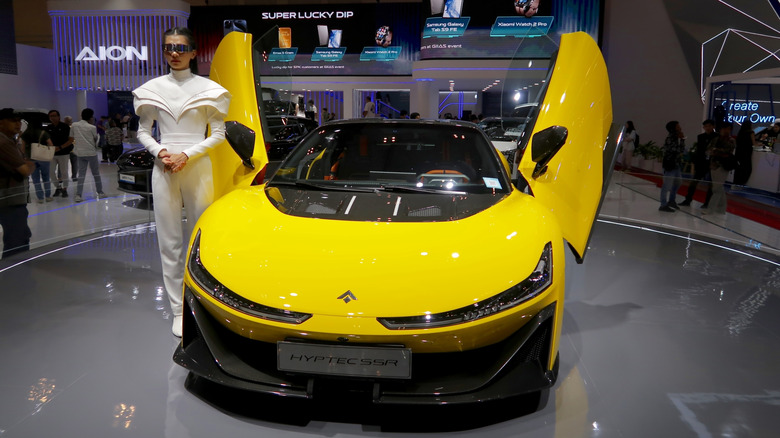
A few years ago, in 2023, China's Guangzhou Automobile Group Co. (GAC) pioneered a four-cylinder engine that runs on ammonia. But why bother? In part because ammonia, like hydrogen, can burn without generating carbon emissions, because it's composed of nitrogen and hydrogen (the chemical formula is NH3), so it doesn't contain any carbon atoms to emit.
GAC said at the time that its two-liter engine would burn liquid ammonia and produce up to 161 hp with a 90% reduction in carbon emissions versus an engine that ran on gasoline. But that explanation should make you scratch your head. Why 90% and not 100%, since we just told you there's no carbon to burn?
Well, in part because ammonia won't stay liquid at non-Arctic temperatures. So you have to cool it to below -28 degrees Fahrenheit, and you also need to keep it under pressure. In turn, when it's cold, it doesn't really want to ignite. Which is probably why GAC's solution was to add some gasoline to the ammonia in order to get it to combust.
As if that's not the only issue, ammonia on its own is only half as energy dense as gasoline. But there are upsides. First, you can make so-called green hydrogen via electrolysis directly from water. This produces hydrogen and oxygen, and ammonia can then be further split off from the hydrogen, ideally with the entire process run via renewable energy, such as solar. Speaking of hydrogen, carmakers like Toyota keep trying to push hydrogen as a viable car fuel, but that's not as energy dense as ammonia and has pretty substantial range challenges. But if you can produce green ammonia, you have a carbon-free fuel without the concerns like slower EV fueling and heavy batteries, right? Yeah... but.
A lack of energy density and many other problems
Okay, so ammonia is more energy dense than hydrogen. But it's still only about half as energy dense as gasoline. Which is partly why, yes, you've seen ammonia tech coming faster to shipping than to cars, where that density is less of a challenge. Also, a by-product of ammonia combustion is nitrogen emissions, which cause toxic air that's bad for human breathing. However, at the time GAC presented its findings, the carmaker said it had also tackled the latter issue, which is good news if true.
But there are yet more quandaries. For instance, ammonia likes to corrode metal, and especially galvanized metals, like iron, copper, brass and copper alloys. Every fitting has to be made of steel. That part, perhaps, is something that can be tackled in the engine bay — but there's still the challenge of fueling and transporting the stuff. Imagine trying to keep it liquified for cooling, and keeping it refrigerated in underground storage that you typically have at a gas station, and the hazards that it presents , including nausea, blistering, and all sorts of other fun, according to the CDC. Then again, we do blithely tend to accept liquid petroleum's icks, like the fact that gasoline is a known carcinogen.
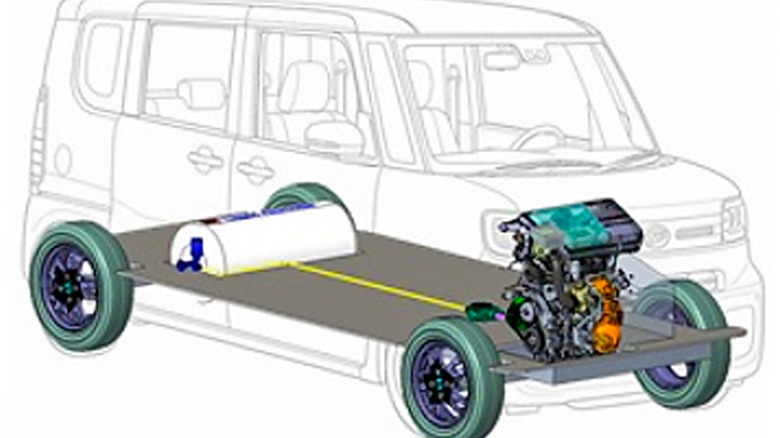
Meanwhile, carmakers beyond GAC (which is a partner of Toyota) keep pushing ammonia's boundaries. In fact, Daihatsu, which is a Toyota subsidiary, just released a new ammonia engine concept, and so has Toyota's own division, Toyota Industries. Probably for good reason, they both seem to have arrived at a way to combine using both hydrogen and ammonia together.
The clever hack for solving hydrogen's energy density problem
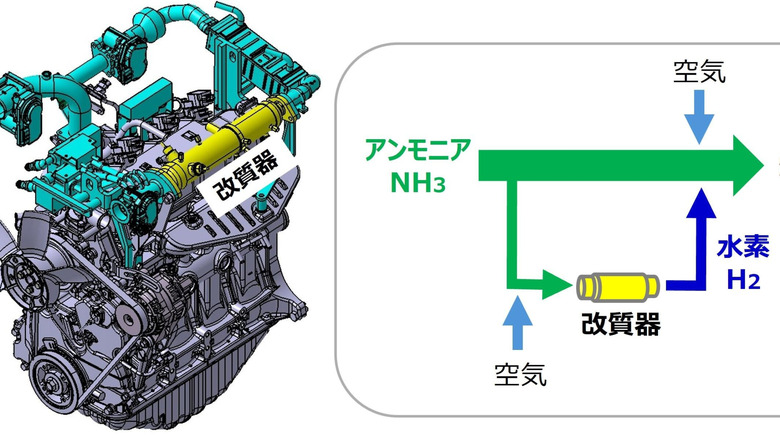
We just told you that ammonia has a higher energy density than hydrogen. Also, hydrogen has to be stored at much higher pressure and colder temperatures. But then, ammonia has both a combustion issue, and an emissions one. What if you derived the ammonia from hydrogen, stored that (rather than hydrogen) in the car, then converted it back to hydrogen for power production? That solves a bit of the density problem of hydrogen and the combustion problem of ammonia, and seems to be what's going on with two different engine concepts.
Daihatsu just exhibited their Ammonia/Hydrogen Co-firing Engine at the Japan Mobility Show. By converting some ammonia to hydrogen the engine overcomes the poor ignition problem of the former fuel, and the 658cc three-cylinder Kei-car mill presumably doesn't need exceptional range — just better range than hydrogen would offer.
And Toyota Industries Corporation also just developed an engine that, likewise, doesn't emit any carbon and runs on ammonia. For now, they seem to be focusing on the motor as a generator, with demonstrations beginning next year. It uses the same kind of technology, where it converts ammonia to hydrogen on the spot, for ignition and smoother running.
No, that isn't applicable for your average Land Cruiser. Unless, that is, you think about EREVs, or range-extender hybrids like, oh, this face-lifted Hyundai Santa Fe that we just spied. Because that kind of hybrid really runs a generator — which is exactly the kind of hybrid all of Scout's buyers seem to want. Now, dream a bit, and you can imagine a zero-carbon-footprint hybrid that uses a liquid fuel that you never have to plug in. Neat! However, it'll just smell a bit like window cleaner.