

What's The Difference Between Hydraulic Oil And Motor Oil?

Under the hood of cars and trucks, you'll find many fluids flowing around, lubricating and actuating different components — especially if the vehicle has hydraulic power steering. With the exception of the coolant, most are classified as a type of oil, even if you don't think of them as such.
That's because we often classify hydraulic oil as simply a fluid — on the flip side, who refers to engine oil as engine fluid? Hydraulic fluids are more for hydraulically actuating things, such as the braking system, automatic transmission (though there are important differences between transmission and hydraulic fluid), and power steering system (again, if it has it). So what's the difference between hydraulic oil and motor oil? It all comes down to viscosity, purpose, and the various ingredients that treat their given systems right. With that being said, engine oil also actuates some components hydraulically, but we'll get into that shortly.
Hydraulic oil is thinner and serves specific purposes
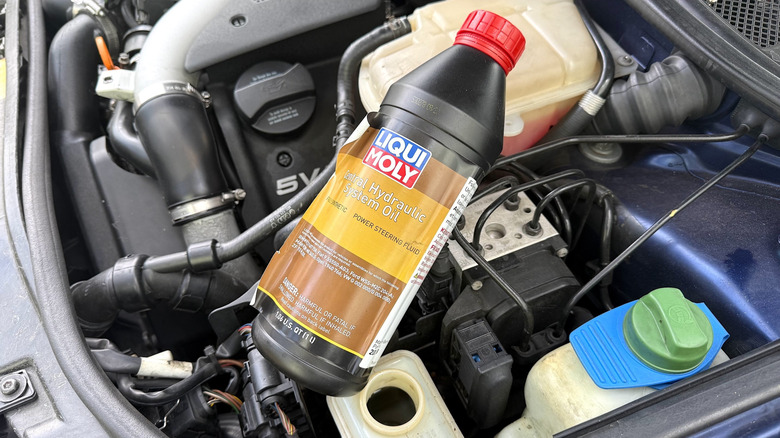
Hydraulic oil comes in different grades (viscosities) and is usually either mineral-based or synthetic, just like engine oil. Fun fact: It's easy to decipher the different grades of the latter. But the hydraulic stuff is generally thinner and is primarily used to actuate components. It also must be virtually incompressible under high pressure.
Not only that, but there are special additives that help prevent hydraulic oil from cavitating (forming vapor bubbles), which would greatly reduce its ability to power the hydraulic steering system. And hydraulic oil gets pretty hot — ask this author how they know after having fixed a few power steering leaks on their B5-generation Audi S4 — but it's not really designed to get as hot as engine oil. Like engine oil, it does provide lubrication to the systems it's flowing through. Finally, hydraulic oil has various agents mixed in to prevent foaming when air is introduced into it, commonly due to a power steering system leak (again, ask me how I know).
Engine oil is thicker and, well, also serves specific purposes
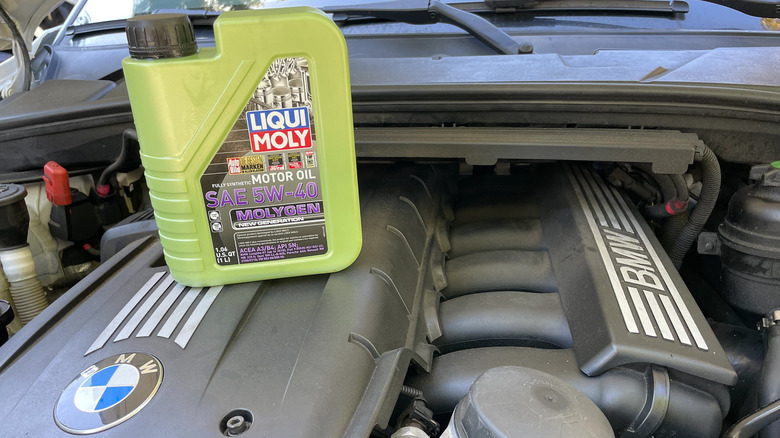
Engine oil comes in higher viscosities so that it properly flows and lubricates at high temperatures, like operating temperature, which is why you should go easy on the revs before the engine is properly warmed up. The "W" in oil viscosity stands for "winter," which is its viscosity rating when it's deemed cold. Engines are high-heat, high-friction environments — healthy oil that's changed at the proper service interval must do its job through it all.
In terms of special additives, engine oil has various detergents to clean the engine's interior, as well as additives that form protective films on metal parts, make surfaces inside slicker, prevent oxidation, and ensure it's doing its best to lubricate everything inside the engine. Then, there are certain additives that prevent carbon buildup as well.
Oil hydraulically actuates some components inside the engine in certain applications, such as variable valve timing systems, like Honda's VTEC and BMW's VANOS. The oil is introduced into these systems at a certain PSI by an ECU-controlled solenoid valve to change valve timing.
The difference between hydraulic oil and motor oil lies in the job each is designed to do. They may have a similar makeup in terms of being mineral- or synthetic-based, but the former is more geared toward actuation, whereas the latter is mostly for lubrication. It's worth noting that automatic transmission fluid (ATF) is sometimes substituted for gear oil in a manual transmission — it flows better in low temperatures, creates less drag, and doesn't harm synchronizers' friction materials. Regardless, it's a good idea to use only what the manufacturer recommends.