

Watch A Pickup Truck Pull Start This 102.4-Liter Engine Like It's A Lawnmower
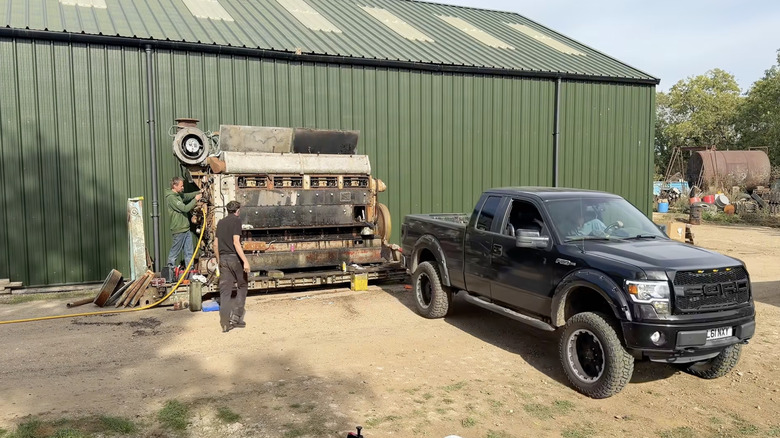
What in tarnation do you need a 102.4-liter engine for? Well, it's not horsepower. This 102.4-liter inline-eight-cylinder turbodiesel was delivered just after World War II to the U.K. Air Ministry in Scotland. It probably deserves honors as one of the largest engines ever built.
The purpose? It's a generator, just a very large one, likely used on a Royal Air Force base. The Mirrlees Blackstone JS8 was part of a series of power plants that went up to 16 cylinders, producing up to 2,446 horsepower. But on a power-per-liter measure, this beast is anemic. Consider that the 2023 Dodge Challenger Demon 170 made 1,025 horsepower from a minuscule 3.0-liter displacement. That's 341 horsepower per liter. The Mirrlees Blackstone J-series of engines, at their highest output, delivered a paltry 24 horsepower per liter.
Sometimes, however, the story isn't about sheer muscle. Mirrlees specialized in diesel engines for locomotives and industrial use and was one of the pioneers of that engine type. By the time they were making J-series engines, they'd been at it for over half a century. Oh, and besides, the JS8 made its muscle at under 1,000 rpm. You have to spin that Dodge's engine to 6,500 rpm to get its maximum output.
Still, as Joe Hewes, who goes by the handle Mr Hewes on YouTube, found out the hard way, a JS8 that has sat rusting and decomposing for several decades isn't so keen to stir back to life. And while Hewes is used to a challenge, typically rescuing large powertrains in vintage military machinery, the JS8 wasn't meant to start through anything like a standard ignition. Instead, it uses what's known as air start.
When compressed air doesn't work
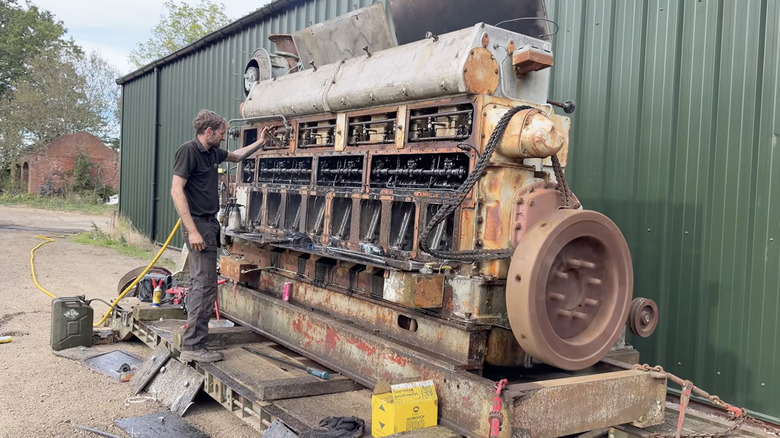
Hewes found that the Mirrlees had only 720 hours of service time, which is hardly broken in, considering the company trialed these engines at 1,650 hours; getting it to turn over was a bit of a journey. It had frozen valves, and where there should have been oil, it was filled with water.
In the longer video, you can see the attempt to start it using compressed air, which is how the JS8 would've been started when it was used as a generator. But the attempt failed; there just wasn't enough pressure to kick the Mirrlees to life, because diesels ignite by compression, not spark, and that requires a great deal of force.
Consider the size of the parts alone. The J series has a bore of 9.75 inches and a 10.5-inch stroke. Compare that to any of GM's legendary LS engines, the latest of which has a 103.25-millimeter bore — just four inches – and a stroke of about the same. You can turn over that car engine with a small starter. Reviving something as massive as the JS8 required a very different kind of machine. This led to wrapping a ratchet strap around the flywheel and speeding away in the Ford F-Series. Once that was achieved, Hewes stood there fine-tuning the engine while getting steadily coated in oil, very much in his happy place.