

Even The Most Powerful Classic VW Beetle Factory Engines Never Exceeded 65 HP
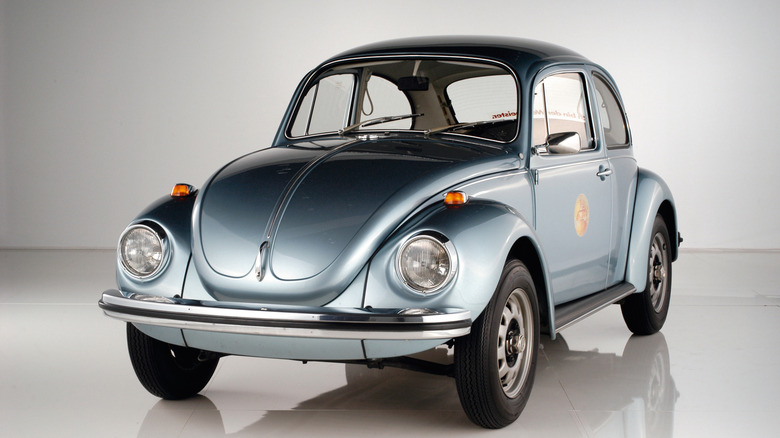
There are very few cars that are as closely associated with affordable mass-motoring as the original Volkswagen Beetle. The famously rear-engine, rear-wheel-drive Type 1, as it was known internally, entered series production way back in 1945. No fewer than 21.5 million units later, production finally wrapped up in 2003.
Despite enjoying a near-60-year-long career, the Beetle's underpinnings went through very little in the way of revolution over that time. The air-cooled flat-four engine remained rear-mounted for the entirety of production, although Volkswagen did experiment with at least one water-cooled prototype, and the recipe was tweaked as the years marched on.
Initially, the flat-four boasted just 22.5 horsepower from a capacity of only 985 cubic centimeters, although later iterations saw that capacity grow to 1.1-, 1.2-, 1.3-, 1.5-, and finally 1.6-liter versions. Power rose in the Brazilian-market 1.2- and 1.3-liter variants to a peak of 45 gross hp, while the 1.5-liter saw that swell to 52 gross hp. It grew higher still with the 1.6-liter four, with the Brazilian-market 1974 Fusca 1600 seeing the Beetle's time-tested flat-four engine reach its peak gross rating of 65 hp. It was the use of twin carburetors that allowed the Fusca 1600 to achieve such an output, making it the most powerful original Beetle in a factory state. The implementation of dual-port cylinder heads in 1970 had also assisted Volkswagen in its pursuit of improved performance.
However, performance was never the Beetle's primary goal, so it should come as no surprise to read that its air-cooled four never exceeded the dizzying heights of 65 gross horses. Its core purpose remained solving mass-market transportation problems, with motivation provided by a simple, easy-to-service, easy-to-repair flat-four.
A closer look at the flat-four's journey of development
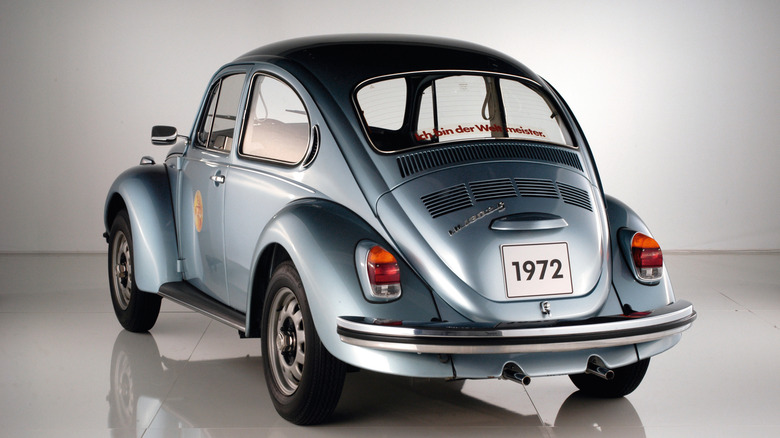
While the Beetle did originally start off with a dinky 985 cc engine, that engine never made it into Beetle series production. When production officially began in the post-war years, the engine size had grown slightly to 1,131 cc, and power sat at 25 horses. These units also featured engine and transmission housings cast from Elektron, an alloy of roughly 90% magnesium, for lightness, but the real changes were to come from '54 onward.
That year, 1,192 cc engines were introduced. Early versions gave just 30 hp, while engines of this displacement from '60 onward saw cylinder head work implemented too, which netted owners a few valuable extra horses. Still, at just 34 hp, the Beetle was far from a performance machine, and customer demands left Volkswagen looking at a displacement increase once more.
A 1.3-liter engine was introduced in 1965 and was soon followed in '66 by the 1.5-liter. It was very similar to the earlier 1.2-liter units in its construction, but power had now increased to 44 horses. Fast-forward to the '70 model year, and the U.S. market received the 57-hp single-port 1.6-liter engine, followed by the '71 model year's 60-horse dual-port 1.6-liter lump (both gross figures). Just a few short years later, Brazil's '74 Fusca 1600 would arrive, realizing the peak of Type 1 performance. Over the years, the engine was constantly tweaked in order to survive, gaining things like market-specific altitude sensors to improve air-fuel ratios, electronic ignition, and fuel injection systems.