

Gorgeous Alfa Romeo Cuorerosso Concept Is Our First Look At A Post-Giulia Alfa
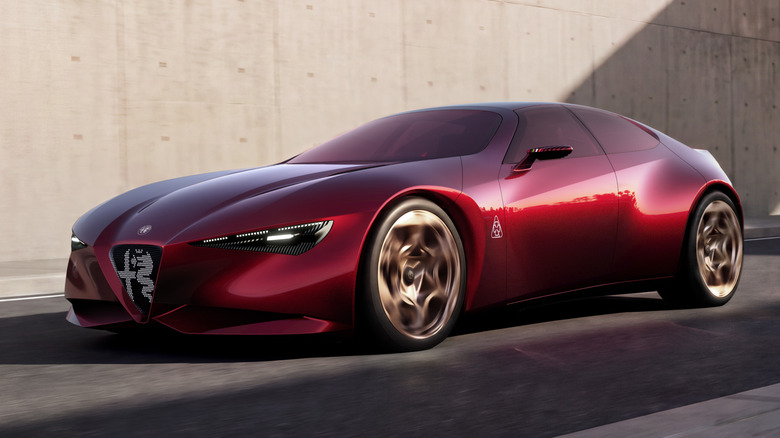
Alfa Romeo has been building the Giulia sedan for over a decade at this point, and it has served as the standard-bearer for the Italian brand that entire time. Even though the compact sedan still looks great, there's no getting around the fact that it's nothing if not a bit long in the tooth, but at this point it's almost hard to imagine a modern Alfa Romeo (the company) without the Giulia. Well, Alfa knows it's just about time to move on. Perhaps that's why it just pulled the covers off the four-door Cuorerosso concept at the Paris Motor Show, and would you just look at it. Gorgeous. Amazing. Wonderful.
 Alfa Romeo
The Cuorerosso concept is apparently "born from the heart of the brand, designed for those who still love the pleasure of driving," according to the company, and its name rather appropriately directly translates to "Red Heart." Unlike many concept cars we see today, the sleek four-door isn't an EV. Instead, it's part of the company's "multi-energy" manifesto, powered by a hybridized version of the twin-turbocharged 2.9-liter V6 that can be found in the Giulia Quadrifoglio, along with all-wheel drive, an automatic transmission, and a carbon-fiber driveshaft to help keep weight down. It does a somewhat commendable job, as the Cuorerosso comes in at 3,858 pounds.
Have you ever heard the word phygital before?
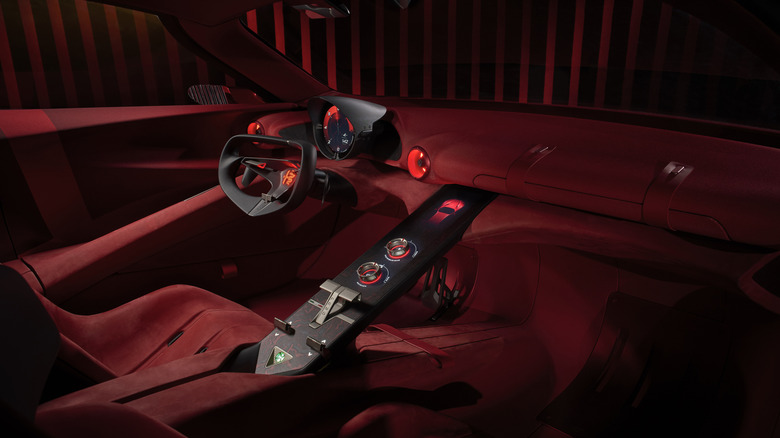
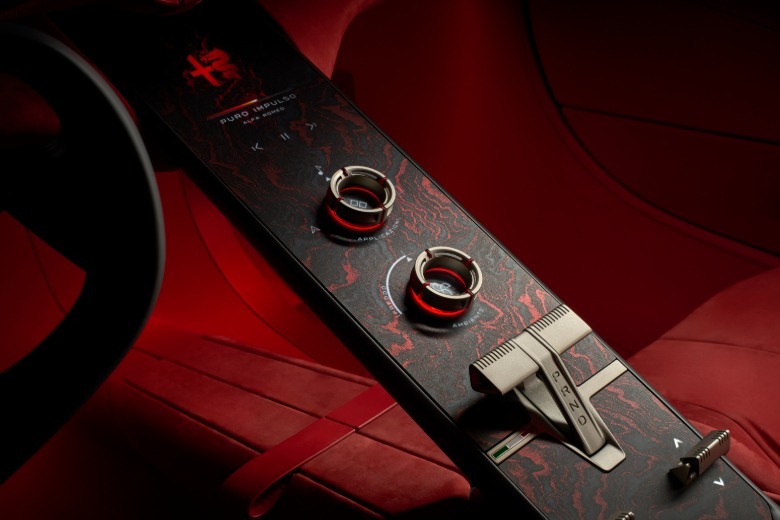
It's certainly driver-focused on the inside, where you won't find any giant tablets or touchscreens. Instead, there's what Alfa Romeo calls the Magma Display, a "phygital" combination of digital and physical controls. The infotainment screen appears to shine through the stone-like material, with two prominent knobs below it that control different things depending on the situation, from climate and media functions to power distribution and drive mode.
 Alfa Romeo
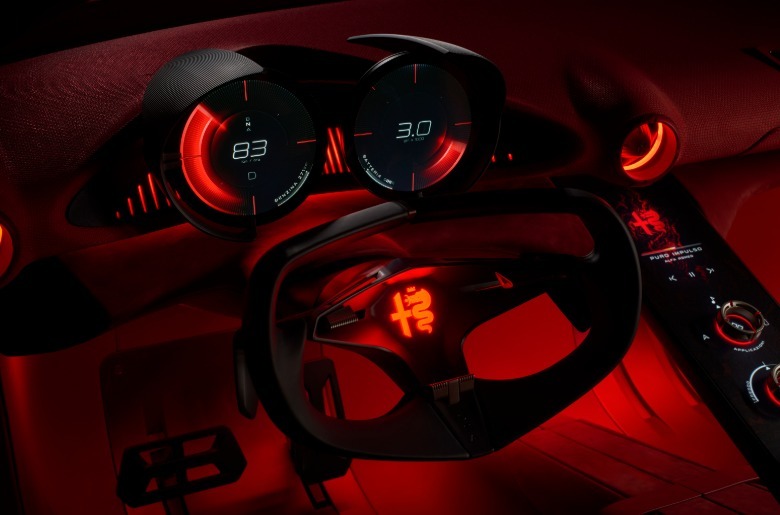
Mounted ahead of the steering wheel is a pair of pod-shaped gauge cluster screens that Alfa calls the "Cannocchiale Vivente," or "living telescope," which can combine into one single pod depending on drive mode. Alfa Romeo says "this technology has potential for further development in STLA SmartCockpit," so we could see moving gauge clusters brought to a production Alfa in the future. Don't hold your breath for that phygital panel, though.
 Alfa Romeo
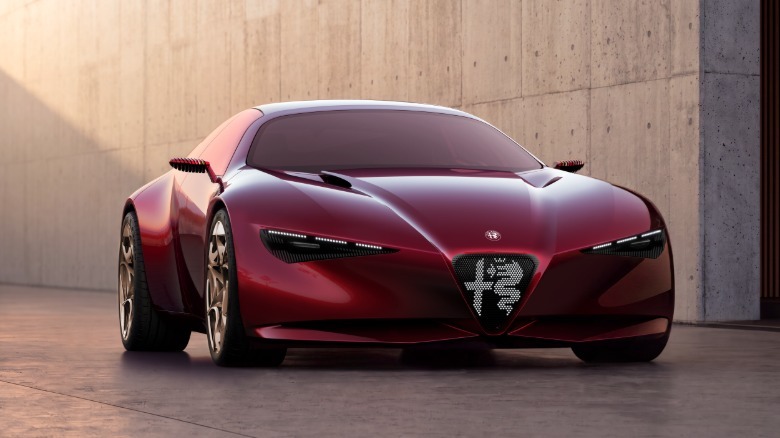
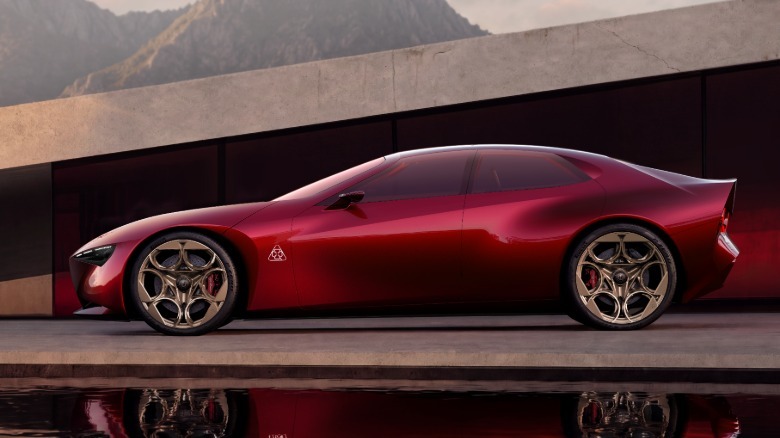
All signs are pointing to the Cuorerosso being a preview of what'll eventually become the Giulia's replacement. Of course, the real car will lose the coach doors and some of the more extreme proportions of the concept, but the automaker's new Bellezza Necessaria (Necessary Beauty) design language will shine through... hopefully. Hell, it's even the right size to replace the Giulia at 185 inches long and 77 inches wide, roughly 2.5 inches longer and 3.8 inches wider than the old sedan. At 52.4 inches tall, it's also a few inches lower than a Porsche Taycan.
Replacing the Giulia
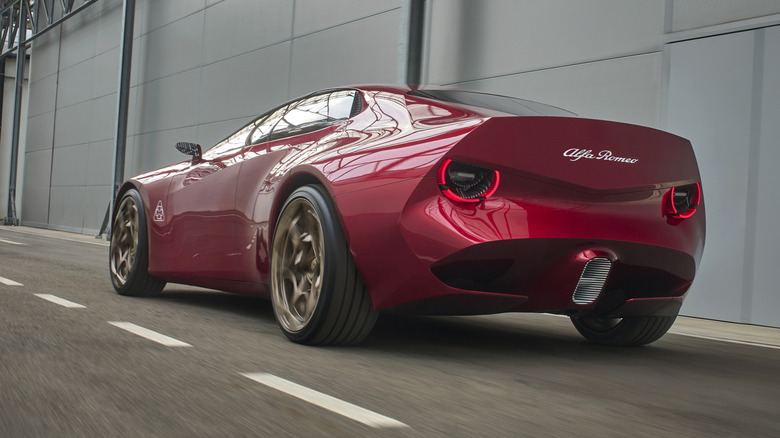
While the Cuorerosso does carry many of the familiar Alfa Romeo design cues we're used to seeing, it wasn't penned in the same way other cars have been. Designers initially sculpted the basic shape without wheels, windows, or even the traditional Alfa Trefoil grille. Their goal was to focus on the proportions and surfaces of the sedan before adding other elements, and that's part of why it looks so clean. The windows are flush with the bodywork, and you won't find any glossy black trim. They even reworked the badge, giving it a more two-dimensional look while also adding the serpent emblem to the aforementioned grille. It's lovely. All of their hard work was also for a purpose: low drag. Alfa says the Cuorerosso has a drag coefficient of 0.28, which is damn low for a gas-powered car.
 Alfa Romeo
It might seem like the Giulia was destined to last forever, but even Stellantis knows it had to be replaced at some point. While the production car probably won't look exactly like the Cuorerosso, even if it's able to capture some of this thing's essence, I'd say that's a job well done. It better be, too, because let's just say if the production version of the Cuorerosso manages to go on sale in 2030, you can expect it to still be in production well into the 2040s.