

8 Rare Engines With Super High Redlines
What defines a truly great engine? Could be power output, because, hey, that's what makes a car faster. Or maybe torque is more important for daily drivability because it arrives earlier in the rev range. In fact, the bottom line is that together, more horsepower and torque unlock more speed. This is the main reason most modern engines are turbocharged.
However, a particular subset of automotive enthusiasts (me included) swears by high-revving naturally aspirated engines. They make less power than their boosted counterparts and aren't nearly as torquey — but boy, do they make your heart race. They sing. They vibrate. And crucially, they do this for longer. Where a high-performance turbocharged engine hits a redline, one that's high-revving and naturally aspirated just starts hitting its stride. From there on, it's like ecstasy hit you, no matter the cylinder count. This, Jalops, is what separates an engine from an appliance.
Astute readers will immediately think of the Lamborghini Temerario and its twin-turbo V8 that revs to 10,000 rpm, but you won't read about it here, as Lambo plans to produce 2,500 every year. We'll feature the F1-derived 1.6-liter V6 turbocharged engine in the Mercedes-AMG One because it fits the "rare" bill, but this list is otherwise populated by naturally aspirated gems like the Lexus LFA's Yamaha-tuned V10. The other entry fee is a redline of at least 9,000 rpm (sorry, Porsche Carrera GT), so, yeah, it's an elite bunch. Let's have a closer look at these high-revving unicorns.
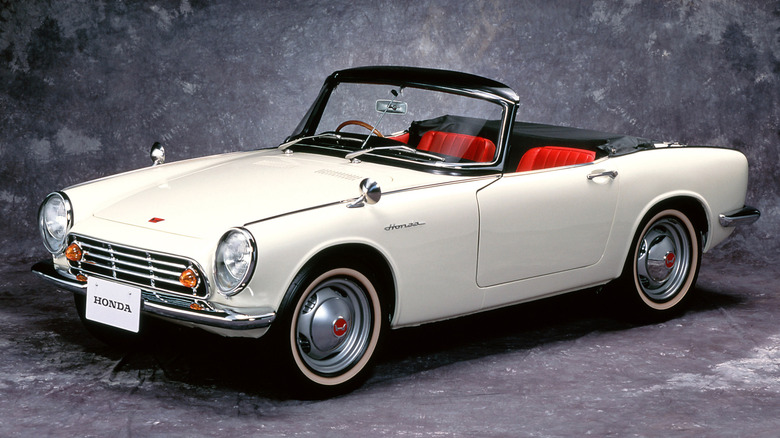
1963 to 1964 Honda S500 531cc inline-4 (9,500 rpm, 1,363 units)
Few do high-revving engines like Honda, but the Japanese automaker has mostly employed them in mass-produced sports cars. That's great for enthusiasts, but we're looking for unicorns, not everyday performance staples.
Fortunately, Honda has one engine that fits the bill — the tiny 531-cubic-centimeter inline-4 from its first sports car, the S500. Unlike the rest on this roster, the S500 wasn't designed to be a limited-run boutique car, but a small, lightweight sports car for the masses. Still, it was produced for less than a year, resulting in a limited run of 1,363. Honda replaced it with the improved S600, designed for international markets, which got a 13,084-car production run. Both followed the same principles: a compact, featherlight body; high-revving, motorcycle-like engine; and front-engine, rear-wheel-drive roadster body.
The S500 was advanced for its time, particularly the twin-cam 531 cc engine. It was made entirely from aluminum, featured four carburetors and a crossflow cylinder head, and produced 44 hp at 8,000 rpm — excellent output for such a small engine. More importantly, it spun to 9,500 rpm, making it the highest-revving production engine at the time, with the tachometer reading 11,000 rpm. The engine was paired exclusively to a four-speed manual.
Thanks to the car's low curb weight of 1,598 pounds, all this was enough for a top speed of 80 mph. Yet the small buzzer was only the headliner. The S500 also had an independent front/rear suspension, and instead of a differential, utilized a chain drive — just like in a motorcycle.
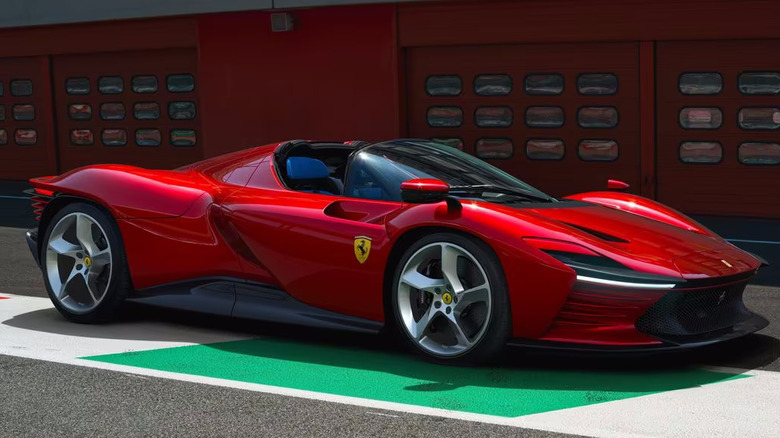
2021 to 2025 Ferrari Daytona SP3 Tipo F140HC 6.5L V12 (9,500 rpm, 599 units)
Say what you want about Ferrari, but its insistence on still employing machines with a naturally aspirated V12, including the Purosangue and 12Cilindri, is praiseworthy. Dating back to 2002, Ferrari's Tipo F140 engine has attracted enthusiasts with its pure, high-revving nature and incredible sound that set it apart from its rivals. Indeed, in the new Ferrari 12Cilindri, the 6.5-liter F140HD variant pumps out 818 horsepower, revs to 9,500 rpm, and produces that spine-tingling V12 sound we all love.
Still, it's the F140HC version inside the Daytona SP3 that matches the "rare" profile. Ferrari produced only 599 of these stunning mid-engine masterpieces, developed to commemorate the 330 P3/4, 330 P4 and 412 P race cars that swept the podium at the 1967 24 Hours of Daytona. Based on the lightweight carbon-fiber monocoque tub from the LaFerrari and adorned in beautiful body panels, the Daytona SP3 weighs only 3,275 pounds, but boasts a low center of gravity and outstanding body rigidity.
The best part: You get to hear more of the V12's aural bonanza by removing the carbon-fiber roof panel. Like 12Cilindri's V12, the Daytona SP3's F140HC revs to 9,500 rpm, but cranks out a higher 829 hp at 9,250 rpm and 514 pound-feet of torque at 7,250 rpm. Paired to a seven-speed dual-clutch automatic, the Daytona SP3 blitzes to 62 mph in 2.85 seconds (manufacturer's estimate), an impressive figure for a non-hybrid rear-wheel-drive sports car. Even more savage: 0-124 mph takes only 7.4 seconds. Find a long enough straight and the Daytona SP3 will reach 211 mph.
2010 to 2012 Lexus LFA 1LR-GUE 4.8L V10 (9,000 rpm, 500 units)
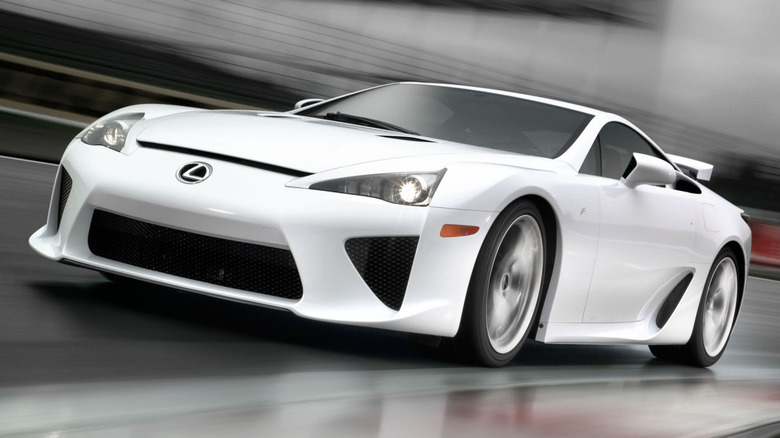
Few modern supercars have been as romanticized as the Lexus LFA. Hardly surprising, as the highly limited LFA (500 cars) is Lexus' most advanced car to date, featuring full carbon-fiber-reinforced plastic construction and one of the pinnacle of naturally aspirated engineering.
Its beginnings were marred by setbacks, though. From the first sketch engineer Haruhiko Tanahashi scribbled on a napkin in 2000 to the final model that appeared at the Tokyo Motor Show in October, 2009, the LFA has been through many iterations. Most notably, Lexus moved from aluminum to carbon-fiber construction to shave 220 pounds and make the body more rigid.
The 1LR-GUE V10 engine, though, was there from the beginning — maybe that's why it ended up being so polished. Developed in collaboration with Yamaha, the 4.8-liter has all the parts you'd expect in a motorsport engine, like titanium valves, ultra-light diamond-coated rocker arms, low-friction components, and a dry sump setup for low center of gravity. Crucially, LFA's V10 also has 10 individual throttle bodies for razor-sharp throttle response.
The result: a frantic 9,000-rpm redline, arriving from idle in needle-blurring 0.6 seconds. It's a potent machine, too, producing 553 hp at 8,700 rpm and 354 lb-ft at 6,800 rpm. Paired with the six-speed automated manual, the LFA dispatches 60 in 3.6 seconds and tops out at 202 mph. All that wrapped up with an F1-like symphony produced by a special surge tank designed by Yamaha's music instrument division. According to our readers (and many other people), it's one of the best-sounding engines of all time.
2022 to 2025 Mercedes-AMG One PU106C 1.6L V6 Turbo (11,000 rpm, 275 units)
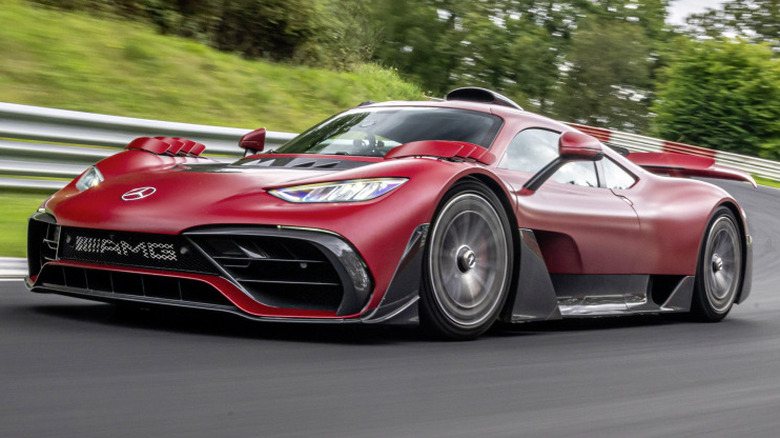
Mercedes-AMG all but demolished the F1 field during the turbo hybrid era, winning eight consecutive constructor championships from 2014 to 2021, along with seven drivers' titles, and 111 of 160 races. Naturally, the AMG road division wanted to capitalize on this dominance by creating one of the wildest hypercars ever — the One. Equipped with the same turbo-hybrid V6 as AMG's F1 race cars, the One packs 1,049 horsepower and revs to an incredible 11,000 rpm. The internal combustion engine alone spits out 566 hp — surreal considering its tiny 1.6-liter capacity.
But that engine hardly paints the whole power train picture, since the One's E Performance plug-in hybrid system is also equipped with four electric motors. Two 161-hp motors power the front wheels to help with traction, similar to the Ferrari F80 configuration. An additional 161-hp electric motor, which F1 fans know as MGU-K (Motor Generator Unit–Kinetic), is attached to the engine, and a 120-hp MGU-H (Motor Generator Unit–Heat) spools the turbocharger to reduce lag. All these motors are fed by an 800-volt battery.
Yeah, it's complicated, but also on the heavy side. The AMG One is built over a carbon-fiber monocoque, yet it still weighs 3,737 pounds. As a result, it's not as ballistic in a straight line as you'd expect, accelerating to 62 mph in 2.9 seconds. Still, the electronically limited 219-mph top speed, allowed by the active aerodynamics (which also provide more downforce when necessary), is mightily impressive. Unfortunately, you'll probably never see one on the road, as Mercedes-AMG produced only 275.
2021 to 2024 Aston Martin Valkyrie Cosworth RA 6.5L V12 (11,100 rpm, 275 units)
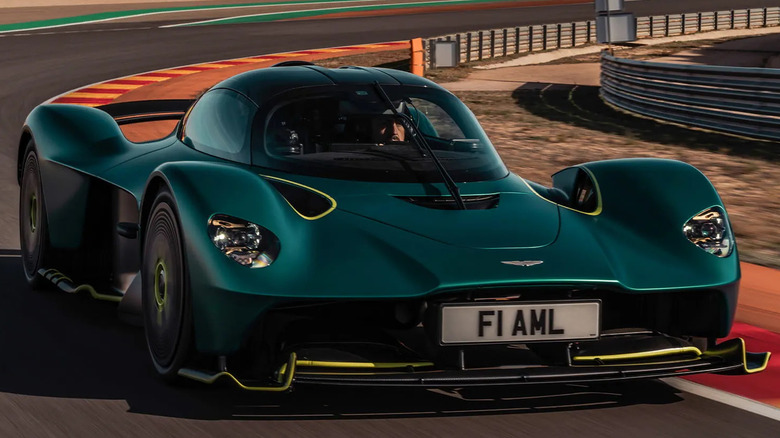
Like AMG with the One, Aston Martin produced only 275 of its hypercar, the Valkyrie. The British automaker leaned on Adrian Newey's F1 expertise for the aerodynamics and used a lightweight carbon monocoque.
Still, Valkyrie's power train is worlds apart from the AMG One. Yes, both are hybrids, but that's where the similarities end. Instead of a small turbocharged engine, Aston Martin went with a 6.5-liter naturally aspirated V12, co-developed with Cosworth, that produces an amazing 1,000 hp at 10,500 rpm and 546 lb-ft at 7,000 rpm. The Cosworth RA engine spins to a stratospheric 11,100 rpm, and, because it has no turbos, it sounds much more ferocious than the AMG One's V6, with a high-pitched tone reminiscent of an old F1 car.
At only 454 pounds, the screaming V12 is remarkably light, too. To achieve this, most of the engine's internal parts are machined, including the titanium conrods, crankshaft, and F1-spec pistons. To cut weight even further, Aston Martin used a single 138-hp electric motor bolted to the engine, which the driver can call upon with the Energy Recovery System (ERS) button on the steering wheel. The result is a dry weight of only 2,800 pounds.
Coupled with a seven-speed sequential gearbox, the V12 propels the Valkyrie to 62 mph in 2.6 seconds and on to a top speed of 220 mph. Still, the real party piece is the outstanding 2,425-pound downforce created at only 137 mph, which helps the Valkyrie remain stable at those immense speeds. The real flex? Newey used the ground effect and no spoilers to achieve that figure.
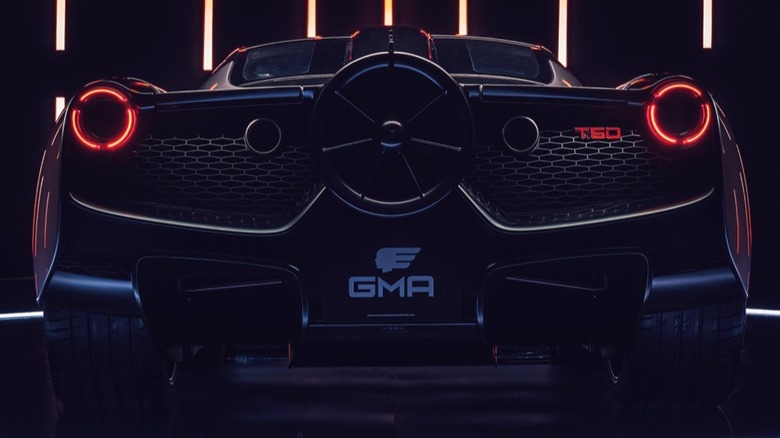
2023 to 2025 GMA T.50 GMA-Cosworth 3.9L V12 (12,100 rpm, 100 units)
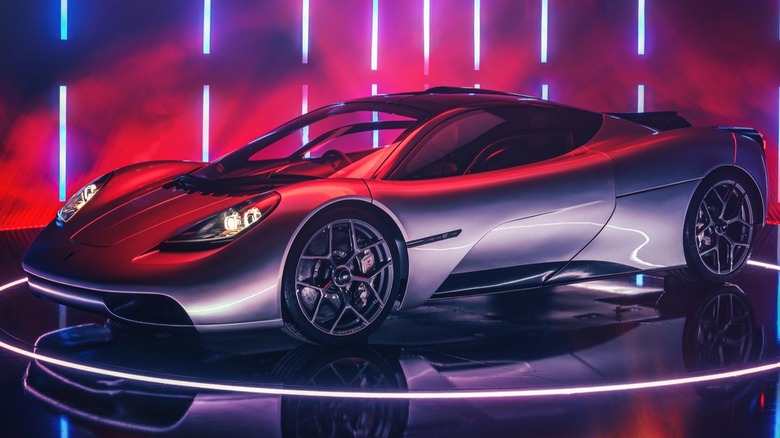
A product of former Formula 1 technical director and leading McLaren F1 engineer Gordon Murray, the GMA T.50 might be the purest expression of a driver's car ever made. Not that we expected anything different from Gordon Murray Automotive, a boutique automaker laser-focused on driving in its most elemental form.
Unlike most hypercars nowadays, the T.50 has no turbochargers. No hybrid system. Heck, it packs a six-speed manual because who cares about 0-60 times? With the T.50, it's all about enjoyment — not bragging rights. Still, the T.50 is plenty fast. It packs a Cosworth-developed 3.9-liter V12 that produces 661 hp at 11,000 rpm and 353 lb-ft at 8,000 rpm. The pièce de resistance figure, however, is the otherworldly 12,100 rpm redline, which the V12 hits in unhinged 0.3 seconds from idle, and the mesmerizing high-pitched sound it produces. And if all that wasn't impressive enough, the T.50 weighs an absurd 2,198 pounds!
Really, is there anything better than a lightweight, high-revving, manual-equipped, mid-engine sports car? How about one where you sit in the middle with two passengers beside you, just like in the McLaren F1? Murray says the T.50 is F1's second coming, so he copied most aspects from his most legendary work, including the seating configuration.
However, Murray wouldn't be one of the most legendary automotive engineers if he didn't modernize the concept. So the T.50 also has a rear-mounted 48-volt fan system that creates downforce by sucking air from underneath the car. It's impressive, yes, but you won't get a chance to buy one, as the 100-car production run ended in 2025.
2011 to 2012 Ariel Atom Hartley 3.0L V8 (10,600 rpm, 25 units)
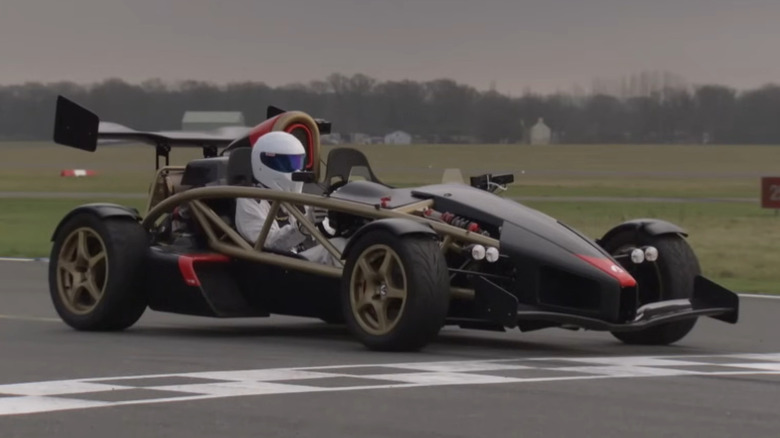
The AMG One, Valkyrie, and T.50 are somewhat connected to F1, but they are still regular closed-wheel cars. The Ariel Atom V8, on the other hand, employs no F1 tech, yet it offers an extreme, F1-like open-wheel driving experience. And this rare machine (25 units) is a road car, not a track-only weapon.
The Ariel Atom V8 is a weapon, though, and one of the wildest, most unhinged sports cars ever produced. For starters, it weighs only 1,433 pounds with a full gas tank, thanks to its compact dimensions, lightweight spaceframe chassis, and minimal bodywork. It has no doors, meaning you'll need to protect your face from road debris. But as Jeremy Clarkson found when he reviewed the non-V8 Ariel Atom fir Top Gear, this thing takes driving exhilaration to the extreme.
Ah, yes, the engine. Designed by U.S.-based Hartley, the 3.0-liter V8 was built from two Suzuki Hayabusa motorcycle engines. It produces 475 horsepower at 10,500 rpm in the regular model, and up to a whopping 500 hp at 10,600 rpm in the track-oriented version. It also weighs only 198 pounds — impressive for a V8 engine.
Ariel offered no manual option, only a six-speed sequential, which makes sense, because fiddling with a clutch in a machine this feral seems like a recipe for disaster. With a higher power-to-weight ratio than a Bugatti Veyron, the Atom V8 is a real rocket, reaching 60 in less than 2.5 seconds, despite only driving the rear wheels. Yet its unmatched steering responsiveness might be even more impressive, as it unlocks highly desired go-kart-like driving dynamics, only with a dose of hypercar speed.
2007 to 2008 Caparo T1 3.5L V8 (10,500 rpm, 16 units)
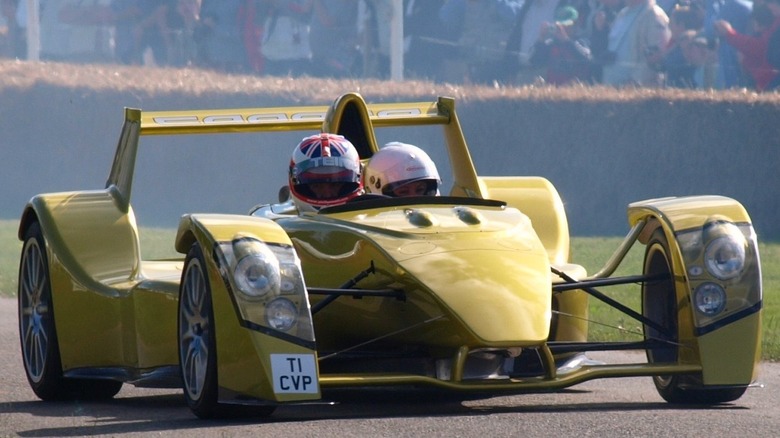
If you thought the Ariel Atom V8 was unhinged, think again. The Caparo T1 isn't only more extreme, it pioneered the F1-themed, V8-powered road-legal sports car. And it was built by ex-McLaren engineers who served under chief engineer Gordon Murray during the F1 program.
Behind the driver, the T1 packs a 3.5-liter naturally aspirated V8 developed in collaboration with Menard Engineering, producing a whopping 575 hp at 10,500 rpm and 310 lb-ft at 9,000 rpm — though Caparo claimed the engine was unstressed and could easily rev to 17,000 rpm. Caparo paired the high-revving beast to a six-speed sequential gearbox, much like in an F1 car.
Perhaps even more impressive, the Caparo T1 weighs only 1,212 pounds dry thanks to the use of aluminum and carbon fiber in the chassis. That equates to a power-to-weight ratio of 1,046 hp per ton, higher than the Ferrari F80 (738 hp per ton) and McLaren's W1 hybrid hypercar (899 hp per ton). As a result, Caparo said the rear-wheel-drive T1 blitzed to 60 mph in less than 2.5 seconds and to 100 mph in blistering 5 seconds. Top speed: 187 mph.
The Caparo T1 also featured a race-car-like suspension and aggressive aerodynamic elements that created 1,764 pounds of downforce at 150 mph. Still, Jeremy Clarkson claimed the T1 was unpredictable at low speeds (via Car Throttle), becoming stable only when the spoilers did their work. This, alongside the T1 catching fire with British race car driver Jason Plato behind the wheel and a launch-day crash with a Dutch journalist aboard effectively stalled production at just 16 of a projected 100 units.