

What Truly Counts As Camping In The Left Lane?

If you're reading this and you live in the United States, you may notice the subjectivity of that first word, "united." The states aren't very united when it comes to left-lane camping, i.e., the practice of (some would say) obstinately cruising slower than prevailing traffic and forcing faster drivers to pass on the right. This isn't merely annoying to other road users; It's unlawful in many states. In 2025, Colorado issued 2,540 tickets to drivers for camping out in the left lane.
Well, unlawful, sort of, depending on the state. We're not especially unified or precise on what constitutes camping, either. Even within a single state, the laws are confusing. For instance, in Colorado, where it's technically illegal to remain in the leftmost lane if you're not passing on roads posted with a 65 mph speed limit or higher, there's an important exception. If that left lane is for high-occupancy-vehicle (HOV) use, legally you're not a camper if you're over there. So camping in Colorado, not in a tent, is a qualified condition.
Cross from Colorado into Arizona, and, according to that state's law a camper is someone driving "at such a slow speed as to impede or block the normal and reasonable movement of traffic." Note that this doesn't mention the speed limit; the law is designed to keep everyone moving. In fact, according to AAA, most states have limits for cruising in the left lane save for passing, merging, or exiting; otherwise, you're a left-lane camper. Maybe.
Let 'em merge
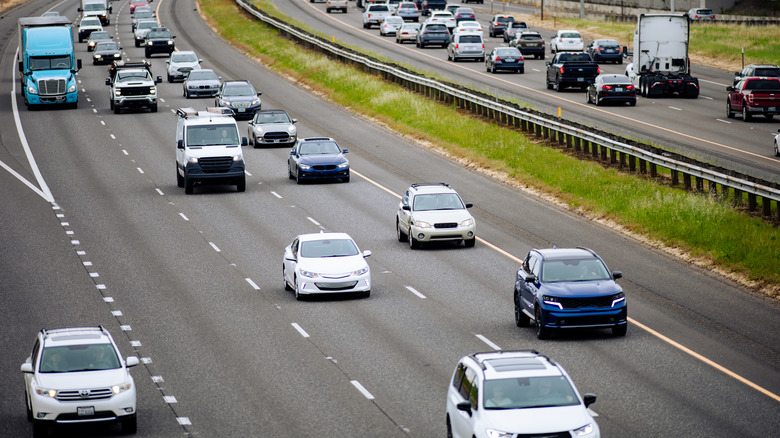
In Washington State, Montana and Pennsylvania it's legal to move into the left lane to allow a car to merge onto the highway. Which makes perfect sense, but isn't necessarily codified everywhere, according to MIT's compiled survey of state laws. By the way, Colorado isn't alone in designating the HOV lane as not technically the left lane, preserved for passing. Washington's law also makes that distinction.
What's odd is that Alaska, Maryland, North Carolina and Ohio all somewhat permit left-lane camping. In Alaska the law says you have to be going the speed limit or to move over. In Maryland, if you're chugging along at 10 mph or more below the speed limit you'd better scooch right. North Carolina sides with Alaskan diktat and says you've got to slide right if you're not pegged at the maximum speed limit. And Ohio — is odd.
Ohio law permits left-hand camping as long as you're going the prevailing speed limit. If not, you have to give way when being overtaken once the passing vehicle gives an "audible signal," presumably with its driver tapping on their horn before passing. Actually, North Carolina also mentions an audible signal, which has us wondering why both legislatures haven't heard of this fancy new device called a horn.
FYI, there's a way to get revenge on left-lane campers, who of course are engaged in one of the five bad habits guaranteed to annoy everyone else on the road. But you can only legally engage in the following payback in a handful of states.
Pass on the right — where it's legal.

In Maryland, Minnesota, New York, New Hampshire, Utah, Wyoming, and Tennessee it's legal to pass on the right under certain circumstances. Those include when there's a left turning lane, but also when there are two or more lanes traveling in the same direction. These laws would seem to defy everything you learned in driver's ed about passing on the right.
For instance, nothing in the New York State language seems to suggest you cannot blow by a left-lane vagrant on the right while driving on the interstate. These are the conditions the law spells out when right-lane passing is permitted:
"Upon a street or highway with unobstructed pavement not occupied by parked vehicles of sufficient width for two or more lines of moving vehicles in each direction."
And the New York State DMV section on passing says very plainly that indeed you may pass on the right, naturally while abiding by the aforementioned statute. So do you want to make this part of your go-to plans for avoiding traffic tickets where right-lane passing is technically legal? Uh, sure. Let us know how that works out.