

The Rules Around Stopping Your Car From Being Towed Are Annoyingly Complicated
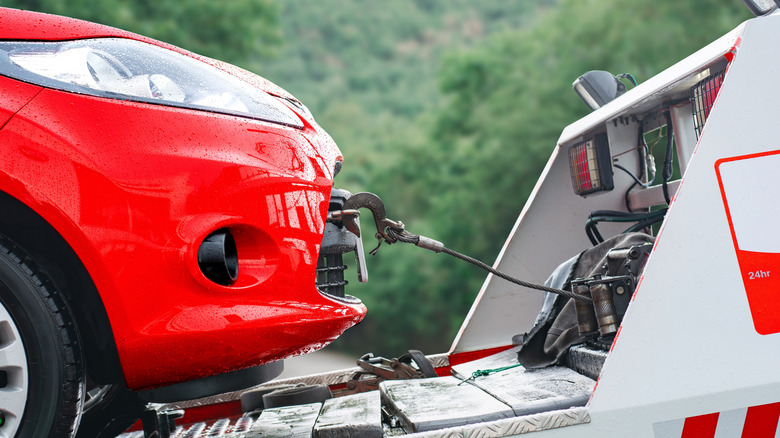
Your car is getting towed. Not really, sit down. But it could be. And while most tows happen when you're otherwise occupied and you only find out when you come to the slow realization while approaching your now-empty parking spot, in rare cases you might arrive in time to catch the tow truck in the act. It seems like getting there before your car is gone should count for something. The real question is whether or not it actually does. The answer is: it depends.
We're going to talk a little bit about the various scenarios and some of the geographical nuances next, but first, let's point out another part of the problem: if it feels like you've been hearing a lot lately about shady towing situations and frustrated drivers doing their best to combat them, it's because it really is happening a whole lot more these days. For example, the National Insurance Crime Bureau reported an 89% increase in claims of predatory towing from the beginning of 2022 through the end of 2024. Heck, even when a state dissolves a towing company it can keep taking people's cars. So yes, it is entirely possible that they are indeed out to get you. Let's see what you can (or can't) do about it.
Towing laws can change from one state or city to the next

If you're hoping for one overarching federal rule that clearly and succinctly explains when tow truck drivers do and don't have to back off and surrender your car back to you, you're mostly out of luck. Towing laws vary widely across the United States, and the rules for stopping a tow in progress can depend on where you live and the specifics of the situation.
In a 2021 study, the U.S. PIRG Education Fund, a consumer advocacy group, found that fewer than half of all states had set maximum towing rates and plenty didn't even require that drivers be told that their cars had been towed. Some municipalities will often pick up the slack — a few have even created a towing-specific bill of rights – but the bottom line is that much like motorcycle lane filtering or going topless on the beach, location is everything. We'll get into how you can educate yourself on your area in particular shortly, but first, the basics.
Can you stop your car from being towed? Sometimes!
First of all, yes, there are situations where catching a tow truck before it leaves with your car can spare you a trip to the impound lot, and maybe even save you some money. If you want the best chance of driving home instead of shaking your fist at your car disappearing into the distance and then calling an Uber to the impound, two things matter most. The first is whether the tow truck has finished connecting to your vehicle, and the second is whether or not it's left the parking lot.
For purposes of illustration, let's play these out in Texas. In that state, if the tow truck hasn't finished connecting to your vehicle, it's basically a get-out-of-jail-free card. You win, and the company has to release your car without charging you anything. If, however, your car is fully hooked up but still in the parking lot, the rules change. Now the tow company is entitled to a so-called "drop fee," a ransom you'll find annoying to pay, but still preferable to what would have happened had it made a clean getaway. Other states have similar guidelines.
The kind of tow matters, too
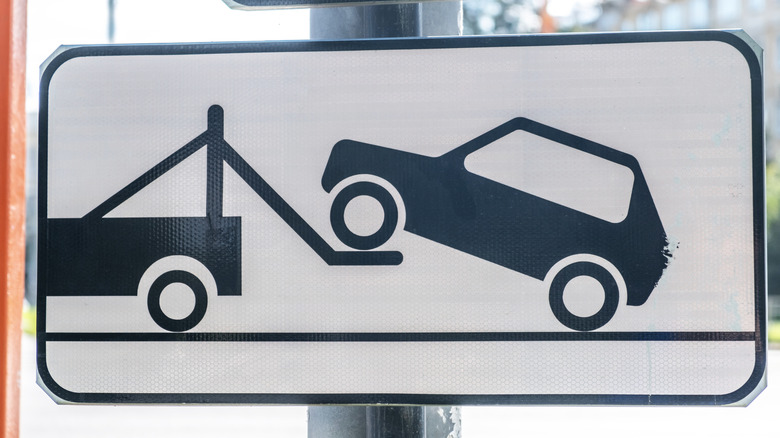
The examples we've talked about so far primarily involve private-property towing, where an owner or a manager has arranged to have an unauthorized vehicle removed. But if the police order the tow, that's a different thing, and the same protections may or may not apply.
We already talked about Texas, so for this next example, let's hit the approximate opposite of Texas: Massachusetts. There, state law says that if you show up before a private-property tow is completed, the tow operator may choose to charge you half of its usual towing fee instead of completing the tow. If the Massachusetts State Police initiated the tow, an entirely different set of provisions — and fee schedule — applies.
There's also the matter of whether the tow is lawful in the first place: remember what we said before about predatory towing? Going back to our Texas case study, the state has a formal hearing process for drivers who feel they've been wrongfully towed. This is probably preferable to arguing about it in a parking lot. In other words, just because you're right doesn't mean you'll get satisfaction on the spot.
How to find the towing rules where you live

We've established that all of this is annoyingly complicated and that the rules are inconsistent. But unless you're planning to do a Cannonball Run of parking violations from coast to coast, you probably don't need to study up on every region and locality. Fortunately, there's some decent guidance available that allows you to look up the rules in the state where you live or where you plan to do your next parking crime.
The U.S. PIRG Education Fund, which we mentioned earlier, has put together a state-by-state guide on towing practices that addresses each of the 14 consumer towing protections it recommends, answering questions ranging from the maximum towing rates to whether vehicles must be released if you arrive during hookup to recourse for illegal tows. Pull up the guide, throw in your state, and see what it says.
As for jurisdictions more granular than state level, you may have to do some digging within your city or county government website. Terms like "nonconsensual towing," "private-property towing," and "drop fee" are all good places to start. Because we're not always talking about the most honest of actors here, knowing your rights might matter quite a bit. Just like how a tow company was ignoring new laws specifically designed to help low-income folks, sometimes it's on you to advocate for yourself.