

This Subaru 4-Cylinder Has A Terrible Reputation For Reliability, Here's Why
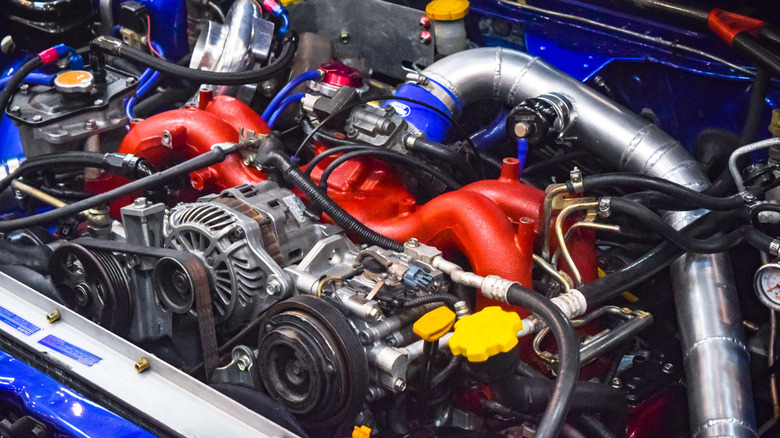
Subaru made several generations of EJ boxer engines, from the EJ205 in early 2000s Japanese domestic market WRXs, to the EJ255 in some WRX, Forester XT, and Legacy GT models up to 2014, and finally the EJ257 in the WRX STI from 2004 to 2021. But if you know these cars, and how boxer engines work — which is with horizontally opposed pistons, meaning they move side-to-side rather than up and down like in V-shaped configuration — then you also know that despite performance advantages, there are at least three major issues with boxer engines in particular.
With the Subaru EJs, these issues come down to that boxer design, and EJ25s had it the worst, with a very bad reputation for reliability thanks to failed head gaskets. That's not the sole issue with EJs, since earlier EJ20s share some frailties with the EJ25 that we'll get into shortly. But the head gasket failure on EJ25s is pretty notorious, and partly inherent to the boxer design. It affects engines in Legacy, Outback, Forester, and Impreza Subarus from the late 1990s through the mid-2010s, and these Subaru model years were the worst affected by head gasket problems.
As to the why of this failure, the bottom of the gaskets (one on each side) sit vertically, so oil can saturate this material when the engine is turned off, rather than draining back into the oil pan. Older Subarus used a more porous gasket material that let coolant seep through. While later models switched to a multi-layer steel gasket, those could also tear or corrode. When a head gasket leaks you'll get poor compression, overheating, and white smoke blowing out of your Subie's tailpipe.
Pistons are also a problem with some Subaru engines
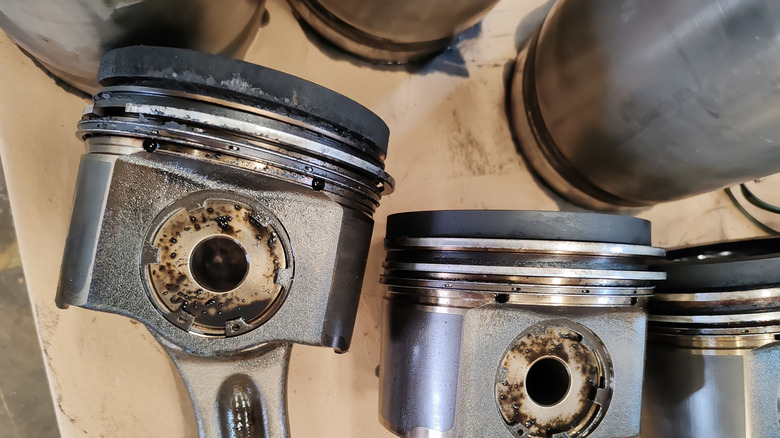
Enter the search term "piston ringland" in Google and the first several results pages reference Subaru engines. That's not a good thing, right? Nope. The reason for that result is that EJ20 through EJ257 engines suffer from what's known as piston ringland failure. Piston ringlands sit just below the top of the piston, known as the crown, and on EJ20 and EJ25 engines perform multiple functions. The top ringland seals out heat and combustion gases from the crankcase. The second ringland does the same with any gases that get past the first ring, while simultaneously scraping oil that has seeped past the third ring from the cylinder walls. The third ring's job is to squeegee oil from the cylinder walls toward the wrist pins.
When the top piston ringland can't create a combustion seal, you'll see a drop in power. That causes a further issue with blow-by of combustion gases, which can lead to excessive oil burn-off — which then leads to more damage we'll tag below.
As for the cause of ringland failures, these are multifaceted. Some Subaru experts blame the thinness of the piston material and its brittleness, and also excessive heat caused by modified engines. The EJ257 in particular is tuned for higher-octane fuel, and running lower octane gasoline can cause knocking. Combining high boost from an aftermarket turbo and middling octane gas can lead to detonation or knock, which shocks the ringlands and can cause them to die. In turn, damaged ringlands can score cylinder walls and unleash a further cascade of chaos.
Oil starvation can also be deadly
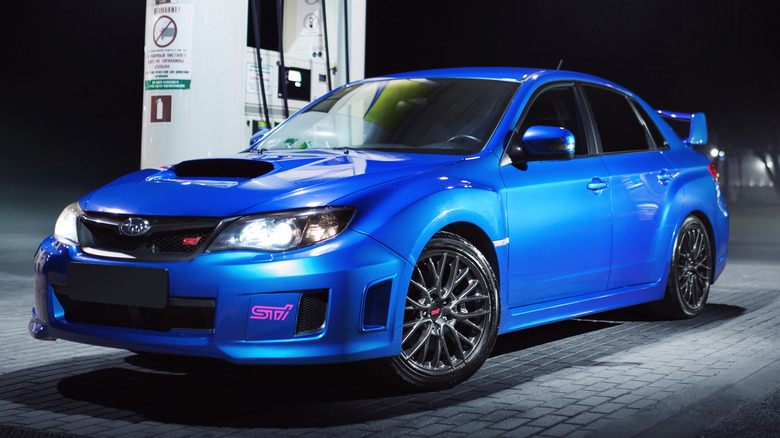
EJ engines are known for consuming oil. But very high oil consumption is a sign of piston ringland failure and left unattended can be one of a few causes of oil starvation. Mind you, the boxer design already leads to the greater potential of oil starvation, since oil can flow away from the engine's pickup tube during hard cornering. If the oil pump is sucking air rather than oil, your boxer power plant might suffer bearing damage. (Oil pump failures aren't exactly rare in EJs, either.) The advice on this pretty simple: Don't let your Subaru run dry of oil! And that means being vigilant about both head gasket failures and piston ring death.
No, we're not done yet. Because these engines have a timing belt rather than a timing chain. And you know what happens if a timing belt breaks on an interference engine, right? Ka-blam, basically. Timing belts synchronize the camshaft and crankshaft. And either a belt snap or a jump disturbs the delicate dance between pistons and valves, throwing them out of sequence. And we use the word dance here on purpose, because this is like the lead partner stepping on the toes of the person they're twirling around the room. In this case if the teeth on the timing and crank sprocket aren't aligned properly via that belt, the pistons will slam into the valves — and that's the end of your EJ. Subaru recommends swapping your timing belt every 105,000 miles, but given the sword of Damocles (or is it a noose?) this belt holds over owners, perhaps change that belt sooner.