

7 Oil Tankers Attacked In Strait Of Hormuz, As U.S. Official Admits Iran's Targeting Abilities Keep Improving

Depending on where you live, you may have seen fuel prices drop over the weekend, but that wasn't because Republicans are finally winning the senseless war they started with Iran. No, it's mostly because the governors of Georgia and Ohio suspended their states' gas taxes, while governors in other states have found short-term solutions for temporarily making diesel less expensive. Meanwhile, over in the Strait of Hormuz, the Wall Street Journal reports Iran has increased its attacks on oil tankers attempting to transit the strait, slowing oil exports yet again.
According to the WSJ, crude oil shipments had largely returned to prewar levels after a series of U.S. strikes took out Iran's radar and communications abilities along the strait. That lull in hostilities, combined with Gulf countries working overtime to find alternative routes that avoid the strait, briefly allowed oil exports to surge. But much like Georgia's suddenly lower gas prices, Iran losing its targeting capabilities was only temporary. Since September 28, UK Maritime Trade Operations data shows Iran has hit seven ships traveling through Hormuz, and it appears Iran struck an eighth ship on Sunday, as well. As the WSJ explained:
Iran's Islamic Revolutionary Guard Corps navy issued a warning to ships planning to use the U.S.-backed route through the strait on Saturday, saying that they would be targeted and destroyed. "Don't trust U.S. Navy and don't use south corridor at all and don't put your life in danger," a radio message transmitted on a public shipping channel and reviewed by The Wall Street Journal said.
The renewed attacks may already be taking a toll, with early signs that oil flows are beginning to slow, analysts say. Firm data comes with a lag, because many ships are operating without their transponders switched on to avoid becoming targets.
All seven vessels were attacked near the narrowest part of the Hormuz strait, according to UKMTO.
Iran's targeting is improving
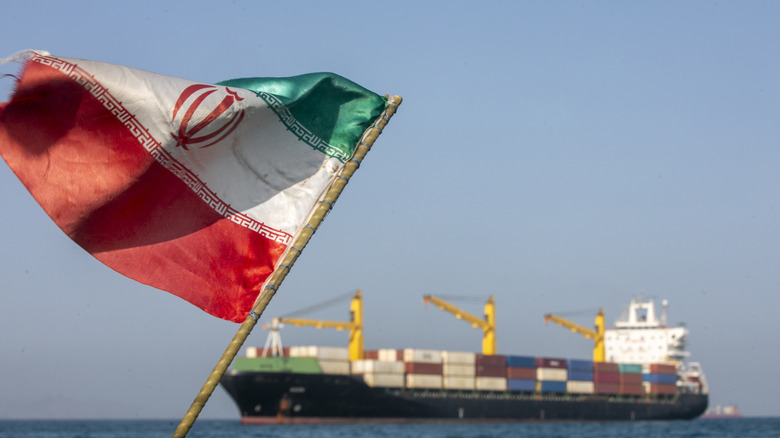
Ideally, the oppressive regime running Iran would be getting weaker as the war stretches past its seventh month, but according to one U.S. official the WSJ spoke with, that's not the case. Instead, they're reportedly getting better at targeting ships in the strait, undermining Republican claims that the U.S. controls the strait and threatening to send fuel prices even higher:
Iran's ability to target ships has also improved in recent weeks, adding to the risks in the strait, according to a U.S. official. The U.S. several weeks ago said it would strike Iranian oil tankers in response to Tehran's attacks, but it has since backed off that effort after Iran unleashed a wave of missiles at a U.S. air base in Jordan, the official said.
The new strikes expose the fragility of the recovery in oil flows and come as President Trump, who has claimed full U.S. control over Hormuz, weighs renewed military action against Iran.
At the moment, AAA reports the average gas price in the U.S. is still $4.37 a gallon, while the average gallon of diesel sits at $6.32. Brent Crude, meanwhile, is still trading at more than $100 a barrel, and if Iran continues to target tankers with increased precision, analysts say to expect Brent to stay over $100 through the rest of this year and on into 2028. "The step-up in attacks on ships highlights how the current equilibrium in the oil market is fragile and could easily be shattered," Capital Economics senior economist Hamad Hussain told the WSJ. "This would especially be the case if there is further escalation and energy infrastructure is targeted."
Putin continuing his invasion of Ukraine isn't helping with global oil prices, either, with ABC News reporting that Ukrainian counterattacks have knocked out half of Russia's refining capacity. Meanwhile, NBC News reports Yemen and Saudi Arabia still have their hands full with the Houthi rebels who took control of the Bab al-Mandeb Strait and recently struck an Aramco facility in Riyadh. Oh, and on top of that, Reuters reports China just suspended fuel exports. Fun!
Higher gas prices aren't going anywhere
According to another analyst the WSJ spoke with, the pullback in response to Iran's attacks is already starting. From the WSJ:
Rory Johnston, founder of oil research firm Commodity Context, said he has seen a potential pullback in recent days and estimates that flows are down by two million to three million barrels a day, though those initial totals could be revised higher as better information becomes available.
"The recent pace of flows, while impressive, has never been sustainable and has already come at great expense," Johnston said. Part of the surge may reflect exporters rushing barrels out before a feared new escalation, he said. Gulf oil producers are shelling out between $30 million and $40 million for a round trip shuttle run in and out of Hormuz—or $15 to $20 a barrel, according to shipbrokers, before insurance costs.
Even if the U.S. somehow wins a war it currently appears to be losing, don't expect higher gas prices to drop overnight, either. Speaking publicly for the first time since the war began at the end of Feburary, Reuters reports that Saudi Aramco CEO Amin Nasser told London's Energy Intelligence Forum, "Until Hormuz fully re-opens and confidence returns, the crude reality is that pressure at both ends of the barrel will intensify. Even then, replenishing inventories while meeting demand could take up to two years." Nasser also added, "The system is already straining."
So basically, expect gas to stay expensive as long as this war drags on and probably several years after it ends. We aren't to the point where it makes financial sense to sell a perfectly good car for something more efficient — if you drive 21,000 miles a year and average 20 mpg, $6 a gallon is only $525 a month — but if you have to replace your current car anyway, you may want to take a look at hybrids or EVs. Alternatively, just do what I did and buy a motorcycle from a chainsaw company. Trust me when I tell you expensive gas isn't so bad when you're averaging over 50 mpg.