

GM's 1969 XP 512E Concept Car Was A Tiny EV With A 58-Mile Range
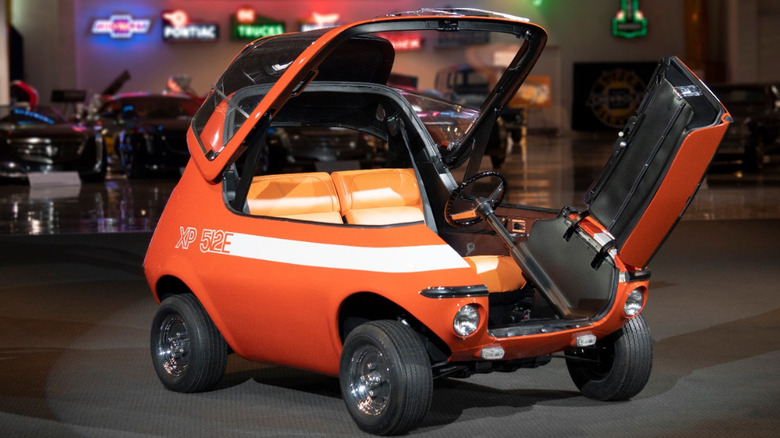
The GM EV1 gets a lot of attention as one of the industry's first modern electric vehicles. Produced in two batches — in 1997 and 1999 — the 1,117 sleek machines became almost as famous for being crushed into tiny cubes as for their electrical innovations. They weren't the General's first all-electric cars, though. That title goes to the 1969 XP 512E concept vehicle. (And we'll further point out that GM sold all-electric commercial trucks, although not passenger cars, from 1912 to 1916.)
As for the XP 512E, it was actually part of a family of small city-sized cars that GM had originally built for its 1969 Progress of Power exhibition. This press event attracted media from across the country to GM's Technical Center in Warren, Michigan, where they could check out some of the company's latest power train advances. A number of other projects were on display as well, including silver-zinc batteries, hydrogen fuel cells, turbines, wheel-hub motors, modernized steam engines, and even early catalytic converters. Remember, GM would go on to become the first automaker to develop a production-ready catalytic converter in 1975.
Some of the cars at the exhibit, like the XP 512E, were available for seat time, too. In fact, when Mechanix Illustrated's Tom McCahill took his turn at the wheel, he called the car "quite smooth" (per Hemmings). It also, however, was quite tiny, as was its driving range. The 512E is shorter in length than NBA star Victor Wembanyama is tall, and its maximum range was 58 miles. That was at only 25 mph, too. Pushed to its top speed of 30 mph, the car's range slipped to a bare 47 miles.
Delving into the XP 512E details
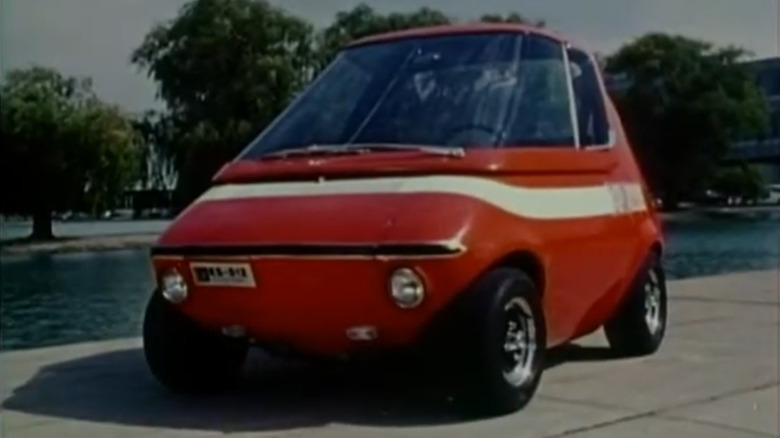
Officially known as the 512 Electric Experimental, the 512E was a tidy 86.3 inches long and 56 inches wide, and it rode on a wheelbase of 52 inches — a foot shorter and 3 inches narrower than a first-generation Smart Fortwo. It was also about 250 pounds lighter than the typical Fortwo, with the former tipping the scales at 1,250 pounds and the latter typically coming in at around 1,500. Helping GM keep the pounds down were the 512E's fiberglass body and an 84-volt lead-acid battery pack specifically engineered to save weight.
Just don't expect the same kind of acceleration as with today's EVs. It took the XP 512E roughly 12 seconds to reach its 30-mph top speed with its rear-mounted DC motor. Today, of course, we can quickly come up with a dozen EVs capable of reaching 60 mph in 3.5 seconds or less. On the other hand, the 512E was surprisingly competitive on the charging front. It took approximately 7 hours to charge the batteries from a 115-volt household outlet, and while the comparison isn't exactly apples to apples, it takes approximately 60 hours to fill up the 2027 Toyota bZ using a Level 1 charger.
Nor was the XP 512E loaded down with fancy equipment. The single bench seat was complemented by a heater/defroster, an ashtray, and not much else. The high point might have been the car's unique canopy that tilted backward — and worked with a lower front door that opened BMW Isetta-style — to let folks in and out. The canopy created a drop-top driving experience, too, since you could travel with it opened.
What were the other 1969 XP 512 cars?
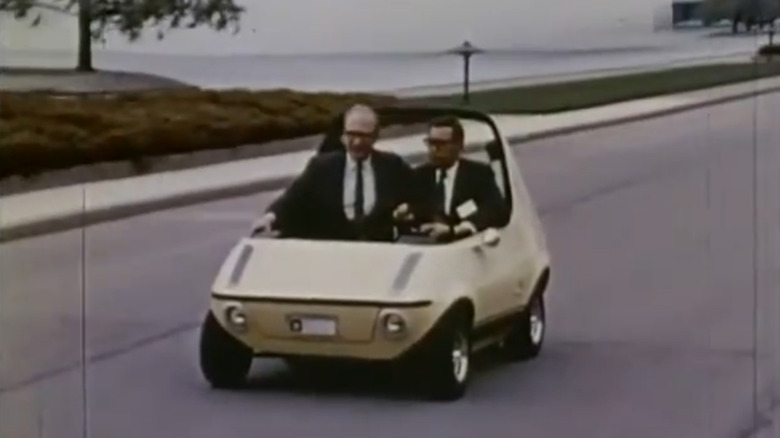
As we mentioned, the XP 512 was one of a group of cars on display at GM's Progress of Power event, and among them were two other concepts wearing the XP 512 designation — led by the General's first-ever plug-in hybrid. Checking the calendar, the 1969 XP 512H premiered more than 40 years before the Chevrolet Volt, which is considered the world's first commercially available PHEV. That's a big deal even though it's now looking like PHEVs may not be the small first steps toward full electric vehicles after all.
There seems to be a lot less info about the 512H than the XP 512, but the basics seem pretty clear. The car featured a 200-cc gasoline engine and a DC electric motor that drew juice from a 72-volt lead-acid battery setup. What's especially interesting here is that the engine could both help drive the wheels and, at the same time, help generate electricity for the battery pack. It operated on electricity alone up to 10 mph, after which the gas engine kicked in for additional motivation. Like the 512E, the plug-in hybrid also could be charged via a standard household outlet. Backed by that hardware, the car had an all-electric range of more than five miles when traveling at 30 mph, and it could cover 150 miles, with a top speed of 35 mpg, while sipping just three gallons of gasoline.
The final XP 512 concept, the 512G, was a gas-only model that packed a 19-cubic-inch two-cylinder mill that kicked out 12 horsepower. Yes, the 512G took 18 seconds to hit 30 mph, and it topped out at 45 mph, but it squeezed 280 miles of range from a 4-gallon fuel tank — that's 70 mpg.