

13,000-Mile 1990 Chevrolet Camaro IROC-Z For Sale With A 5.7 V8 Is Pure Nostalgia Fuel
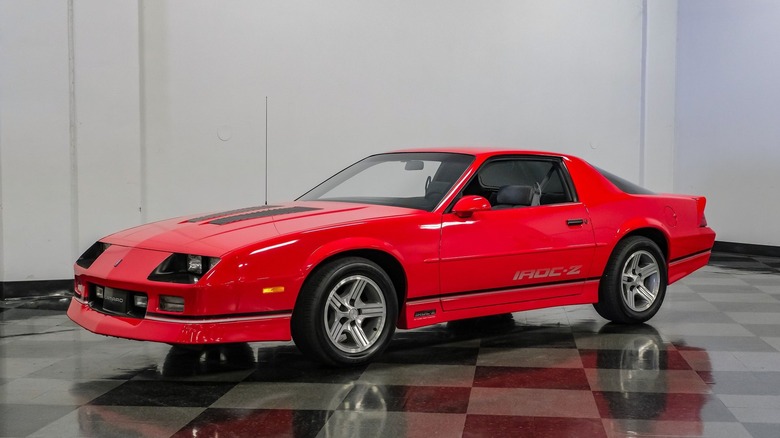
Reagan was president, greed was good, and pants looked like they were made from parachutes way back in the 1980s. But that was also the same decade that the Chevy Camaro IROC-Z became an absolute icon. Inspired by the International Race of Champions, the IROC-Z was at the top of the Camaro food chain from 1985 to 1990 — although its inability to outrun the Mustang GT must have been hard to swallow.
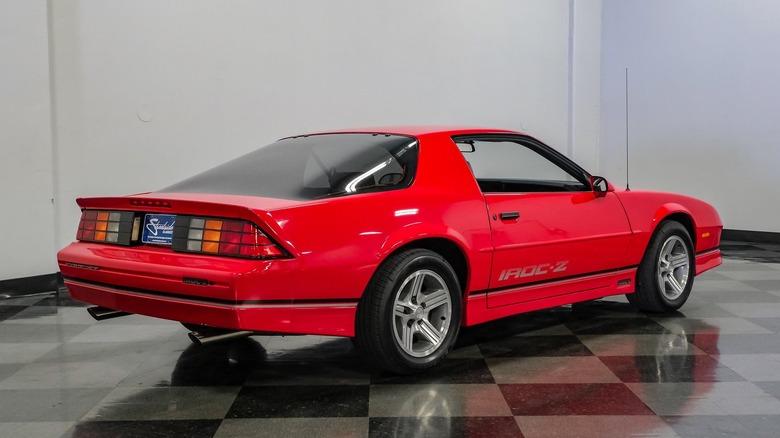
Still, those with a hunger for a remarkable Radwood-era muscle car may want to visit Streetside Classics in the near future. The site currently has a 1990 Camaro IROC-Z for sale that's ready for the open road with your favorite 1980s synth band on the soundtrack.
The Bright Red beast — complete with classic 1980s-style IROC-Z graphics — features a fuel-injected 5.7-liter/350-ci L98 V8 under the hood with 245 horsepower on tap. Unfortunately, that output is routed through a 4-speed automatic transmission. The Medium Dark Gray cabin is fairly well-stocked for its time. Highlights include air conditioning, cloth upholstery, a tilt-adjustable steering wheel, AM/FM/cassette stereo, power steering, power brakes, power windows/locks, and power mirrors. It has only 13,166 believed-to-be-original miles on the odometer. You can drive it home for $58,995, too, which is pretty close to its Hemmings-sourced value of about $55,000 on the high end — before a 10% to 20% premium for the 350 V8. Yet for some context, a similar car with 14,000 miles on the clock sold at Bring a Trailer for $28,500 in 2025.
When did Chevy build the first IROC Camaro for production?
Noted motorsports cheater Roger Penske helped launch the International Race of Champions in 1973. The idea was to settle the question of who was the world's best driver, and the method was to invite top racers from multiple motorsports disciplines to compete in identically prepared cars. Porsche Carrera RSRs were used the first year, but it cost too much to keep them on the track. Of course, Porsche is still known today for having among the highest 5-year maintenance costs in the industry.
The solution was to switch to the Chevrolet Camaro, and the 1974 racing versions were kept somewhat close to stock. Sure, their cabins were reconfigured for motorsports, with racing seats, roll cages, racing gauges, fire-safety equipment, and not much else. But track-ready models did wear the same steel bodywork and rode on the same basic suspension configuration. Chevy, however, didn't offer a production tie-in model.
Nor did that happen in 1976, when Penske & Co. turned to Banjo Matthews, a legendary NASCAR builder, to create a new batch of IROC Camaro race cars with tube-frame chassis and fiberglass body panels. The series went on hiatus from 1980 to 1983, and when it returned in 1984, the IROC Camaros were — except for their exteriors — practically identical to NASCAR Winston Cup stock cars.
The difference was that Chevrolet was finally able to license the rights to the "IROC" name from the racing organization. As a result, a decade after the Camaro became the star car of the series, Chevy could sell an actual IROC-branded Camaro — during the same production run as the 1990 model waiting for you at Streetside Classics.