

7 Of The Worst Cars That Lived Behind The Iron Curtain
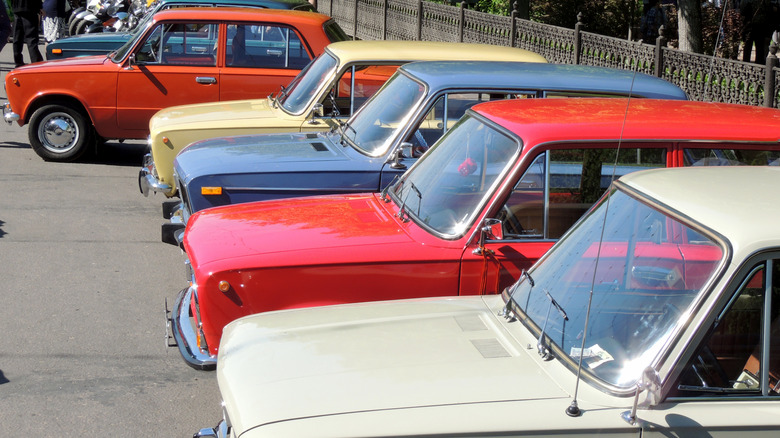
It wasn't a simple thing to buy a car behind the Iron Curtain. In the Soviet Union, you'd pay the money, put your name on a waiting list, and then wait seven or eight years. You might expect to get one heck of a car for that long of a wait. Not so, Comrade. Vehicles manufactured in the Eastern Communist Bloc were often underpowered, unreliable, and, in some cases, smelled bad.
When we say these cars were often underpowered, we don't mean by a little bit. The Zaporozhets ZAZ-968, for example, could only produce 40 horsepower, and the hp ratings for most of the cars on our list were in the double-digits. That meant these cars were typically slow, like the FSO Syrena, which had a top speed of only 61 miles per hour. Eastern Bloc vehicles were often based on older designs from other countries, putting them behind in automotive technology. These cars, like the Lada Riva, were stripped down to the bare bones from older designs before being sold to the public. Some vehicles, like the UAZ-452, turned out to be very useful, in spite of their spartan designs.
And then there are the particularly funky entries, like the Czech Velorex, which was basically a motorcycle sidecar sans motorcycle. Another example was the East German Melkus RS 1000, which tried so hard to be a sports car, but fell far short in performance.
Zaporozhets ZAZ-968
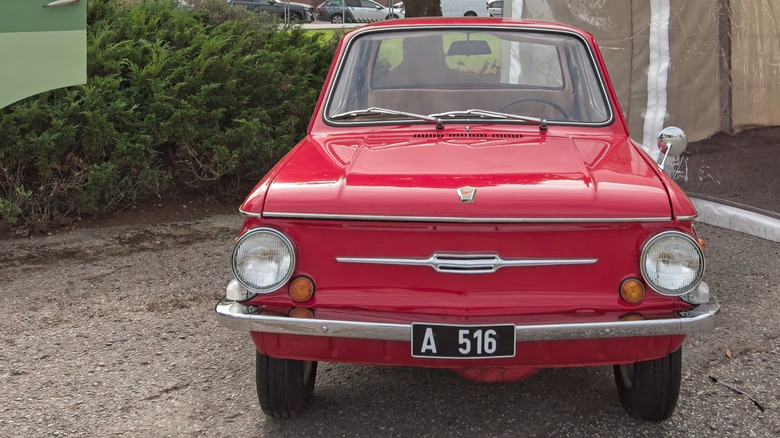
The Soviet Zaporozhets ZAZ-968 was a funky-looking, boxy little car. Even the front looked different from other cars of the time, since it had no grille. Nowadays, a car without a front grille is likely an EV, but this was 1971. A front grille was entirely unnecessary on the ZAZ-968, since its engine was mounted in the rear. But there wasn't much of a rear grille either, nor was there a radiator. Cooling of the engine depended on airflow through an air scoop on each side of the car. This worked about as well as you'd expect, as overheating was a known problem. Oddly enough, the engine would get hotter at higher speeds, though that's presumably when there was greater airflow. And it was necessary for the driver to regularly clean the cylinder cooling fins. It didn't help that kids would often stuff foreign objects into the large air scoops.
The engine itself was pretty small, a 1.2-liter V4 that cranked out a meager 40 hp. Its top speed was rated at around 75 mph, and it had a cruising speed of around 56 mph. The front suspension was known to wear out to the point that well-used Zaporozhets could be identified by how far the front tires had spread out. And then there was the front-mounted gasoline heater, which kept the cabin warm, when it worked. Keeping it working was a challenge, requiring the owner to tap the housing with a mallet and to blow out the soot.
FSO Syrena
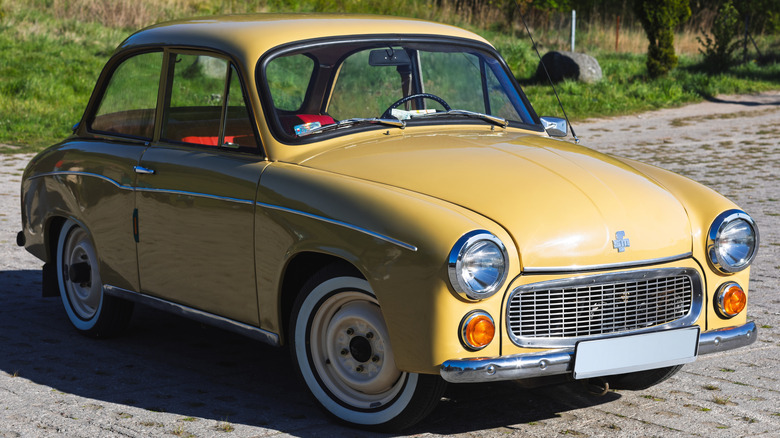
By the late 1950s, Poland already had a domestically produced car, the Warszawa. But the Polish government felt that wasn't enough, and so it commissioned another one. Thus, the FSO Syrena came into existence. To accomplish this, FSO decided to copy designs from a German automaker. If you're going to crib another automaker's notes, borrowing from German engineering would be a good choice, right? Except the design concepts they used were from DKW models built in the 1930s. By the time the first Syrena rolled out the factory doors in 1957, its design was 20 years obsolete.
This automobile's specs were less than impressive, even for the late 1950s. It featured a body-on-frame design and was powered by a three-cylinder, two-stroke engine. As odd as cars with two-stroke engines seem today, GM would like to bring them back. It had drum brakes on all four wheels and link-based front suspension with a transverse spring, along with a transverse spring in the rear, which had a rigid axle. It had a top speed of 61 miles per hour.
Evidently, one of the most prominent characteristics of this automobile was its smell, which you can't say about most car models. The Syrena ran on a mixture of gas and oil, which came out of the exhaust with a pretty bad odor. It was so bad that the Syrena came to be known by its nickname, the "Sock." It was produced all the way until 1983, never quite escaping obsolescence.
FSO Polonez
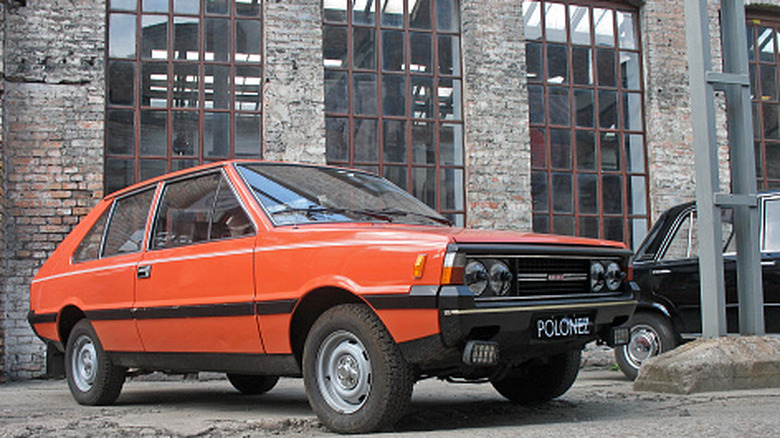
In 1968, FSO licensed the right to produce the Fiat 125 in Poland. FSO's version of the Italian car was called the Polski Fiat 125P. The 125P was very much like the 125, except it used running gear from an older model, the 1500. Fast forward a decade to 1978, and FSO decided to make its own branded version of the Fiat 125P, by putting one of those newfangled hatchback bodies on top of it. The FSO Polonez looked modern but, much like a Boomer dressed in Gen Z clothes, wasn't all that convincing when it came time to move. It had a contemporary look on top of older technology. When the U.K. magazine Autocar compared it to the likes of the Ford Escort, Chrysler Sunbeam, and Morris Marina in 1979, it said that the Polonez was 20 years behind.
That review by Autocar was hysterically brutal. It noted that the Polonez was even slower than the 125P, taking 4.2 seconds just to get to 30 mph and 39.1 seconds to get to 80 mph. The review panned everything from knee room and headroom to how the windshield wipers performed, and even complained about the car's "rubber and plastic" smell. At one point, the author attempted to say something nice, acknowledging that the designers "tried hard" and had some "good ideas," praising the "heavy and practical bumpers," but also noted they were "clumsy to look at." If you're interested, you can pick up a restored Polonez pickup for just $13,500.
Velorex
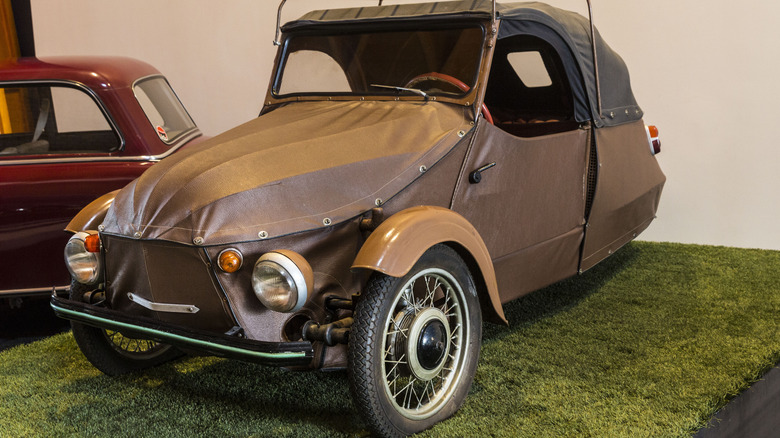
Have you ever looked at a motorcycle and its sidecar and thought, "This setup would be a lot better without the motorcycle?" That's apparently what two brothers in Czechoslovakia thought back in 1942. They used motorcycle sidecar construction techniques to build what would later be known as the Velorex. It was a tiny three-wheeled vehicle, with two wheels in front and one in the rear, seating one person with the motor beside them. Then they decided what this motorized sidecar needed was to be wrapped entirely in leather-like vinyl on the outside. The brothers, František and Mojmír Stránský, had built ten of them by 1950, when the Czech government reviewed this odd contraption and thought it seemed like a good idea. The Velorex was thenceforth manufactured in earnest.
This little car had an air-cooled, parallel-twin cylinder, two-stroke, 16-hp, 344cc motorcycle engine. In its defense, other cars have been made with motorcycle engines. Its top speed was a blistering 53 mph. It was produced all the way up to 1974, with around 16,000 produced in total.
As weird as this thing was, the intentions behind it were good. It was meant to be sort of a souped-up wheelchair, and the government would make it available to the disabled only after a stringent medical exam. According to the Czech Ministry of Culture, the ad slogan was, "Physically disabled to a happy future!" A nice sentiment, though we think maybe something is lost in the translation.
Lada Riva 2107
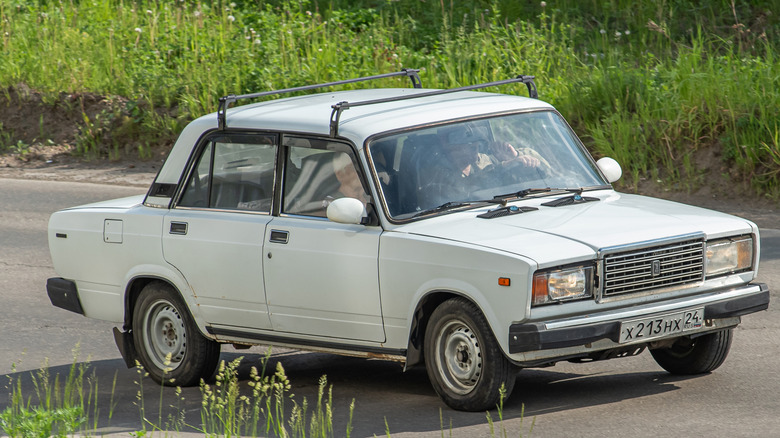
Jeremy Clarkson of Top Gear once called the Lada 2107, also sold as the "Riva" or "Nova," the "worst car in the world." That may seem a bit hyperbolic, even from someone who has driven as many cars as Clarkson has. But the Riva was notorious for breaking down. According to ABC News, there's an old joke that goes: "What's the difference between a Lada and a golf ball? You can drive a golf ball 200 yards." Apparently, the car was easy to work on, which is an aspect of these Eastern Bloc cars we keep coming across. If you're going to make a car that keeps breaking down, ease of repair is a good thing, we guess.
The Riva launched in 1980 and was based on the 1960s Fiat 124 platform. The Fiat 124 wasn't quite ready for the Soviet people, as it had far too many extravagant Western features. So, the disc brakes were swapped out for drum brakes, and there was no radio or air conditioning. The manufacturer also added a manual fuel pump and starting crank. The last version of it had a 1.7-liter, four-cylinder engine that had a top speed of 90 mph. It could crank out 73 hp and go from 0 to 60 mph in only 17 seconds. It was produced from 1980 to 2012, when sales dropped considerably, but changed very little in that time. Top Gear, in its typical snark, explained, "the manufacturer blames consumers turning to considerably less rubbish cars for the downturn."
UAZ-452
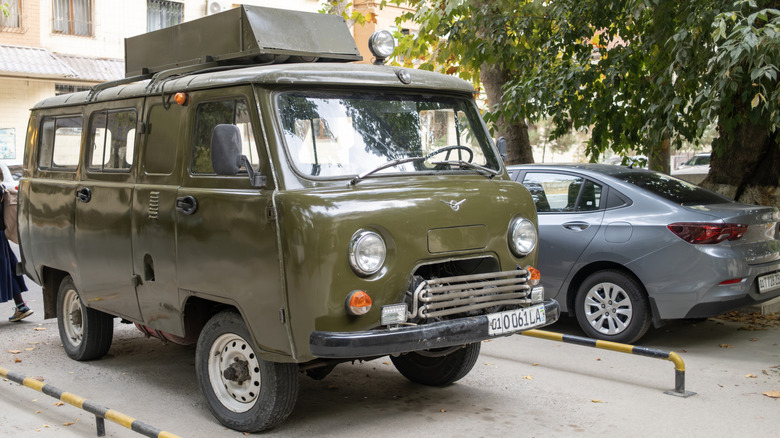
It's the post-war era, and the Soviet Union needs a vehicle to transport people and goods across its vast area and handle all kinds of conditions, including the rugged mountainous terrain of the Urals and the Arctic weather in Siberia. It needs a van that can do it all, or at least some of it. That's how the UAZ-452, developed from the UAZ-450, came to be in 1966. It was loud, it was hot, and it had an appearance so uninspiring that it came to be known by its popular nickname, the "Bukhanka," or "loaf," as in "loaf of bread."
Sure, it was ugly, but it got the job done. The four-wheel drive, which needed both hands to operate, could handle rough terrain and harsh northern Russian winters with ease. And, like the Lada Riva, it did it all while being free of shameless capitalist excesses, like air conditioning or shock absorbers. That's right, it had no shock absorbers, so we probably wouldn't ride it over bumps too fast. Speaking of driving fast, you weren't going to burn up the track in this thing, as it maxed out at 112 horsepower.
Believe it or not, this van has been fairly popular in Russia, proving useful as a remote ambulance, a military supply vehicle, and a mountain taxi, among other things. It even has an international fanbase among off-roaders. UAZ still builds it today, with few changes from the 1966 model.
Melkus RS 1000
Have you ever bitten into what you thought was a chocolate chip cookie only to find out it was actually oatmeal raisin? Life plays some cruel jokes on us sometimes. We imagine that's the way someone might have felt the first time they sat behind the wheel of the Melkus RS 1000.
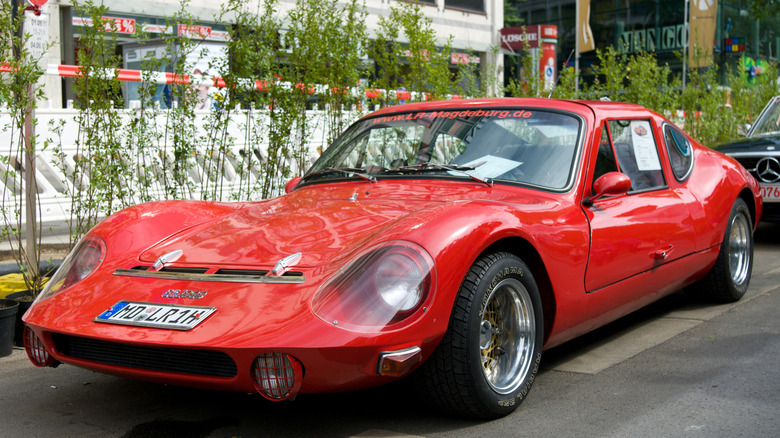
Truth be told, this was one sharp-looking car. The makers of this East German sports car marketed it as the "Ferrari of the East," and it certainly looked the part. It featured gull-wing doors that swung up instead of to the side, and its fiberglass body had that swoopy shape sports cars of the era typically had. The fenders curved up and over the tires, pointing down toward the front. It looked like an honest-to-God racecar. And no wonder, since it was developed by racecar driver Heinz Melkus in the 1960s, during the height of the Cold War.
The performance of this sports car is where the cruel joke comes in. It had a 1-liter, two-stroke, three-cylinder engine that cranked out just 68 horses. Its top speed came in at 102 miles per hour. To be fair, those specs were pretty impressive for a car coming out of the Eastern Bloc at the time. But it's awfully meager for a car that wanted to be known as the "Ferrari of the East." Only 101 RS 1000s were built between 1969 and 1979. A successor to the RS 1000, the RS 2000, was unveiled in 2009. It unfortunately didn't sell well, and Melkus filed for bankruptcy in 2012.