

7 Budget Drones That Are Aimed At Beginners
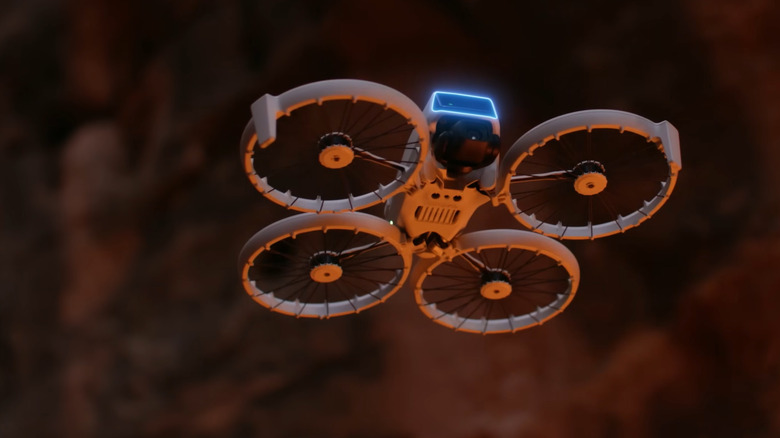
Drones are no longer super-pricey pieces of equipment reserved for professionals. In fact, it is possible to pick up a variety of models for less than $50 from popular outlets such as Walmart or Amazon. However, a cheap drone doesn't necessarily equate to a good value for the money, but not everyone has a bottomless wallet to just head out and buy the best of the best.
So, we have composed this list of seven drones, all available for less than $500 — some considerably cheaper — to highlight the very best out there at the more affordable end of things. Among them sits a number of DJI models, such as the Neo and Flip, in addition to an FPV drone from BetaFPV, and comprehensive kits, too, such as the Holy Stone HS900. To ensure keen beginners don't go and blow their hard-earned cash on toys that simply can't deliver the expected experience, every drone featured here — apart from the single FPV (first-person-view) drone — boasts 1080p camera quality, GPS stabilization for stable hovering, and reliable return-to-home functionality, plus a suitable spares supply and a weight below 250 grams.
That last point is key, as drones south of 250 grams side step the otherwise mandatory FAA registration for recreational users. While larger drones that require such registration may be more technically advanced in many ways, it's the beginner end of the market we have in our sights here, so there is no need to venture into such machinery. Entries have been ranked by price, starting off with the cheapest and ending with the most expensive, and therefore, presumably, the best.
The DJI Neo is a great choice for beginners on a budget
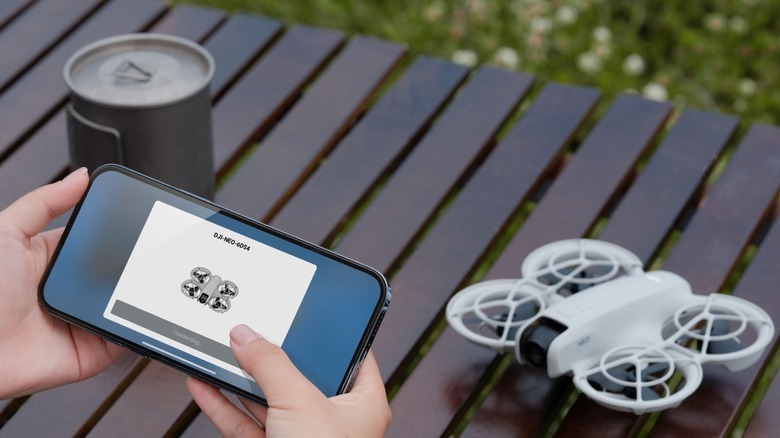
DJI is a big name in the world of drones and action cameras, and the great news is that it produces a whole host of affordable camera drones that are readily available for below $500. It's worth noting that, while the FCC has banned the sale of new foreign drones in the U.S., existing models can still be sold. The first to appear on our list here today is the DJI Neo, which can be snagged on DJI's official Amazon store from as little as $169 right now, while it's regular non-sale price is $199.
That's a super accessible price point, so it definitely delivers on the beginner aspect there, and with it weighing only 135 grams, it's well under the 250-gram limit we've imposed on this piece. The good news keeps on coming when investigating the Neo's footage-capturing capabilities, as it sports a 12-megapixel camera and is capable of recording 4K video at 30 fps or in 1080p at up to 60 fps — no excuses for shoddy videos here, then. It also packs the all-important GPS positioning feature, alongside stabilization modes within the camera, too, such as Rocksteady and HorizonBalancing.
Shortcomings arrive in the way of limited fps settings, such as 4K being stuck at 30 fps, plus there is no choice for speeds south of 30 or indeed north of 60, which can be frustrating for those wanting to capture either cinematic or slow-motion footage. Also, the camera has no built-in mic, so silent footage is all it will capture. What's more, hovering can be tricky to keep stable if the wind picks up even a little, plus controlling the drone via a phone does limit its performance capabilities somewhat.
The BetaFPV Cetus Pro kit is a cost-conscious entry point into FPV drones
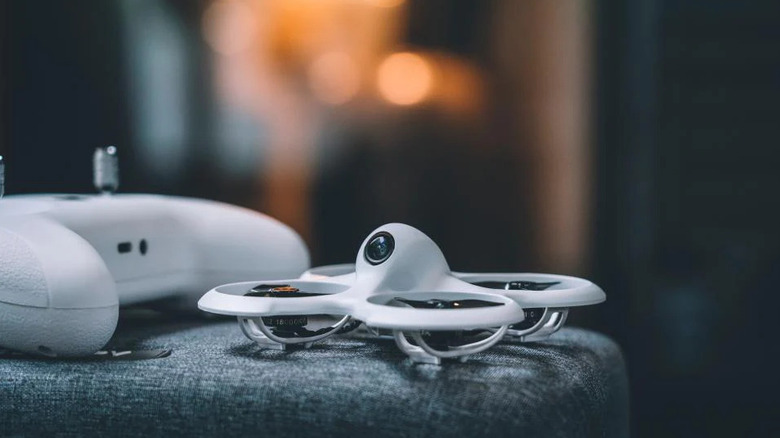
Here's the odd one out in the list, as rather than being a camera drone, the BetaFPV is just that, an FPV drone. The initialism stands for first-person-view, and users wear goggles that link to a camera on the drone to control it, rather than physically watching it from beneath.
The BetaFPV Cetus Pro kit includes not just the drone, but everything needed to be fully set up. Alongside the drone itself, buyers receive a transmitter, goggles, battery and charging tools, blade and prop accessories, plus a bag and screwdriver. So, $189.99 — its current discounted price — is the cost BetaFPV offers for the full works, not just the drone. That means there is no need to worry about spending extra on a heap of must-have accessories. The normal price is $229.99. While it's currently out of stock with the manufacturer itself, you can find it elsewhere online for its regular price.
Those in the industry do suggest that FPV drones are best experienced in a simulator first. However, the Cetus Pro kit is advertised as suitable for beginners, so a lack of simulator access shouldn't rule this purchase out for those interested in FPV drones. It sports powerful brushless motors, and with a ready-to-fly weight of just 45.8 grams, users can be safe in the knowledge that they are well below FAA regulation limits.
The Potensic Atom 2 is a more complete package than cheaper offerings
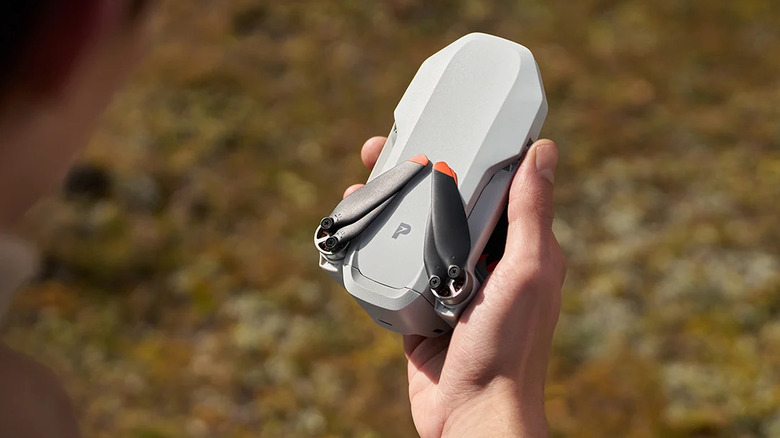
Jumping up a rung on the pricing ladder, and going back to camera drones, too, we come across the Potensic Atom 2. It is available directly from the manufacturer at $299. So, while it isn't as cheap as the aforementioned DJI Neo, it's certainly far removed from the world of more advanced drones, which can happily command thousands.
That jump up in price over the Neo is easily justified, and a quick review of the Atom 2's spec sheet explains why. While the Neo sports a single-axis gimbal for stabilization, the Atom 2 enjoys a three-axis setup, plus its camera boasts 48 megapixels, compared to the Neo's 12. It can take 8K photographs, and its maximum flight time of 32 minutes is almost double that of the Neo's.
Slotting in just under our weight limit at 249 grams, the Atom 2 is a chunk heavier than the Neo and also larger. That's not necessarily a bad thing — at least it should be easier to spot from a distance. In terms of features, the Atom 2 sports most of what a beginner may need or want, including GPS, plus both app and remote control settings, although there is no display on the drone itself, unlike the Neo. Accessories can run up the cost but also add value, with propeller guards selling for $14.99, an upgraded RC PRD 1 controller coming in at $120, and the option to expand from a single to a triple battery kit for $100. Tick all the options, and the complete kit will set buyers back $534.99.
DJI's Flip is packed with features yet also incredibly user-friendly
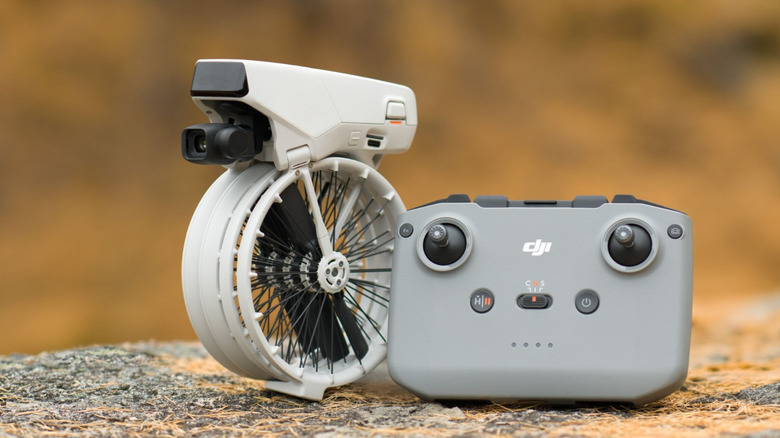
Our next offering also comes from the industry juggernaut DJI, which will actually no longer stop you from flying your drone over airports or the White House, due to Remote ID rules, and this time it's the Flip. It's a more expensive option that can be purchased directly from the manufacturer for $439, although it is possible to find it from alternative outlets from around $349 and up.
This is a perfectly well-rounded camera drone, bringing with it virtually every feature a beginner may need in order to both have fun with a reasonably affordable drone and capture top-quality footage at the same time. Backing up those claims is a 1/1.3-inch image sensor, perfect for taking snaps in low light, 4K/60 fps HDR video capturing capability, subject-tracking – ideal for keeping users in frame when filming — and a 48-megapixel camera for crystal clear photos.
The DJI Flip sports all the essentials that a beginner-friendly camera drone must have. That includes a sub-250-gram weight, return-to-home and obstacle avoidance functions, and a moderately affordable price point — but it also sports a bunch more unique features that ensure it's even better suited to beginners. For example, it supports palm takeoff without an external controller, there are full-coverage propeller guards included within the basic design, and automatic braking capabilities help prevent crashes. All of these features work together to ensure that this isn't an intimidating drone for those just starting out.
Holy Stone HS900 Pro is a comprehensive packaged equipped with a Sony camera
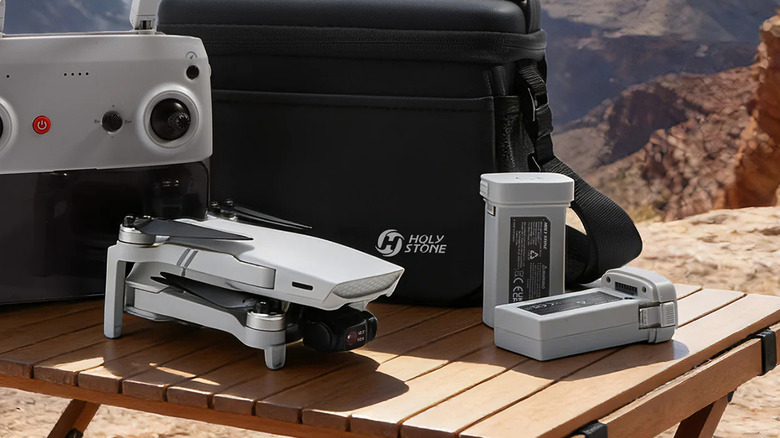
Holy Stone is another drone manufacturer keen to point out that DJI isn't the only way to go in the market, sort of like how you can buy other full-size trucks, even though Ford's F-Series has been on top for almost half a century now. The HS900 Pro is a comprehensive package priced at $389.99 which includes a bunch of genuinely impressive features, such as a Sony camera, capable of both 48-megapixel photos and 4K/30 fps videos, plus a three-axis gimbal for smooth and steady footage. It also offers GPS and dual batteries, which provide up to 60 minutes of flight time.
There are also a bunch of creative filming modes built into the camera. So, users can quickly switch between Time-Lapse, Dolly Zoom, "Inception" Spin-Style Zoom modes, and more to create adventurous footage without having to dive through hundreds of menus.
Holy Stone does note that the HS900 Pro is perfect both for beginners and those with experience looking for something more advanced. However, it is worth noting that, while it boasts the key must-have features like a lightweight design and the aforementioned GPS, it isn't advertised or shown with propeller guards, and it doesn't offer obstacle avoidance or palm take-off capability, which the Flip boasts as standard.
The DJI Mini 3 is creator friendly and won't break the bank
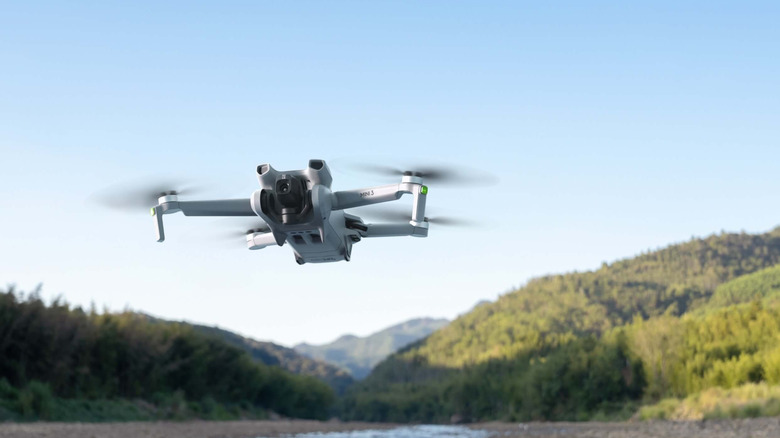
DJI's Mini 3 is the final camera drone from the brand to feature on this list and also the second most expensive overall, shown on the manufacturer's official Amazon page with a price of $418. As mentioned toward the top of this piece, DJI can only sell existing drones in the U.S. and not new models, which may explain why finding a store with the Mini 3 in stock is quite difficult.
For those fortunate enough to find a new one in stock, or to settle on a used example, the DJI Mini 3 makes for an excellent entry-level drone. It's also packed full of features and easy to use. It sports many of the same pros as the Flip, such as the 1/1.3-inch image sensor and a feather-light weight, but it also benefits from more advanced unidirectional obstacle avoidance, plus a longer maximum flight time at 51 minutes.
One interesting benefit of the Mini 3 is its ability to rotate the camera 90 degrees, allowing it to shoot vertical footage, as well as horizontal. For cross shoppers, the Flip does boast a vertical 9:16 mode, but it's formed by cropping the 4:3 mode, which reduces the quality from 4K to 2.7K. So, for any beginners looking to film really sharp material in vertical mode, most likely for social media content, the Mini 3 is an interesting option.
Potensic's Atom 3 provides users with room to grow
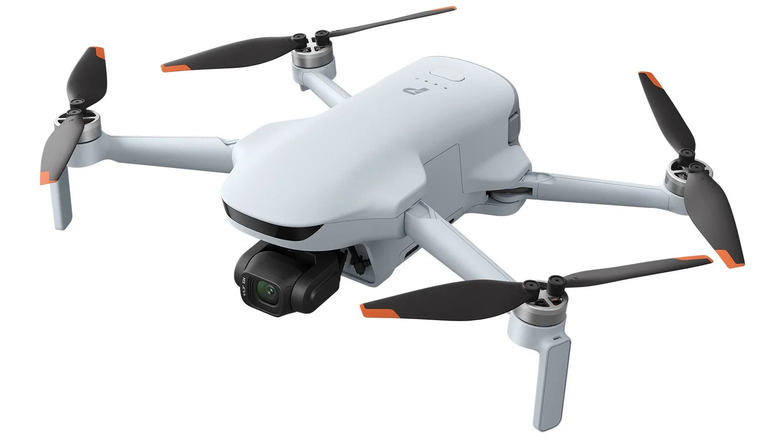
Creators may be surprised at just how impressive the footage from a budget-oriented drone like the Potensic Atom 3 ($429.99) can be. Perhaps the most obvious comparison to make here would be with the Atom 2 that we covered above, which starts $130 cheaper.
Justifying that jump in price are some fantastic features on the Atom 3: namely, a DJI-matching 1/1.3-inch image sensor, versus the ½-inch sensor on the 2. In addition, Potensic's latest release also features the brand's log profile, dubbed P-Log, plus the Atom 3 is compatible with ND (neutral density) filters. Essentially, ND filters allow users to operate with a lower shutter speed, without overexposing the image. Without an ND filter, it's far easier to lose highlights in an image when using low shutter speeds, and it's possible to damage the camera's sensor, too, so it's a real plus to find the Atom 3's camera is filter compatible. As for P-Log, it allows more information to be captured with the camera, providing more scope when it comes to color grading during the edit.
It goes without saying at this point that the Atom 3 also packs the key features beginners need the most, including the sub-250-gram weight and GPS tech. It may seem unnecessary for a beginner to splash out and buy a drone equipped with such impressive camera features, but that's what makes the Atom 3 a compelling long-term purchase. There is so much room for users to learn and improve with a drone of this level, rather than having to upgrade after hitting the creativity limits of a cheaper model with fewer features.