

The New Edge Ford Mustang Mach 1 Had A Shaker Hood, More Cars Should Have Shaker Hoods
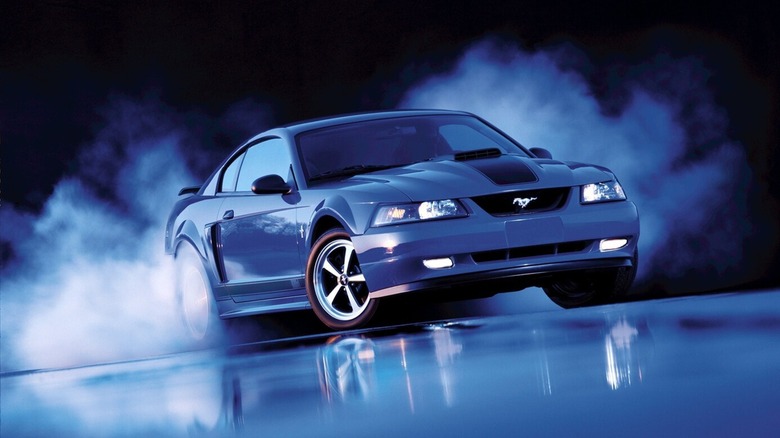
One of the primary defining characteristics of a muscle car is that it should have some visceral crudeness. While you may not require a reminder that there's a big honking American-made V8 under the hood pumping out gobs of horsepower, the car is going to provide a few clues anyway. Proper American muscle requires displays of ostentatiousness on par with the showiest of peacocks. The best are emblazoned with bright paint, graphics packages, or numbers designed to display how much power is under the skin. The showiest of showy, in my opinion, had "shaker" hood scoops. What better way to show off how much engine is under the hood than by cutting a hole in the hood and shoving some of that engine up into the sunlight?
I have always been a Mustang apologist, with my father having had a few cool 'Stangs over the years. It was his 2003 Mustang Mach 1, however, that really blew me away. Many Mustang fanatics won't even carry water for the 1999-2004 "new edge" era of the car's history, but I'm all the way onboard.
After a few years in the doldrums of 1990s performance fallout, the new edge Mustang was the one that really got its groove back. The stock Mustang GT was only capable of a paltry 260 horsepower, sure, but the SVT Cobra got a supercharged lump good for 390 ponies, and the Mach 1 pushed its naturally aspirated V8 output into the 300s once more (305, to be exact). And part of the reason it could do that was its totally awesome shaker hood scoop. Come on, you can't deny it looks awesome.
Why the Mach 1 had a shaker hood
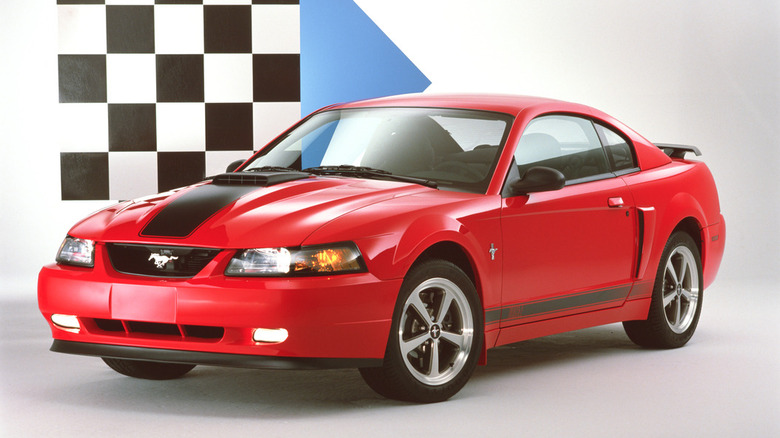
Introduced in 2003 as a limited-run special edition, the Mustang Mach 1 was initially planned for just 6,500 cars. Then Ford extended its run through the end of New Edge production in 2004, celebrating the Mustang's 40th anniversary, with another limited run of 5,000. In addition to the shaker hood and 305-horsepower V8, the Mach 1 featured lower rocker covers and a deeper air dam, and a black Mach 1 stripe to visually distinguish it from a standard GT, as well as retro 17-inch "Magnum 500" wheels. Inside, the seats were crafted from throwback "comfort weave" leather, and were imbued with greater lateral support, while the pedals were crafted from polished aluminum, and the gauge cluster was given a throwback look.
The Mach 1 also got better suspension with half-inch-lowered springs, re-valved Tokico shocks, unique front and rear sway bars, and factory subframe connectors to stiffen the chassis.
From an enthusiast perspective, that extra 45 horsepower was a godsend. To get to a number that started with a three, Ford engineers had to completely re-engineer the 4.6-liter modular motor under the Mustang's hood. The engine had four specially built camshafts, a forged crankshaft, a modified upper intake tract to let the shaker hood work, and more performance-oriented exhaust manifolds. Even the positive crankcase ventilation system was fiddled with to get the new engine working right. And of course, the ram air intake was shoved up through the hood.
By placing the scoop up into the flow of air, the engine naturally ingests more air as the vehicle's speed increases. Think of ram air like a really low-pressure forced-induction system.
The history of shaker hoods
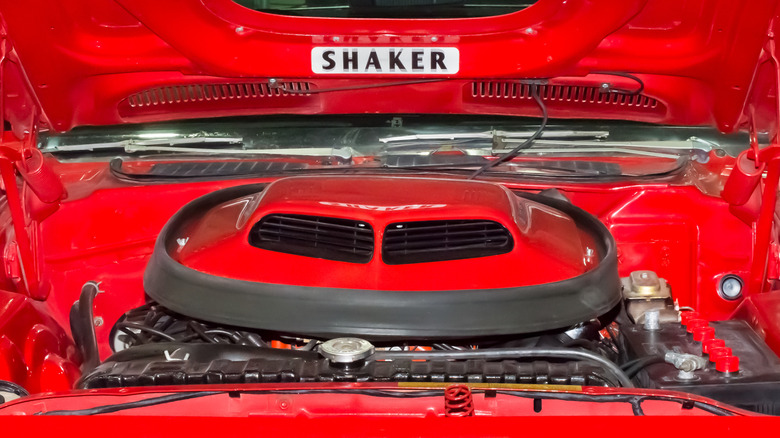
The point of a shaker hood and scoop system is ostensibly to introduce cool, oxygen-dense fresh air into the engine. Most engines breathe in air from under the hood, typically heated by the operation of the engine, leading to less efficient combustion burn. With both the cold-intake air effect and a pressurized ram-air effect, the shaker scoop doesn't act in a demonstrably different manner to any other hood scoop. It does, however, dance around with the vibrations of the engine, and that's just plain fun. Stab the gas pedal and you'll see the scoop move around. It's just plain something you can't get from a cowl induction hood.
First introduced in the late 1960s, the shaker quickly became a staple of ultra-high-performance muscle cars. Ford was the first to offer a factory shaker with the 1969 Mustang 428 Super Cobra Jet "R-code" engine. The R-code was mechanically identical to the Q-code 428 SCJ, and both were rated at 335 horsepower. A shaker hood isn't likely going to make any additional power over a static hood scoop, so long as both are appropriately sealed to the intake tract.
The popularity of the R-code Super Cobra Jet led Ford to offer the shaker hood on multiple Mustang models (including the Mach 1) in 1969 and the Torino in 1970. For unknown reasons, Ford dropped the shaker from all cars from 1971 onward until the 2003 Mach 1 brought it back. The vibrating hood protuberance exploded across Detroit with Mopar brands putting it on all of their sporty offerings, and Pontiac pumping out shaker-induction Trans Ams for half a decade. Pontiac kept the shaker party going through the 1977 Can Am special edition Le Mans.