

This Is The Heavy Construction Equipment Required To Build A Modern Highway
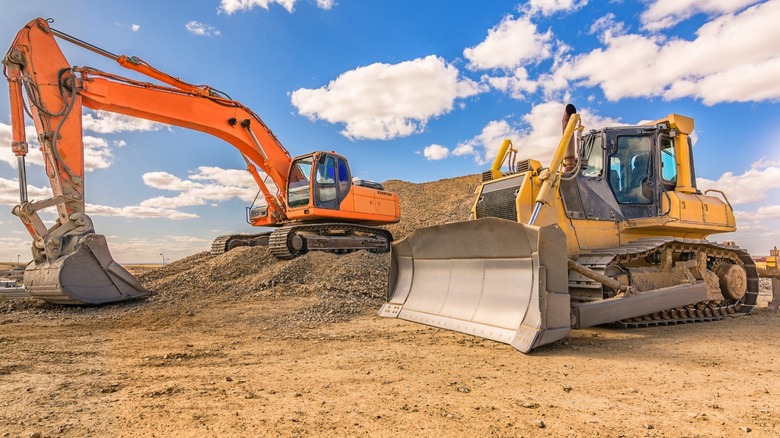
Building a road can be complex. You probably don't think about it as you're fighting traffic on the way to work, steering one-handed while holding your Starbucks coffee. But that highway you're taking likely required a literal fleet of heavy machines to build it.
It took bulldozers, excavators, graders, a water truck, a soil compactor, perhaps a wheel scraper, and maybe a crawler drill just to get the ground ready. If old pavement needed to be removed, that would involve a cold milling machine. Dump trucks and wheel loaders were needed to move that dirt and old pavement. An asphalt paver or concrete paving train was used to lay down the pavement. A compactor was rolled over each layer of asphalt and a distributor truck sprayed liquid asphalt over it so that it will bond to the next layer. All the while a material transfer vehicle may have been receiving asphalt delivery from dump trucks and keeping the asphalt ready for the paver. A special paint is used for the lines and requires a road marking machine to apply it.
Another set of machines was used if part of the road is a bridge or overpass. Heavy cranes lifted the premade parts of the road — the beams and the girders — into place and positioned the piles so that they could be driven into the ground by pile drivers.
Excavating and grading
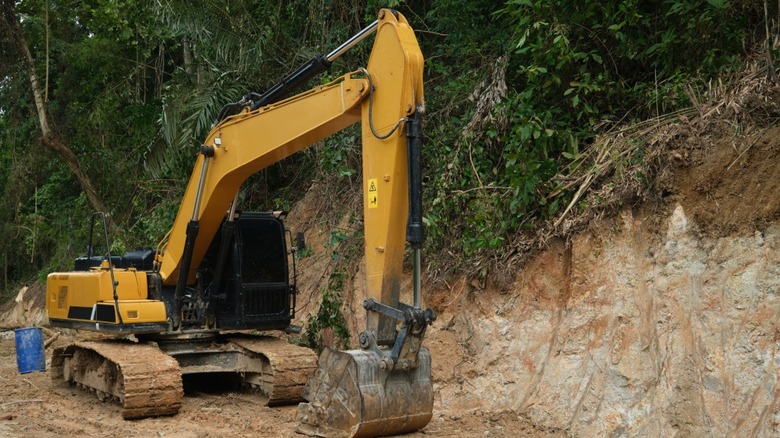
If you're building a brand-new highway on unbroken ground, as opposed to repaving or building over an older road, you first need to dig out the ground and clear the land where the road is going to lie. Scrapers and bulldozers are used to do this part, removing the surface layer of the ground and reshaping slopes. They do the "rough grading" — sort of the first draft of the road. Modern dozers, however, can be way more precise in creating a specific grade than the old earth movers, even being guided by GPS.
For the deeper dig, though, you need an excavator. We've all seen excavators along the road or at a construction site — it's the machine that has the big arm with the scoop on the front. Excavators can do precision grading for roads, but also dig trenches, ditches, and bridge foundations. They're also used for slope work. Modern excavators use sensors and semi-autonomous control.
While bulldozers provide the rough grade of the road, motor graders are brought in to refine that grade. Grades aren't made to be flat but are made at specific angles for water drainage. A motor grader has what's called a moldboard, sitting between its axles, which can be adjusted to different angles to trim the grade to where it needs to be.
Moving dirt
All of that dirt needs to go somewhere. Sometimes it's hauled off-site and other times it's moved to a different part of the site to be processed. An excavator, with its articulated arm, can sometimes be used to load dirt into dump trucks, but other machines are also used specifically for this purpose.
Wheel loaders and front loaders are different from bulldozers in that they don't grade but pick up loose dirt and other materials from piles and move them short distances, sometimes loading them into dump trucks. They can also be used for feeding a crusher, moving old pavement, or rearranging piles of dirt. Wheel loaders often look like bulldozers, except they are on large wheels instead of tracks. They can also move at relatively high speeds for construction equipment.
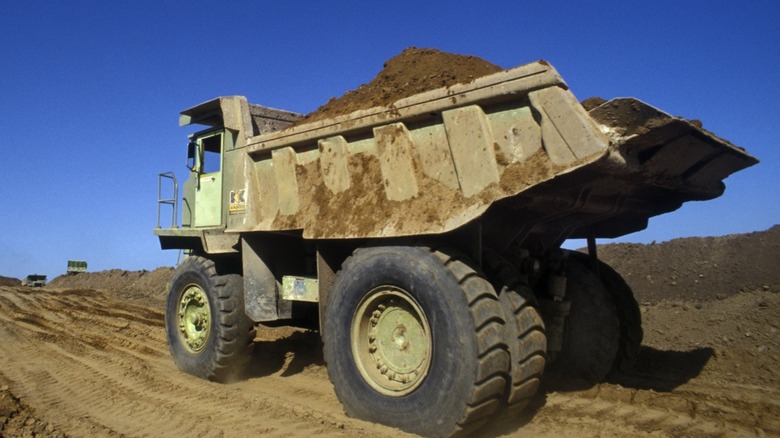
Dump trucks are used to haul the dirt, rock, old pavement, and other materials away. There are different types of dump trucks used for road construction. One is a rigid off-highway truck. This is the truck to use when you've got smooth haul roads in decent shape leading in and out of the site. It has a single rigid chassis and it's made for those kinds of conditions. But when the truck has to go over rough terrain, articulated dump trucks are the way to go. The tractor section and the rear dump body are connected by a joint, giving the truck greater flexibility.
Removing old pavement
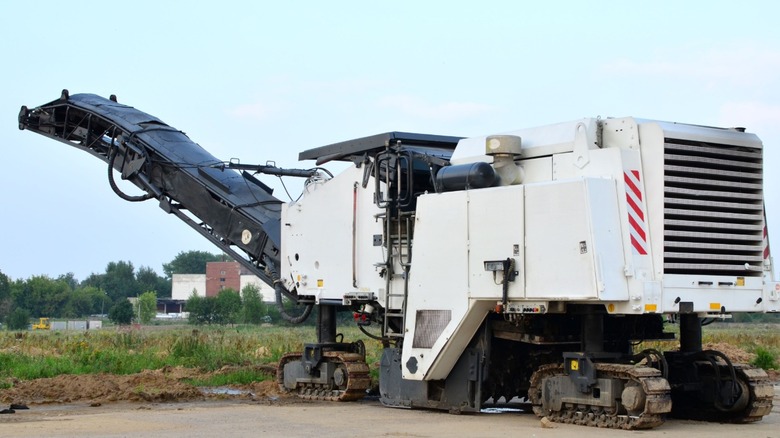
Sometimes a road just needs to be repaved or rebuilt rather than built from scratch. That often means that the old pavement, or at least the top layers of it, need to be removed. There are machines made specifically for this purpose, called cold milling machines. Basically, as they are driven over the old road, they shave off the pavement to a certain depth, chew up the material, and send it along a conveyor belt into a waiting dump truck. This machine, also called a "cold planer," is able to break up old roads by means of a rotating drum with blades on it. The drum sticks out underneath the machine and can often be set to various depths.
Cold milling machines come in various sizes, ranging from small models to massive units capable of tearing up entire highways. Wirtgen makes a variety of sizes. One of its larger ones is the W 220 Fi, which has a 7-foot-3-inch milling width and can cut pavement down to 1 foot, 2 inches. It is a monster of a machine, weighing in at over 81,000 pounds. Impressively, it can also get up to 801 horsepower.
Where does all of that old pavement go? Does it just fill landfills? Actually, asphalt is one of the most recycled materials on the planet and a great eco-friendly alternative to concrete. Once it's ground up, it can easily be made into other surfacing products.
Compacting the soil
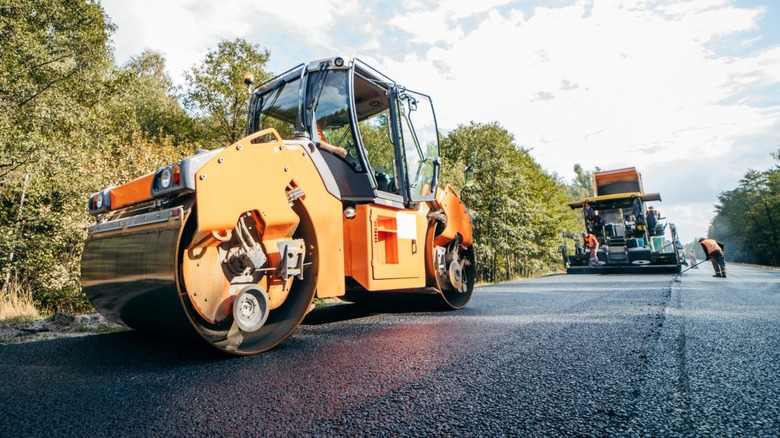
Once the path for the new road is dug out, the soil needs to be compacted, but not just the soil. Roads are built in multiple layers. In fact, Maine once tried using ground-up used tires as a road layer. In the case of asphalt, each one of those layers has to be compacted. Compaction helps keep the soil and layers from rutting and settlement, keeps water out, and prevents the pavement from cracking before its time.
There are several different machines, or rollers, used for compaction. The type of roller used depends on the type of soil that's going to sit under the road. There are smooth steel drum rollers that vibrate. These rollers work well on granular soil and vibration shakes the particles so that settle into a dense formation. Padfoot drums have feet that push into the soil as the drum rolls over it. These drums are good for clay, as they are built to knead the soil into shape.
Pneumatic tire rollers use rows of rubber tires instead of a steel drum. This type of roller also kneads the soil and is versatile enough to be used on several different soil types. One of the most common types of road roller is the tandem steel drum roller. This machine has a giant smooth roller on the front, and one on the rear. It often follows behind the paver so it can work the asphalt while it is still hot.
Paving the road
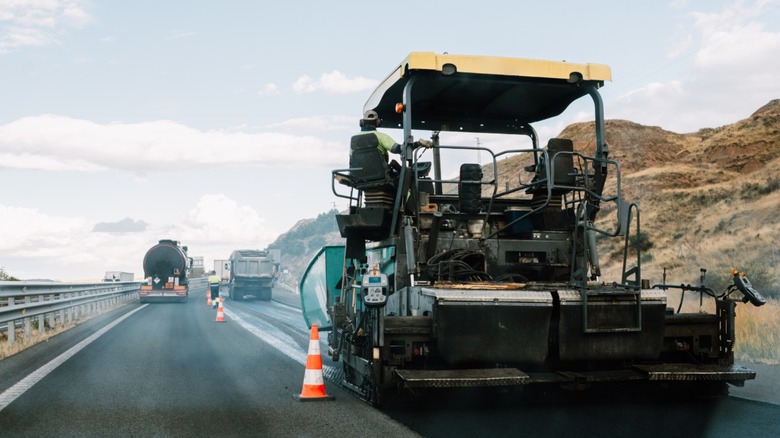
Once the roadway is prepared, it's time to pave that sucker. Sometimes dump trucks are used to dump pavement on the roadway, but typically highway pavers are used, especially on large projects. The paver spreads each layer of asphalt on the roadway, rollers come over each layer to compact it, a bond coat is sprayed on each layer by means of an asphalt distributor truck so that the next layer can bond to the last one, and then another layer is laid.
A paver is sort of a mobile asphalt processing plant. Hot asphalt mix is poured into the hopper, which typically sits on the front of the machine. The hot asphalt is carried by conveyor to the rear of the machine where spreading augers lay it on the road. Pavers are set to automatically distribute the asphalt on the road at a specific width, thickness, and initial compactness.
Sometimes the asphalt mix is fed directly to the paver from a dump truck, but this means that asphalt delivery has to be coordinated with how long it takes for a paver to distribute its load. Instead, a material transfer machine can be found at a lot of sites. Asphalt goes from the truck to this machine, which keeps the asphalt until the paver requires it. This has two advantages. One, the paver doesn't have to stop and wait for a dump truck to arrive, and two, the transfer machine remixes the asphalt, which keeps the temperature down and reduces separation of the aggregate.
Building bridges and overpasses
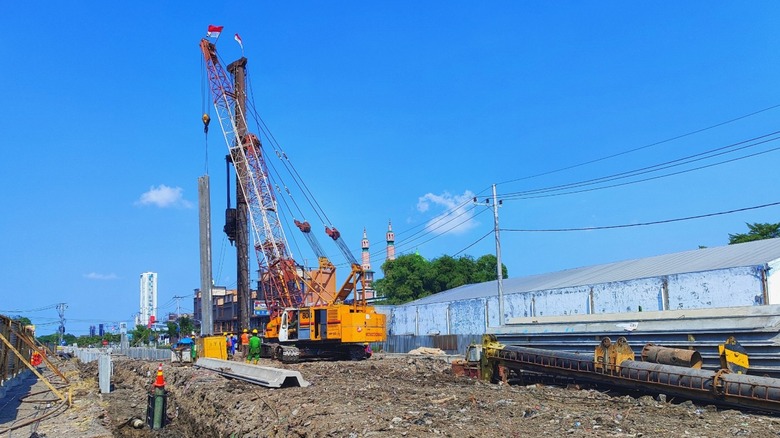
A few years ago, a flyover was built a couple of miles from where we live. Even from inside the house with the doors and windows closed, you could hear a loud "Dink! Dink! Dink!" all day, every day. That sound was the piles, which would support the flyover structure, being driven into the ground. The Federal Highway Administration says that over 100,000 piles are driven into the ground every year for U.S. road projects. That's a lot of noise.
The machines used to drive these piles into the ground are called, creatively, "pile drivers." The pile is held in place by vertical leads, and then the pile driver's large hammer comes down repeatedly on top of the pile, banging it into the ground until it reaches a specific depth. All the while, the driving is closely monitored by the construction crew.
But how are those enormous piles lifted into place? That's where heavy cranes come in. They set the piles into position so that the pile driver can do its job. But that's not all cranes are used for. They are also vital for lifting steel members, beams, and girders into place. You'll often see crawler cranes on construction sites that aren't on paved roads, and large mobile cranes where road transport is needed.
Painting the lines
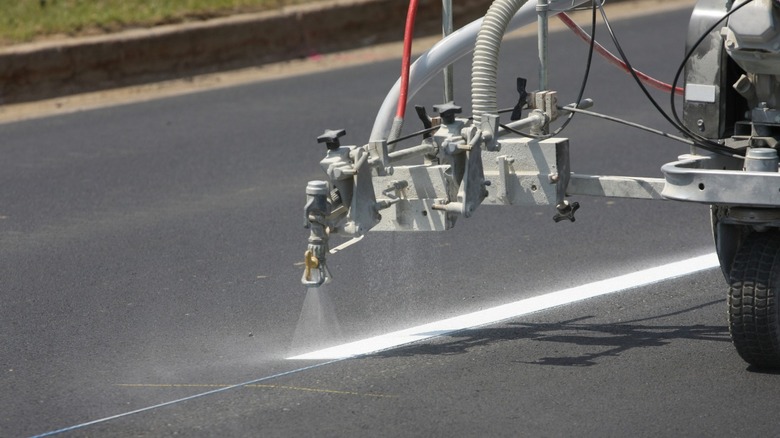
It is way more complicated to paint a line on a highway than you might think. Thermoplastic road marking paint, a special paint made of petroleum resin and titanium dioxide, is often used. Glass beads are also added during the spreading process to give the paint that reflective quality so that the lines can be picked up easily by headlights.
But thermoplastic paint doesn't arrive at the road site ready to be applied. It has to be heated to a molten state so that it can be easily spread. That's what road marking machines are used for (whoever named them really likes being on the nose). The paint mixture is heated inside these machines up to temperatures ranging from 356 to 428 degrees Fahrenheit, which turns it into a molten liquid. Then the paint is sprayed on the road to the specified width along a straight line. It's at this point that the glass beads are dispensed onto the newly painted line to add reflectivity.
These machines can be pushed along by humans or mounted on trucks. There are also cold paint road marker machines, though these are often used at events and construction sites for temporary lines, like the lines painted for F1 races.