

Yes, Vinegar Will Clean Your Car's Windshield And Mirrors, But Avoid These Mistakes
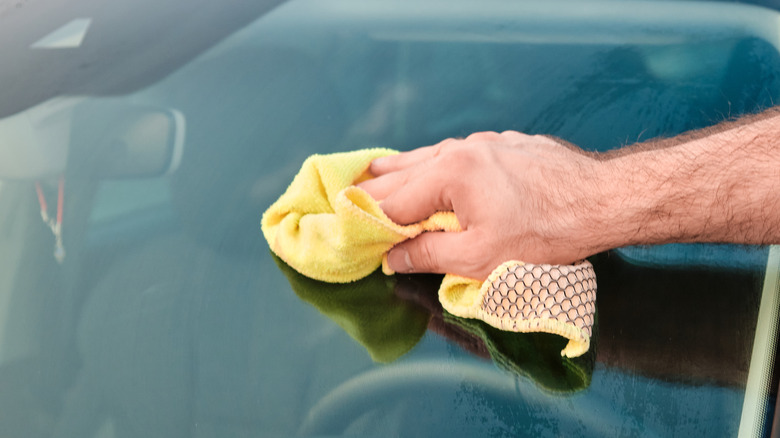
Your windshield and mirrors are arguably the most important non-mechanical parts of your car to keep clean. It's not vanity; it's safety. And if you're looking for a way to clean car glass using a solution that you probably already have and will likely be a lot nicer to your lungs, eyes, wallet, and environment than whatever chemical Armor All sells, vinegar could be your friend. But there are some real caveats to know before you start spraying the stuff in and around your car.
First off, yes, white vinegar is effective at clearing off stuff like hard water stains, accumulated dirt, dead insects, bird poop, tree sap, and even that nasty haze that develops inside car windows from glass — all stuff you often get on your car if it hasn't been washed in a while. This is because it contains acetic acid, which has disinfectant and degreasing properties. That said, there's a proper way to do it.
Cut the white vinegar with water
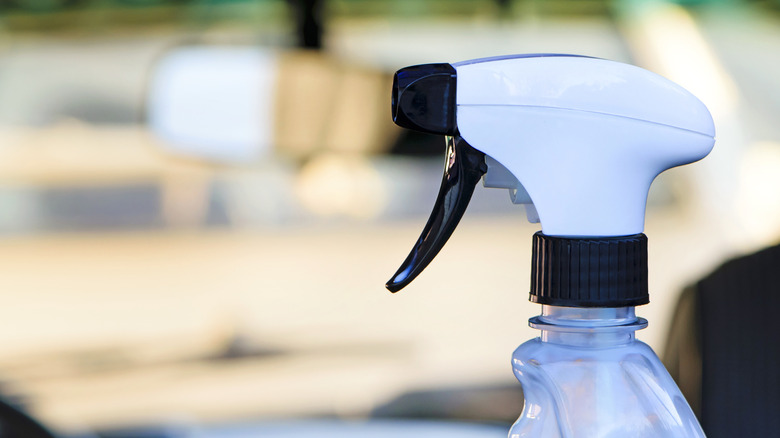
Firstly, use a spray bottle; don't just pour it onto a microfiber rag and wipe, or splash it onto glass with your hand raw. Secondly, regular kitchen distilled white vinegar typically has a concentration of 5% (check the label to make sure), and you'll want to cut this with water 50:50. That is, have your cleaning solution be half water, half vinegar.
Never use industrial-strength vinegar that can have concentrations of 75%, by the way. If you have easy access to distilled water and using it makes you feel better, go ahead and use that, but tap water should also be fine in a pinch. Once you have your vinegar-water mix in a spray bottle, go ahead and spray it onto your windshield and/or mirrors. Then, wipe with a clean microfiber cloth to spread the solution around and rub any stubborn gunk off. Next, use another clean cloth to wipe off the excess vinegar, and be sure to wipe it off of any of the surrounding surfaces, especially your car's exterior paint.
Don't let the vinegar dry on anything else
In fact, you should never let vinegar dry on car paint since it can etch, and as an adjacent rule, vinegar should never touch paint in direct sunlight or when the car itself is hotter than 90 degrees Fahrenheit. What's more, avoid vinegar making contact with your car if it's freshly waxed or has been treated with a ceramic coating, since vinegar strips and degrades both. Oh, and letting vinegar sit on chrome, rubber, or aluminum trim pieces too long can lead to discoloration (via Kelley Blue Book). To be safe, I'd just go ahead and make sure vinegar doesn't dry on anything that isn't glass.
With all of that in mind, using vinegar to wash your car's windshield and mirrors feels like a thing to do only in pretty specific situations where you're constrained by time, geography, budget, or a combination of the three. Doing it improperly can cause damage to surrounding paint and trim that would cost a lot more to correct than that bottle of dedicated glass cleaner at AutoZone. But if you trust yourself not to mess it up, or the car you happen to be working on isn't exactly concours quality to begin with, hitting your windshield and mirrors with a one-part vinegar, one-part water solution can be an efficient way to see more clearly on the road. Vinegar, water, and a dab of dish soap are also great at cleaning seat fabric stains and eliminating odors.