

5 Fun Commuter Cars For The Enthusiast Who Lives In A City

There are many joys to be found living in American cities. Proximity to amenities like theaters, arts districts, shopping, and restaurants can't be beat, and the ability to walk down the block to grab what you need is a quality of life improvement you almost never think about. I'm so glad I don't have to pile in the car and drive through 20 minutes of suburban sprawl traffic to get groceries. City living does come with downsides, though, particularly for automotive enthusiasts. So you have to pick the right car that can do it all.
For example, I have a house in a walkable neighborhood on the west side of Cleveland, Ohio. I'm right near the beach, and everything I need is within a few minutes' walk. Great! Except parking is limited, the roads are absolutely thrashed with potholes, there are certainly no fun driving roads, and getting anywhere during rush hour kind of sucks. So, we make compromises. Can you deal with a stiffly sprung sports car over broken pavement for your daily commute in exchange for the joy of the occasional nice weekend away? I'm just over an hour from Mid-Ohio Sports Car Course, which certainly helps, but the best driving roads in the state are several hours away, and I only get to visit three to five weekends per year.
A city dweller with a commute probably wants something that is good on fuel because getting gas is a pain, something not too precious because someone will inevitably back into you while parallel parking, and something relatively compact to avoid backing into someone else while parallel parking. Speed doesn't matter much, but you want something that gives you a sense of occasion when you drive it. So what do you pick? I put together a list of the five vehicles I'd choose.
Toyota MR-Spyder
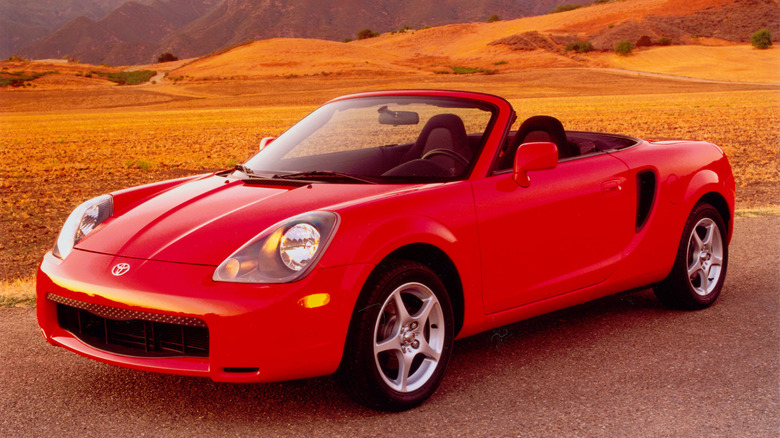
The car isn't aesthetically for everyone, but the MR-S is a pretty competent little sports car that is good on fuel and has a tiny footprint. If you're looking for a fun runabout that can do city work while holding its own on twisty roads or a track day, this could certainly fit the bill. With a few choice modifications, these are properly quick, too, punching way above their weight class.
If it helps you can think of the Toyota MR-S as a slightly heavier Lotus Elise. Using the same 1ZZ four-cylinder for power, the Spyder is about 200 pounds heavier than the Brit featherweight, and you can pick up the Toyota for around $12,000 to $15,000 without too much struggle, while a nice Elise is priced in the $50,000 range. The MR-S isn't cheap, but with that price comparison, it's also not so precious that you're worried about it all the time.
There isn't a bunch of storage space in the MR-S, naturally, so you might have to avoid the trips to Costco for anything more than their cheap rotisserie chickens and the buck-fifty glizzy meals. The frunk is pretty small, and there isn't much room inside the cabin, especially if you have a passenger, though there is a storage cubby behind the seats.
There are a few common failure points for these cars, but they've mostly been remedied by now. Pre-cat exhaust failures are the biggest one, so you'll want to make sure that's been dealt with. The rear subframes also rust pretty badly, and early 1ZZ engines also consumed oil regularly.
A former SCCA B-spec race car
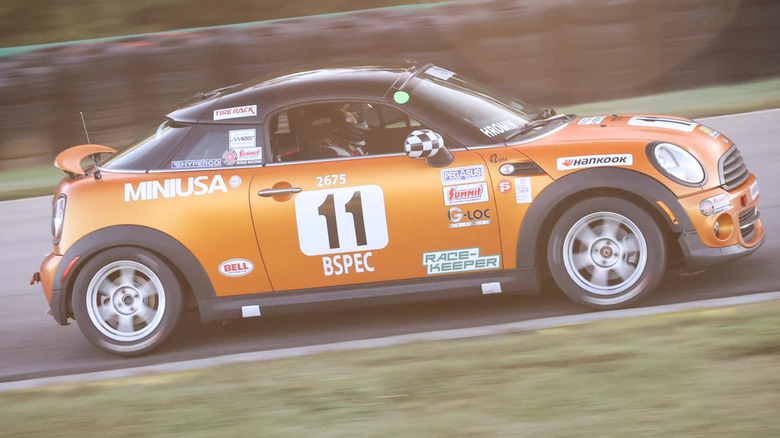
Back in 2012, the Sports Car Club of America introduced the B-Spec class as a way to make modern wheel-to-wheel racing less expensive. The class was open to any automaker with a small hatchback in their arsenal, setting a standard for which all of the cars could compete on an even playing field. Backed initially by Mazda and Honda with the 2 and Fit, respectively, the class grew to incorporate the Kia Rio, Mini Cooper, Chevy Sonic, Fiat 500, Ford Fiesta, Nissan Versa, and Toyota Yaris.
To fit in the class, each car was fitted with a custom sized restrictor to achieve a goal of 23 pounds per horsepower. Once the requisite safety gear was installed, racers were allowed to modify their cars mildly for on-track action. The spec included a manufacturer-approved suspension kit with non-adjustable shocks and a maximum camber setting, aftermarket brake pads, a cat-back exhaust, and aftermarket spark plugs. Boom, you've got a race car. And even better, it didn't remove any of the car's emissions components or affect its street legality.
The class still exists, but doesn't really get manufacturer support anymore, and all of these cars are dead in the U.S. now anyway. You can find complete and competitive race cars online for cheap, and there's nothing saying you can't daily drive them during the week. Take your pick of any of these great compacts and have a blast. It might not be the easiest thing to fold yourself into a caged car with a containment seat every morning for your commute, but some of us masochists enjoy that kind of thing. If you're a real sicko, B-Spec was also available as a kit for stage rally.
Any Kei sports car
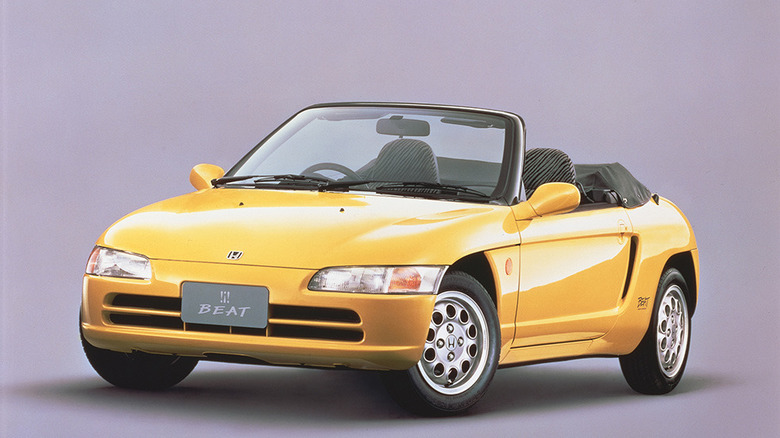
If you have tried a small sports car like a Toyota MR-S or Mazda MX-5 in the city and found them to be too big, heavy, and overpowered, then you're in luck. There is a wide variety of 1990s Japanese import keijidōsha cars already in the country waiting for you to try them out. Limited to just 660ccs, these cars have motorcycle-sized engines that are willing to rev but still positively sip fuel. Plus, the cars themselves fit pretty much anywhere. If you have a freight elevator in your building and a big enough door, you might even be able to drive your kei into your living room.
There are ups and downs to each different offering, but the main players are the Honda Beat, the Autozam AZ-1, and the Suzuki Cappuccino. A fourth is entering the playing field right now, as the Daihatsu Copen will be old enough to be eligible for import to the U.S. market in 2027. It's a multiple-choice question, and whether you choose A(utozam), B(eat), C(appuccino), or D(aihatsu), there isn't really a wrong answer.
Keep in mind that kei cars are not quite up to American highway standards, and it may be difficult to reach high speeds. They're officially capped at 64 horsepower, and most of these cars have a top speed of around 60 mph, so you're certainly in danger of getting run over by a 6,000 pound pickup truck doing 85 if you were to ever venture outside the city onto an interstate. That said, these are incredibly fun around town and on twisty roads. As with any small car, you just have to keep your wits about you.
Chevrolet Spark EV
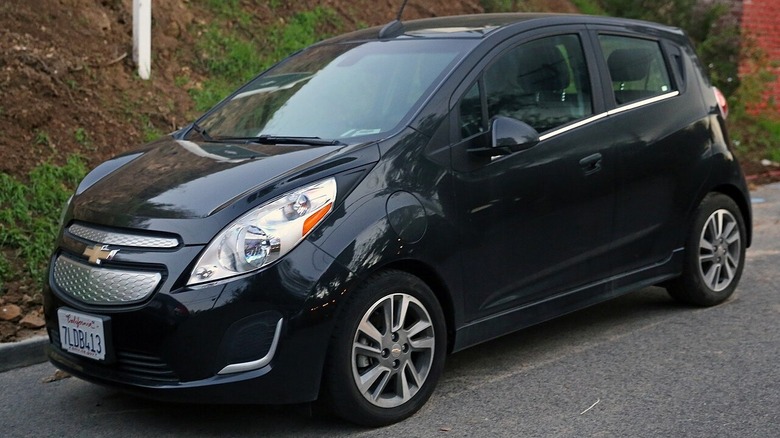
This one might sound like an unorthodox choice, because it's rare that anyone recommends buying a decade-old electric vehicle today, but stick with me on this. General Motors inadvertently built the first electric hot hatch with the Spark EV. Because of its diminutive size and small 21-kWh battery (tiny by today's standards), it's fairly lightweight for an EV at just 2,989 lbs. More important than the weight, however, was the proprietary oil-cooled permanent-magnet electric motor Chevy built for this thing. It churned out a staggering 140 hp and 400(!) pound feet of torque for some serious front-wheel drive power.
With a zero-to-60 sprint in the high seven-second range, it's among the quickest things in its class, and about four seconds quicker than the gas version. In a period review of the car, Car and Driver favorably compared the Spark EV to its Honda Fit EV competitor, saying that while the Fit is a great car with gasoline power, it feels dulled in electric form. However, "the reverse seems true of the Chevy: It makes a boring car intriguing."
If you want something that looks like a normal city car, drives better than it should, and doesn't burn a drop of gasoline in the process, this might be your best bet. They're getting a bit long in the tooth these days, so you may have difficulty finding a nice example. That said, they're cheap as chips, and could be even more fun with a bit of suspension work and some sticky tires. Range is only 82 miles, however, so you might not want to go too far out of the city on your fun drives.
BMW 135i
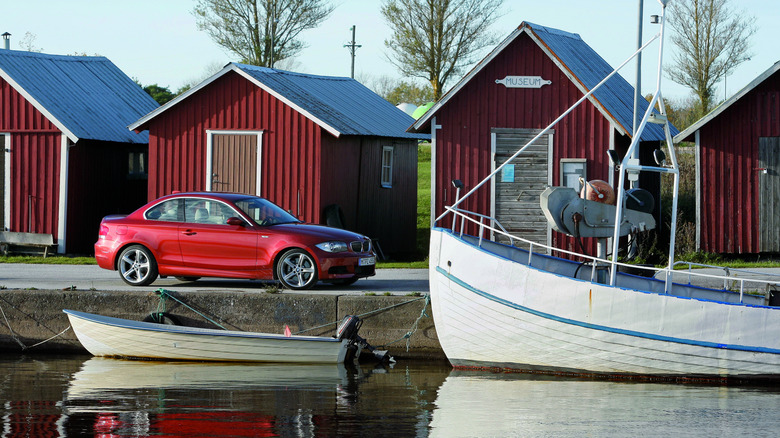
Okay, you've made it through four recommendations for city cars built on shoestring budgets, with austere, cheap, and cramped interiors. What if you're a special boy who likes horsepower and German luxury, but you still want a reasonably sized (and priced) car for the city? Turn your eyes to this BMW E82 1-series coupe. Obviously, the one everybody lusts after is the limited-production 1M coupe, but those are priced to the stratosphere now, so grabbing a 135i is the next best thing.
The BMW 1-series is maybe the perfectly-sized two-door for you to drive in the city, similarly sized to where the 3-series used to be. The 135i is powered by a 321-horsepower N55 turbocharged inline-six engine, just 14 horses shy of the almighty 1M. With a bit of tuning, you can make serious power, and the components to build your own 1M clone are readily available. A few suspension tweaks and wheels, and you're most of the way there. Plus, if someone hits you hard enough while parallel parking, you have an excuse to upgrade to 1M-style bumpers.
They aren't easy to find with a 6-speed manual, but they're out there for the taking if you look hard enough, and you're prepared to pay a premium for it. These little guys handle really well, they're comfortable, and made from high quality materials. They have their foibles, as do any out-of-warranty German cars, but if you're vigilant about upkeep, they'll keep you happy for many years to come. Life is short, so go get your BMW sports car.