

This Might Be The Worst-Selling Car To Ever Become A Seven-Figure Classic
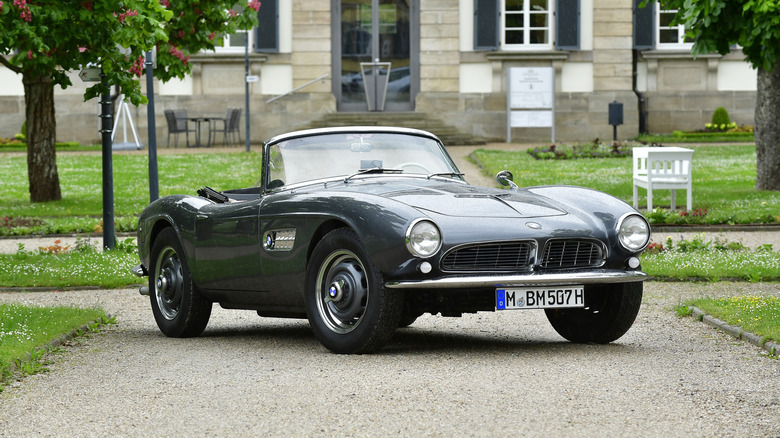
Only 252 units were ever sold, the production run nearly bankrupted the company, and Daimler-Benz came close to absorbing what remained. Today that same car is a cornerstone of BMW's heritage and trades for seven figures at auction. What sounds like a tall tale is exactly how the BMW 507 came about — and why it's worth exploring.
The 507 began with Max Hoffman, an Austrian-born car importer who had built a reputation for reading American appetites for European sports cars correctly. In the early 1950s, he convinced BMW that a sleek open roadster could occupy the space between the Mercedes 300SL and cheaper British alternatives. Hoffman projected the car could sell at around $5,000 in the U.S. — competitive, accessible, and potentially moving thousands of units annually.
What he didn't account for was the cost of actually building it. Designer Albrecht von Goertz produced bodywork that was genuinely beautiful and utterly impossible to mass-produce economically. Each panel had to be hand-formed. Production costs climbed, and by the time the car reached American showrooms, it was priced at roughly $10,000 — double Hoffman's target, and comparable to the Mercedes it was supposed to undercut. In fact, it was nearly twice what a Corvette or Jag XK150 cost, though today's XK150 resale prices can't touch those of the 507. As a result, demand was at a premium, and the aspirations of 5,000 yearly sales were quickly dismantled.
Underneath the troubled economics sat a 3.2-liter aluminum V8 with overhead valves, producing between 140 and 150 horsepower depending on the series. The Series I launched in late 1956; the Series II arrived in 1957 with a small power increase and revised rear bodywork. Top speed figures placed the 507 just north of 120 mph with the handling suited to long-distance touring rather than outright performance.
What time has done for the BMW 507
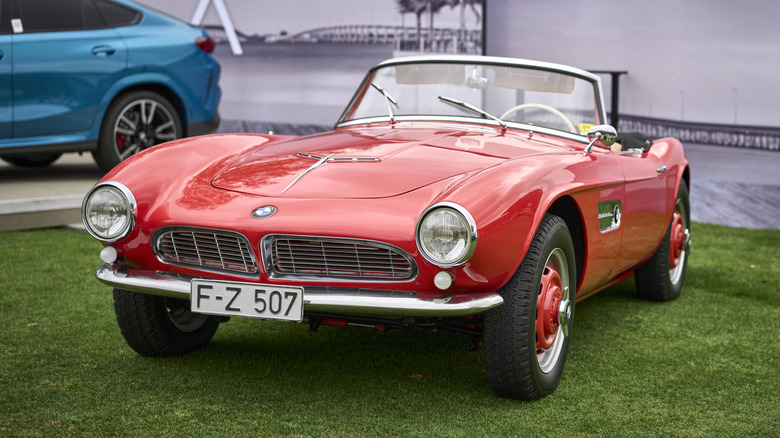
By 1959, BMW had sold 252 examples over three years of production and posted a loss of 15 million Deutschmarks. Daimler-Benz was in discussions to acquire the company. Only Herbert Quandt's decision to inject personal capital saved BMW's independence.
Today, clean examples trade for north of $2 million dollars, and a 1957 example owned by Formula 1 champion John Surtees sold for over $4 million at the 2018 Goodwood Festival of Speed. This has sparked several big-ticket 507 sales since, and even Elvis' long lost 507 was restored by BMW decades later. The gap between the roadster's initial reception and today's sales is one of the more dramatic reversals in automotive history.
The Z8 — introduced in 2000 and widely acknowledged as a spiritual successor — wore gorgeous design cues lifted directly from the 507. BMW itself made the lineage explicit. That acknowledgment, combined with the sheer scarcity of surviving examples and the quality of von Goertz's original design, transformed the car's reputation entirely. A vehicle that destroyed BMW's finances in the 1950s became one of the most coveted collector cars in the world over five decades later.
The 507 didn't fail because it was bad. It failed because it was too ambitious to build and too expensive to buy — a problem that, fifty years later, turned out to be an asset.