

Here's What A Brand-New Duesenberg Model J Cost, And What It Would Be With Today's Inflation
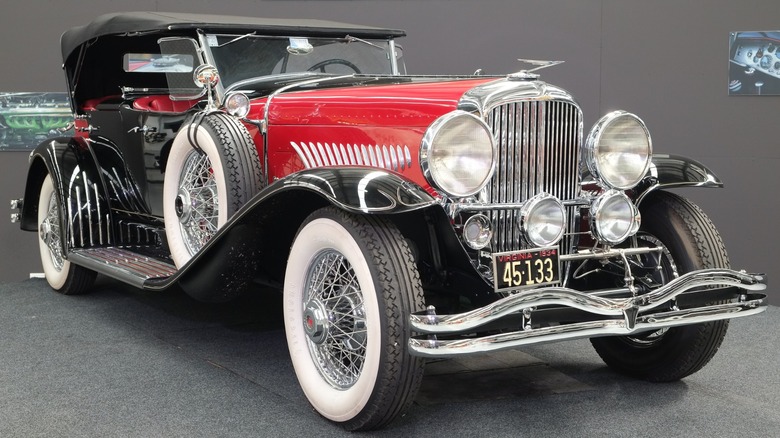
Many people consider the Duesenberg Model J to be the greatest car this country's ever produced — and they may be right. It was a hand-built, race-bred engineering masterpiece with an advanced-for-its-time inline-8 onboard displacing 420 cubic inches. Plus, since the car was from the coach-built era, customers could personalize their rides with their choice of bodies and other accoutrements. Well, that was true as long as they had the cash.
The Model J's engine and chassis alone went for $8,500 at the car's debut in 1929, and adding a body could set you back another $4,500. Translated into today's money, that works out to a starting price of nearly $166,000, almost $88,000 for the body, and a total price approaching $254,000. Now, that may not seem like all that much for a luxury car today, when the huge Rolls-Royce Phantom opens at $555,350. But remember, part of the difference comes from the modern features found on the Phantom, such as its touchscreen infotainment system, multiple ADAS functions, and a fiber-optic headliner that gives the cabin a starry-night effect. None of that stuff was around in 1929.
The Model J also might have been a better — or perhaps worse — example of conspicuous consumption. Its early 1929 introduction came about 8 months before October 28th, when the New York stock exchange plunged by almost 13% – before losing another 12% of its value the next day. In the depths of the Great Depression, the Dow bottomed out 89% below the peak it had reached in September of that year. According to a joke from Jay Leno, who owns a rare one, it was the kind of car that people would throw rocks at when it went by.
The birth of the Model J
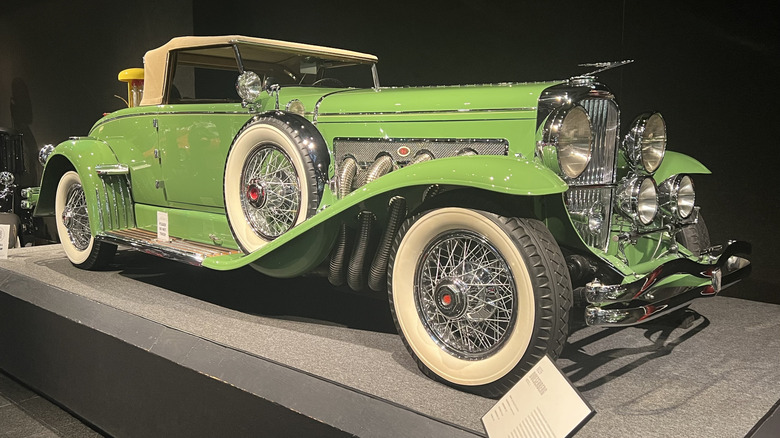
Fred and Augie Duesenberg came to the U.S. as children in 1885 and got into the car business in 1901. That's when Fred opened the second-ever garage to grace Des Moines, Iowa. He'd then take his tuned-up Marion, which he had customized with a dedicated exhaust pipe for each cylinder, to a first-place finish in a race at the county fair. A local entrepreneur named Edward Mason noticed that success, and he tapped Fred to design a car for his new auto company. The result was the 1906 Mason Touring car that's considered the first designed by Duesenberg.
The siblings would eventually create a four-cylinder Mason mill, and they took that design with them when they moved to Minnesota in 1913 to found the Duesenberg Motor Company. The engine was sold to both other car makers as well as to boat builders. The brothers also manufactured airplane engines during World War I. It was while busy with their war efforts that the Duesenbergs partnered with Bugatti to develop a straight-8 for aviation purposes. You can trace a line from there to one of the most famous straight-8 engines ever, the one in the Bugatti Type 35.
Anyways, Fred and Augie also believed the straight-8 was the future. As a result, they sold off their company, and in 1920, debuted what became the Duesenberg Model A. That, in turn, was so impressive that yet another automotive entrepreneur, E.L. Cord, bought up the Duesenberg company in 1926 and hired the brothers to build the next luxury car of the time — the Duesenberg Model J.
What made the Model J so special?
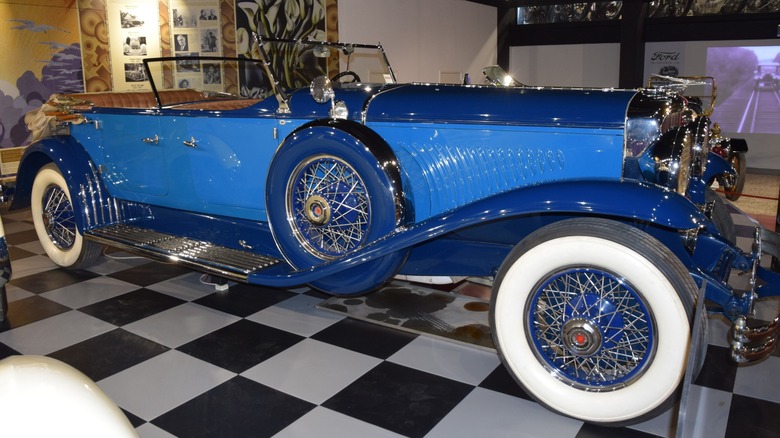
Keeping in mind the fact that the Model J was meant to be finished by a coach builder, it was Duesenberg's engineering that really elevated the car to the next level. And the car's 7.0-liter straight-8 was the jewel in the crown. It was advertised as delivering 265 horsepower, more than double the output in rivals from Packard and Cadillac. The engine propelled the Model J to a top speed of 116 mph, and a lot of that muscle had been unlocked by an earlier Duesenberg innovation: the introduction of aluminum pistons and connecting rods. Before that time, when automakers relied on cast-iron pistons, their engines could have redlines below 1,800 rpm — the Duesenberg inline-8 could spin up to 4,200 rpm in the Model J. Helping to stop the 4,000-pound machine was an early form of hydraulic brakes invented by the company.
Meanwhile, the Model J's massive 42-inch crankshaft was forged from a chrome-nickel-manganese alloy and weighed 150 pounds. To help create a superior driving experience, the crankshaft also integrated a tricky method for reducing noise, vibration, and harshness. The Duesenbergs attached two containers to the shaft, each holding a pint of mercury. As the motor turns, the inertia of the mercury moving in the capsules helps to reduce the shaft's vibrations.
All that was before Duesenberg supercharged its straight-8 in 1935. With 400 horses ready to run wild, the so-called SSJ models were touted by some as raising the car's top speed to 160 mph. Almost 90 years later, the motor raised the Duesenberg's auction value to $22 million, making it the most expensive pre-war American car ever sold to the public.