

Two Chicago Bridges Fail To Close In Extreme Heat Thanks To Aging Garbage Infrastructure
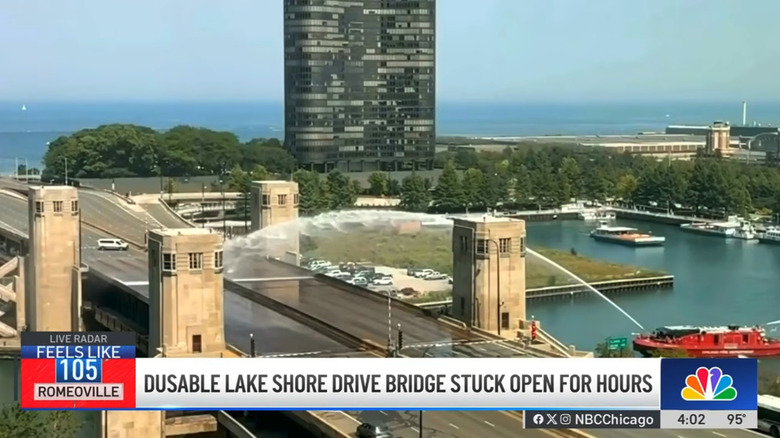
Climate change isn't real, or at least, the White House doesn't seem to think so after withdrawing from every organization fighting climate change, as well as having the EPA reverse its findings on greenhouse gases and ending regulations on cars that help curb those now "non-problematic" gasses. But us humans aren't the only things suffering in the heat. In Chicago, a fairly sizzling week of heat led to the malfunction and prolonged closure of two area bridges in one day, causing hours of delays while firefighters and crews tried to cool them off so they could work again.
Chicago was under a heat advisory at the time, warning residents of heat index levels between 100 and 110 degrees, according to NBC 5 Chicago. The unusually warm temperatures might be easier for humans to avoid, but not the structures exposed to the baking sun. The DuSable Lake Shore Drive bridge that spans the Chicago River was opening for one of its two scheduled bridge lifts on Wednesday, which according to CBS News is a regular occurrence during the summer, allowing passing boats to make their way out to Lake Michigan. After its lift, the two-part bridge was unable to close, reportedly leaving a considerable gap caused by the bridge's expansion from the heat.
Area firefighters were called to spray water from one of their boats onto the bridge, which can be seen in NBC 5's video, hoping to cool it off. The bridge was eventually able to close all of the way and reopened mid-afternoon. On the south side of Chicago, the Torrence Avenue Bridge, which crosses Chicago's Calumet River faced similar problems and was unable to come down from its "up" position during the city's rush hour. It also shut down for a few hours while CDOT crews attended to the issue.
Problems happen when garbage infrastructure isn't fixed or updated to work a century later
Husam Najm, professor and undergraduate program director of the Rutgers School of Engineering Department of Civil and Environmental Engineering explained in 2024 that "Movable bridges can be vulnerable because they have mechanical/electrical systems that can be sensitive to expansion and contraction." He added that extreme fluctuations in heat or cold temperatures can create issues like expansion during extreme temperatures. 'If the bearings weren't designed to allow for this large expansion, problems may arise," Najm said.
Case and point, heat was a major contributing issue for both bridge malfunctions, but so were the ages of both bridges. The Torrence Avenue Bridge was opened in 1938, and the DuSable Bridge, earlier than that in 1920. NBC 5 also found that a September 2024 report on the DuSable found that it was "structurally deficient" and "functionally obsolete," which the same might be applicable to the Torrence Avenue Bridge opened nearly two decades later. The engineering and technology that's been integrated into bridge construction in the century since these bridges were built has better accounted for expansion and contraction in hot and cooler temperatures, among other things.
Back in 2018 the wonderful Kristen Lee wrote about the same DeSable Bridge (then the Michigan Avenue Bridge) getting stuck back. In that case, city workers had to cool off a mechanism directly related to raising and lowering the bridge. One would think that might be a sign to address aging infrastructure and maybe update or fix it so problems like this won't continue to happen. But not in America, where our infrastructure continues to crumble from simple age or the drastic temperature changes that these structures were not built to accommodate. It's hot, but everything is fine.