

This City Built A Multi-Story Parking Garage When There Were 800 Cars In The Country
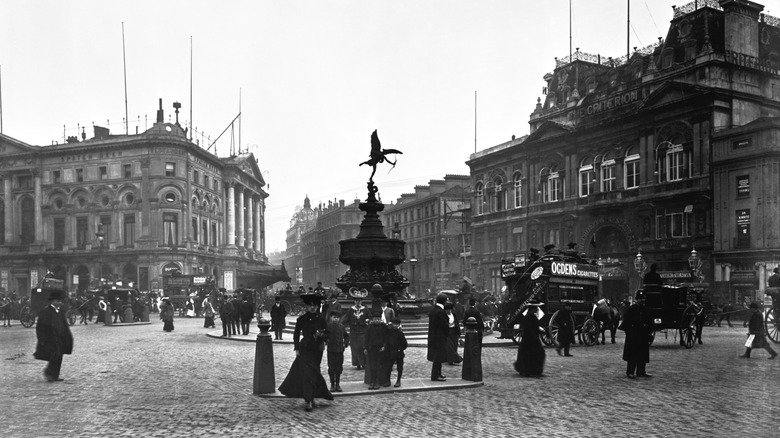
It's easy to take for granted how much of the modern world is built around cars. Seemingly everything around us, from traffic lights to gas stations, was conceived to help drivers get from point A to point B as conveniently as possible. And then, of course, there are parking spots and parking garages. Multi-story parking garages are a popular solution for downtowns, shopping malls and stadiums. The concept actually predated the introduction of the Ford Model T and the mass adoption of the automobile. There was a time, though, when parking garages and 19,000-mile highways didn't exist.
While New York City converted horse stables into car garages at the turn of the 20th century, things were a bit more purpose-built on the other side of the Atlantic. The first multi-story parking garage was constructed in May 1901 at 6 Denman Street in London, just a stone's throw from Piccadilly Circus. The facility was far ahead of its time, because the National Motor Museum estimates there were only 800 cars in all of Great Britain. The idea of a parking garage storing an eighth of the country's entire vehicle fleet in a single location would be ridiculous.
According to the British Parking Association, the seven-story structure could hold 100 vehicles and used an electrically powered elevator to move cars between floors. While electric power wasn't yet the standard for elevators, it's important to note because the garage was built by the City & Suburban Electric Carriage Company.
City & Suburban had a very royal customer for its electric vehicles

For most of its history, the City & Suburban Electric Carriage Company imported vehicles from Columbia, a Connecticut-based electric car brand. City & Suburban would build bodies to drape over the chassis, sell the vehicles, and offer recharging and chauffeur services. According to The Autocar, Queen Alexandra bought a two-seater Columbia victoriette from the company the same month as the garage's opening. The car had a range of 40 miles and could reach a top speed of 20 mph. The magazine also claimed that Alexandria drove the Columbia herself and was "delighted with the ease and simplicity of control and manipulation." If this sounds like an ad, it might have been. British companies often use royal patronage to market themselves, especially during the early 20th century.
For any upstart electric car company in the early 20th century, its garage base was far more than a vehicle service center. Nearly every car it sold would be recharged on site with the lack of EV infrastructure anywhere else. City & Suburban would have owners, including the Queen, store their cars at the Denman Street garage and call via telephone to have their EV delivered to them when needed. Think of it like a summon feature that actually works every time.
Despite the meteoric rise of electric vehicles over the past two decades, they have been around nearly as long as cars powered by internal combustion engines. However, once the spread of refueling stations made long-distance travel possible for ICE-powered cars, early car manufacturers pivoted to market their models specifically to city dwellers. Constraints of rudimentary battery technology didn't matter if you were going out for a few hours before returning home. These automakers also believed that the easier, quieter, and much cleaner operations would be appealing to women.