

8 Ostentatious Cars That Defined The Wedge-Shape Era
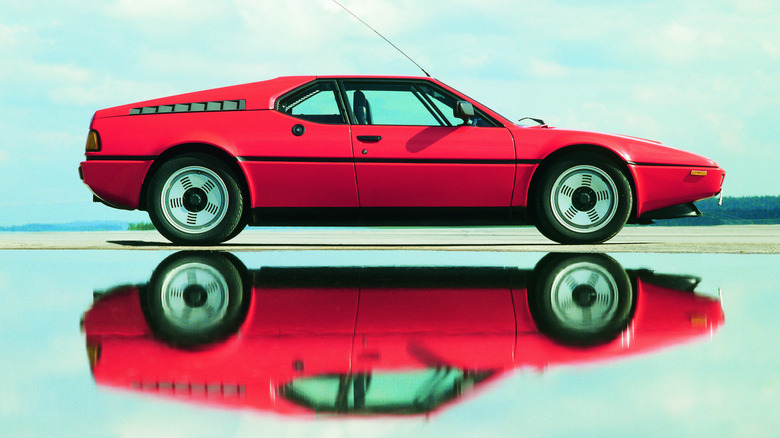
Imagine you're back in grade school, bored in class, and looking to kill a minute while your teacher finishes their incredibly interesting lecture on the quadratic formula. You decide to sketch a little doodle of a cool car. What does that car look like? Well, for many young enthusiasts who doodled when they weren't supposed to, it probably had a wedge shape to it.
Why? Other than being easy to draw, a wedge-shaped sports car just looks fast. It looks like it can cut through the air at incredible speeds and fly through space if it wanted to. It's an aggressive shape that looks like it has a direction — a performance-based purpose. Some of those kids, as it happens, grew up and became automotive designers, and molded their wedge-shaped dreams into real-life cars that millions of others have and will continue to drool over for decades.
This group of cars is a celebration of the period from around the late 1960s to the late 1980s, when harsh angles and wedge silhouettes were the ultimate expression of automotive class and taste. It's not a comprehensive list, but rather a brief overview of the spectrum across two decades and several countries to show you why the best-looking car shape is the wedge.
DeTomaso Pantera
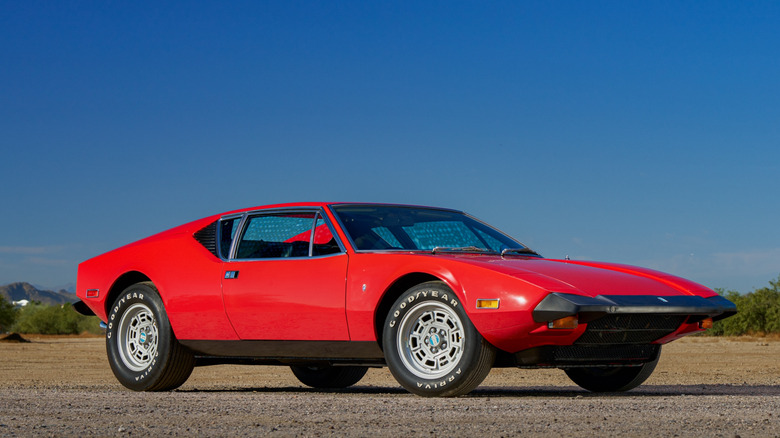
This Ford and DeTomaso collaboration is famous for blending Italian design cues and American V8 power, as the Pantera featured a small-block Ford powertrain underneath all that gorgeous sheet metal (no V12s here). However, most forget that the Pantera has strong American influence. When Carroll Shelby left the original Ford-DeTomaso project that was brewing in the mid-1960s, Ford North America head Lee Iacocca took things over and made a deal with DeTomaso to create an upscale mid-engined sports car targeted primarily at the United States.
If you need more convincing about the Pantera's American influence, we'll guide your attention to its design, which was drawn and crafted by Tom Tjaarda, an American man who worked for the Ghia design house at the time. And boy, did he nail it. For a car that debuted in 1970, this wedge style was fairly revolutionary for a production car. It blended the carefully placed proportions of a mid-engined Italian sports car with muscular lines that teased the 300-plus-horsepower 5.8-liter Cleveland V8 behind the seats.
There were many wedge-shaped concepts in the late 1960s, but the Pantera was one of the few that had the chance to be fully realized. Its wedge look and lack of curved lines debuted before the likes of the Lancia Stratos, Ferrari Dino 308 GT4, or Lamborghini Countach, and as it became more refined over the years, its performance would grow into a serious global competitor. But despite being one of the quickest cars you could buy in the 1970s, its time on the U.S. market ended after 1974, and it went out of production in the early 1990s with just around 7,000 total units produced.
Lancia Stratos
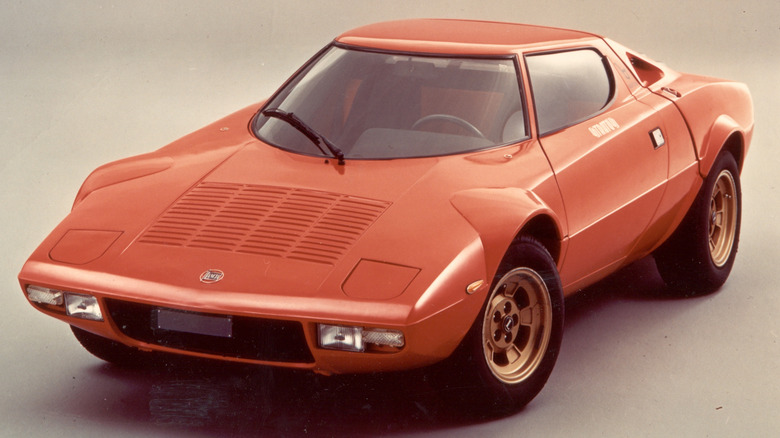
In Europe, Lancia is a brand known for many fine automobiles that exist outside the purview of rally racing. But in the U.S., where Lancia sold its cars for only a short time, we instead associate the badge with its motorsport-inspired offerings. And the big one is, of course, the Stratos. It is a holy grail in this discussion, not just because of how its production version looked, but because even the concept it is based on is also one of the most famous wedge-shaped creations of all time.
Designed by the legendary Marcello Gandini (at the Bertone design house at the time) and unveiled at the Turin Motor Show in 1970, the Stratos HF Zero concept was a proper piece of space-age design. With its roof standing just 33 inches off the ground and a body like a horizontal cyberpunk teardrop, it was the perfect basis for Lancia's sporting director, Cesare Fiorio, to build his ideal ground-up rally racer. The pre-production version and eventual final production model (1973) were vastly different upon debut, but the inspiration in its overall silhouette was unquestionably clear.
The now Ferrari Dino V6-powered Stratos was fully rally-fied, with dramatic overhangs that were angled high to increase approach and departure angles, an extremely tight fighter-jet-style cockpit and windscreen, a vented hood, short wheelbase, complete lack of bumpers, and its particularly genius window operation. Despite the lovely details, though, it's the overall "wedginess" that reminds every enthusiast why it is one of the most iconic automotive designs, period. The stout little Lancia would go on to win three consecutive World Rally Championships from 1974 through 1976, along with countless other victories in separate series, cementing its influence in both design and pure motorsport function.
Ferrari Dino 308 GT4
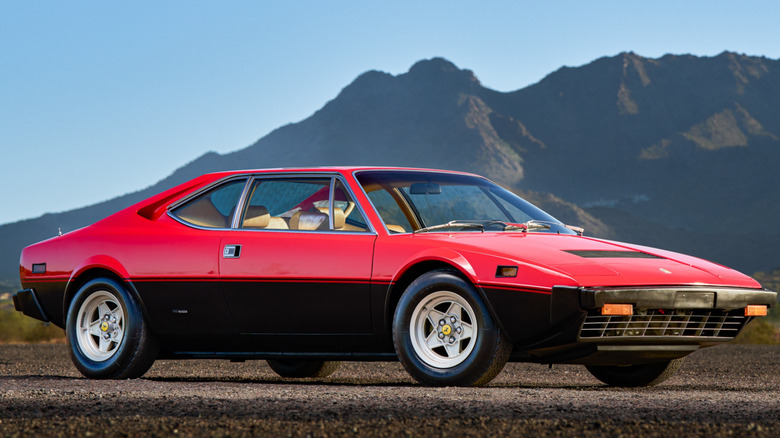
In 2026, we look back on the wedge design era fondly. Everything looks cool through rose-tinted glasses, don't you know? But at the time, many of these iconic designs were seen as too eccentric — too far outside the conventional boundaries of automotive design, and the Dino 308 GT4 is a perfect example. The first hitch in the GT4's story was that it was designed by Bertone instead of Pininfarina, which had been the Italian brand's go-to design house for years. The second hitch was that it was replacing the Dino 246 in 1974, a beloved, traditionally beautiful, curvaceous Pininfarina design. The 246 certainly had its own image issues, but the 308 was seen as a radical departure for the Dino lineup.
The basic idea for this car was pitched to Bertone by Fiat, and the design itself was handled by none other than Marcello Gandini. This was the first and only production Ferrari Gandini would ever sketch up, and it left the studio with his signature all over it. The big overhangs and up-swept edges, the low-slung cowl and hood, the squared-off rear end, and the heavily wedged front end — it was a true product of its time.
Mounted in the middle was a 3.0-liter V8, but between the driver and that engine was a set of rear seats, making the 308 a 2+2 — one of several reasons (including that it didn't have a single Ferrari badge) folks thought it looked a bit odd back in the day. As a result, only 2,826 units were produced during its production cycle. Fifty years later, though, it's clear that the 308 GT4 started a design lineage that would be drawn through several other mid-engined wedge cars that would follow.
Lamborghini Countach
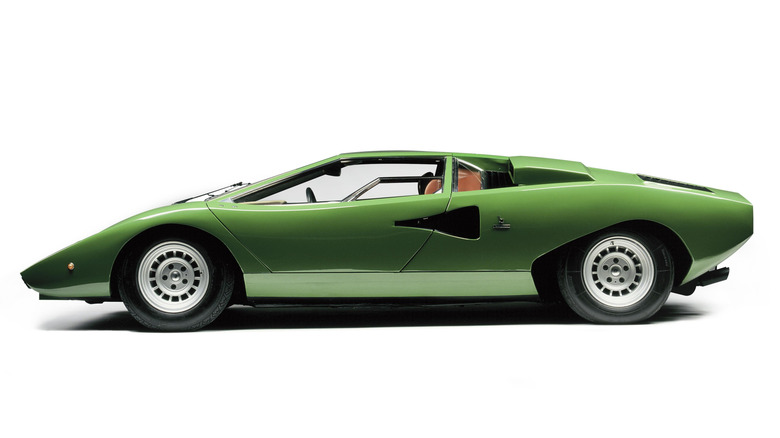
Forget wedge era-defining cars; the Countach is one of the most influential automotive designs of all time. It is the original poster car — the ultimate expression of automotive dreams for a generation that grew up in the latter quarter of the 20th century. But the Countach era of Lamborghini as a company was fraught with issues. Finances were shallow, and as the legendary Miura was nearing the end of production, the brand needed a new flagship supercar to inject some enthusiasm and dollar signs into the raging bull.
What was then set into motion was the LP112 project — a mid-engined, Bertone-designed sports car that would replace the Miura. Styling was done by (surprise, surprise!) Marcello Gandini, who crafted a dramatic and ambitious design that would sit on the bespoke tubular space frame designed by Paolo Stanzani. In 1971, the LP500 prototype, as it was now named, was presented at the Geneva Motor Show to audible shock from the crowd, who, for the first time, were experiencing the low, wide, and flat majesty of the Countach.
And that name. Legend has it that when a design staff member saw Gandini's LP500 prototype for the first time, they uttered a common exclamation of amazement in the Piedmontese dialect — "contacc!" And the rest is history. The Countach LP400 (another name change) debuted for production in 1974 with the craziest sci-fi proportions anyone had seen before, accentuated by its iconic haunch-mounted scoops, scissor doors, and longitudinally-fixed 3.9-liter V12. The Countach would be sold only in Europe until 1982, when the company's new owners finally tapped into the North American market. It would gain displacement and performance with variants such as the LP400 S, LP5000 S, and the LP5000 QV until its discontinuation in 1990.
Lotus Esprit
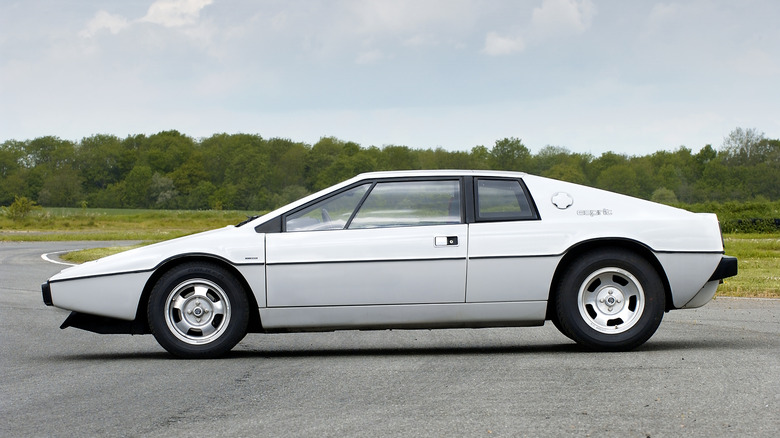
Lotus' business model was always one of small margins, and even smaller cars. The founder, engineering genius Colin Chapman, was obsessed with lightness in his pursuit of creating automobiles that would define the track-ready performance segment. But a specialization in the somewhat niche market of tiny, motorsport-driven cars bought only by enthusiasts is a tough business. So, by the early 1970s, Chapman was ready to enter the road-going car market in an attempt to rival the likes of Lamborghini, Ferrari, and Porsche.
The team started with an existing chassis — that of the Lotus Europa sports car. They modified the chassis and contracted Giorgetto Giugiaro (of Ital Design) to create an attractive yet functional body to fit the project that was now called "M70." The car debuted in 1975 as the Lotus Esprit, and its design is far too underrated. When a car like the Countach debuts and sets the industry on fire with wild styling, other wedge designs can seem too safe. But the Esprit was the gentleman's exotic sports car. The Series 1's styling was toned down, with no frills or flashy appendages you didn't need for a wonderful driving experience.
The Esprit's looks were even suave and stately enough to be featured as James Bond's car in the 1977 film "The Spy Who Loved Me," and it served partly as mechanical and stylistic inspiration for the famous DeLorean DMC-12, a project that Lotus had a heavy hand in. Its original 2.0-liter four-cylinder wasn't quite peppy enough to truly combat the best of Europe at the time, but as it evolved over four generations and gained a V8 in the 1990s, the Esprit became a hugely important part of the brand's history, and with its 2004 discontinuation, it would become Lotus' longest-running production vehicle.
BMW M1
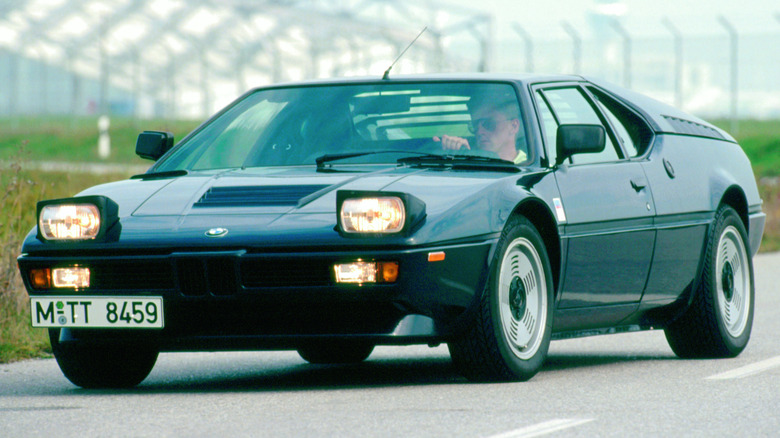
In preparation for Group 4 racing in the mid-1970s, BMW had to start from scratch. The existing 3.0 CSL racecar was wildly successful for BMW's racing division, but BMW wanted to go after the best racing marques in the world. So, the automaker turned to an earlier concept: the mid-engined BMW Turbo from 1972. This was to be the first major project for the M Division (founded in 1972) and its newest racing hero, the M1. Lamborghini would be contracted to build it, and Giorgetto Giugiaro would design it. Simple as pie, right?
Obviously not. Lamborghini then took a nosedive toward bankruptcy, and the rules for the racing series the M1 was intended for were completely changed. The Lamborghini plan was now dead, and they ended up having to execute a long and convoluted process that involved several other third-party companies and shipping the cars back and forth between Italy and Germany to complete production. The design, however, was probably the only major success of this project.
Giugiaro's understanding of packaging and his ability to portray motion even when a car is stationary were on full display with the M1. The press was highly impressed by how usable the M1 was for a supercar at the time. Giugiaro was able to combine great visibility, ergonomics, and aerodynamics even with that tall M88 straight-six in the way. And of course, the ostentatious wedge styling (and the fact that only 460 units were ever built) makes the M1 a legend of this era, despite its failure to meet its intended motorsport targets.
Nissan 300ZX
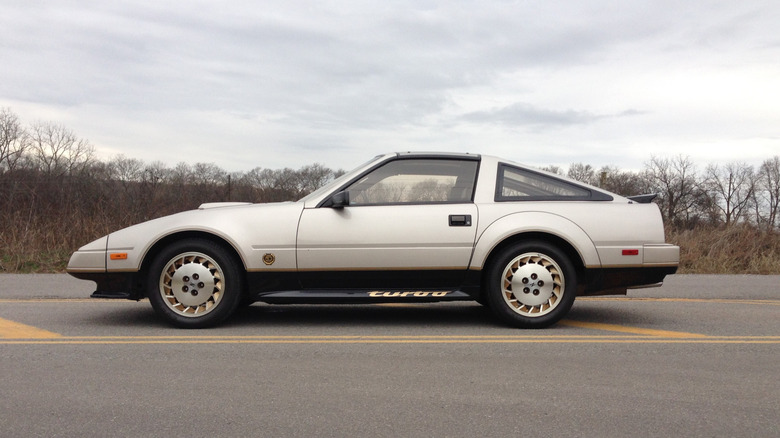
Nissan's Z car is a fantastic example of subtle yet consistent improvement — born in 1969, with continual production (more or less), retaining the same basic front-engine, rear-wheel-drive layout. And while we love to talk about the 240Z, 350Z, and Z32 300ZX, there's only one that firmly placed the Z lineage into the wedge-shape era while also maintaining the car's arc of technological improvement: the Z31 300ZX.
It replaced the 280ZX in the early 1980s, and while it shared much of its underpinnings with the outgoing car, the new 300ZX was far more wedge-like and was designed by Kazumasu Takagi with a massive emphasis on aerodynamics. Upon debut, Takagi and his team were able to achieve a drag coefficient of 0.30, a number that was considered extremely slippery even for supercars of the era (the BMW M1's drag coefficient was a worse 0.35). Thanks to the improved packaging of the VG30 V6 (Japan's first mass-produced V6, by the way), the Z31 had a visibly lower cowl and hood compared to the 280ZX — a great way to decrease lift and improve aerodynamics.
Admittedly, the Z31 is the oddball of this group so far. It's the only car that's not mid-engined, and it isn't typically brought up as a wedge-shaped icon. However, the 300ZX was one of the last wedge sports cars we got. It went out of production in 1989, just as the smooth, rounded, and bubbly 1990s aesthetic was coming into the fray. And going by sales figures, it's obvious that the people weren't ready to let go of this design language, as nearly 330,000 were sold from 1984 to 1989. To us, the Z31's design deserves a shot at being in your wedge-era hall of fame.
Toyota MR2
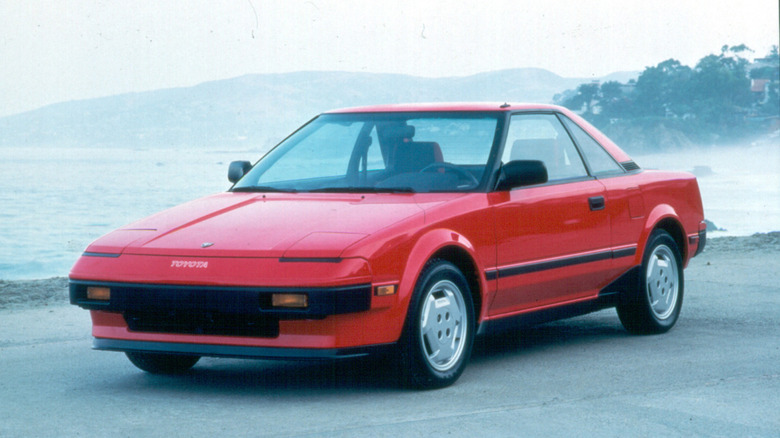
The Toyota MR2 is what we might refer to as the everyman's wedge-era icon. And while it was a quintessentially 1980s design, its roots date back to the mid-1970s, when Toyota was looking to enter the entry-level mid-engined sports car market after witnessing the popularity of European cars like the Fiat X1/9 and Porsche 914. The SA-X project, as it was called at the time, was envisioned by Akio Yoshida, Toyota's lead test engineer, as a successor to the older Sports 800 models — light, cheap, and fun.
But the project wouldn't be finished until 1983, when an evolved version of the SA-X, now called SV-3, would reveal itself for the first time at the Tokyo Motor Show. Long story short, its shape was adored by onlookers, and soon after, it got a new name and the stamp of production approval from the bosses. The freshly dubbed MR2 was now on sale for the 1984 model year, and it would continue in production until 1989, when it was replaced by the SW20-generation MR2.
So why is it a wedge icon? Well, similarly to the Z31 300ZX, the first-gen MR2 was one of the last of a dying breed. It served as an affordable and accessible way for people who enjoyed eye-catching design to actually own something worth talking about. It looked far more exotic than the large number of parts it shared with the Corolla would suggest. Couple that with a mid-engined sports car driving experience, and it becomes obvious why the MR2 is the '80s car you need. In the U.S. and Canada alone, the first-gen MR2 sold nearly 100,000 units.