

Why Saab Killed Its Revolutionary Sensonic Clutchless Manual Transmission
Automakers have produced many different and innovative approaches to manual transmissions over the course of automotive history. The Porsche 911 had the weird Sportomatic, which sounds like a gizmo found in an episode of Looney Tunes, then there have been any number of more modern automated systems, like BMW's SMG or Lamborghini's E-Gear. Somewhere in the middle is an interesting approach taken by Saab, a brand that's often associated with weird and innovative technology — like its APC technology that enabled stupendous turbo power.
Back in the '90s, Saab offered the Sensonic transmission, and to those who haven't seen a very memorable old "Top Gear" special, it's a manual transmission sans clutch pedal, though a clutch is still very much part of the equation. But why did Saab end up killing its revolutionary Sensonic clutchless manual transmission? The answer lies, as with so many forms of weird automotive technology, in complexity and demand. Let's grab a hold of the stick and shift through some gates of knowledge covering this interesting method of changing gear ratios.
Coming in clutch
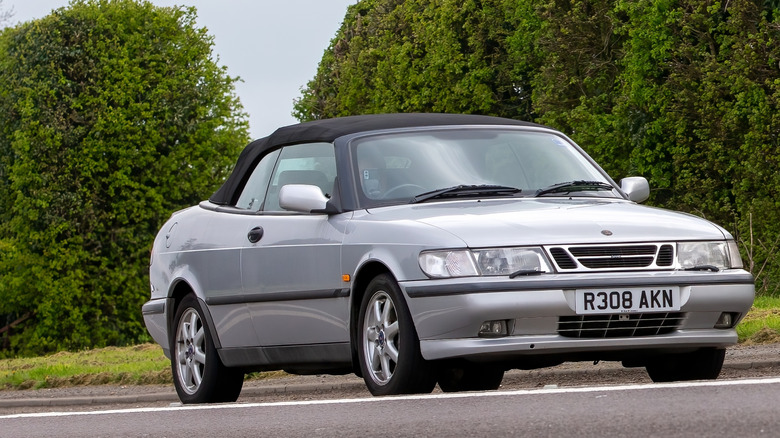
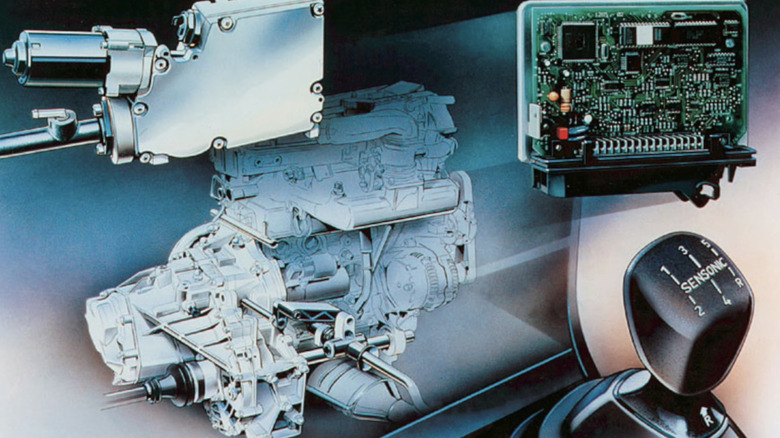
Available between 1995 and 1998 in the turbocharged 900 NG, the Sensonic has a shifter to row through its H-pattern five forward gears and reverse, then just a brake and gas pedal. It works like this: The driver puts their hand on the shifter, which triggers a microprocessor to drive an electric motor, which then operates a hydraulic actuator connected to the clutch master cylinder. This disengages the clutch, allowing the driver to shift to a gear, then, once their hand releases the shifter, the clutch re-engages. If the car sits idle in gear without brake or throttle application, it'll issue a warning and then shut the engine off after seven seconds to prevent any unintentional movements or stalling.
Weirdly, a hill-start assist function is outlined in the Saab owner's manual, but it never went into production. This would've made wielding it from a stop on hills much easier, because it's a bit fumbly to use when an incline is involved, as demonstrated in the famous "Top Gear" bit.
In terms of how it was received, some owners reported many trouble-free miles of Sensonic use, especially while shifting gears at speed — apparently it was rather quick in its operation. However, other owners had issues which resulted in expensive repairs, which weren't helped by parts scarcity over time. Complexity was a major contributor to Sensonic's downfall, because if one component in the clutching sequence didn't work properly, it threw the whole process off. Ultimately, a decrease in demand did it in and the system was gone well before the new Millennium; it was a novel approach, but with no clear performance advantage, why not just shift the old fashioned way or let a decently-tuned conventional automatic take care of the work for you?