

Texting While Driving Bans Exist In Every State But This One
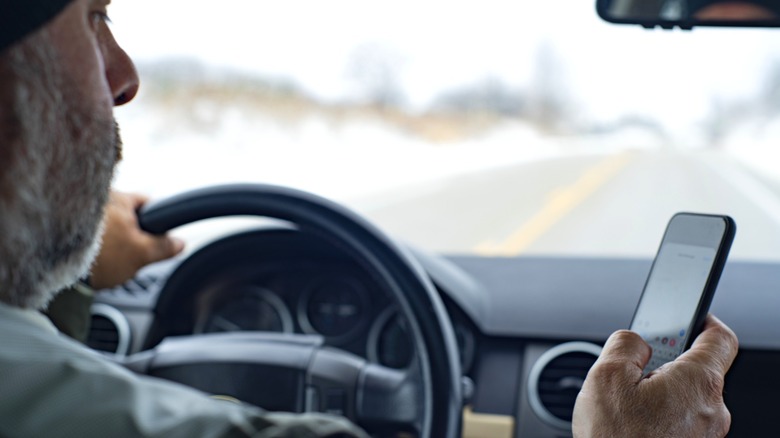
Texting while driving is something most of us would likely not even consider. Not only is it dangerous – the consequences of distracted driving being widely known — but it's also illegal. In fact, fines used to run as high as $10,000 in Alaska, with drivers also facing jail time for the offence. Laws have been softened since, but if distracted driving results in an accident or injury, the consequences can still escalate. So while some states clearly take the matter very seriously, motorists in Montana need not worry about the prying eyes of the law at all, as texting while at the wheel there is perfectly legal.
Montana hasn't simply forgotten to implement a texting while driving law. In fact, house bills have been put forward in the past, but they keep getting turned down. Some of those who oppose the law suggest it would be difficult to enforce, that it restricts personal liberties, and that a ban might somehow encourage even more dangerous behavior such as trying to hide the phone while texting and driving. This isn't an outlier for Montana, either; the state didn't introduce numerical speed limits on its roads until 1999, with prior limits requiring nothing more than "reasonable and prudent" speeds. This effectively saw some Montana roads join the list of the only highways in the world without speed limits before the '90s. And while speed limit regulations finally caught up with the state, restrictions on distracted driving are proving a little trickier to enforce.
Here's why the law is having trouble in being updated
As it currently stands, bans are creeping into Montana, but a statewide ban is still not in the cards. A total of 15 jurisdictions have passed local bans on cellphone use while driving, but even that is coming under fire, with State Senator Jeremy Trebas working to block municipalities from issuing bans. Montana Free Press quotes Trebas as saying, "These laws are going to make the roads more dangerous because people are just going to hide it and put the phone lower in their car instead of keeping their phone up and their eyes up." The same news reports John MacDonald, an opposing voice to Trebas' actions, as stating, "It's something ingrained in Montana that our vehicle is sort of an extension of our home, and the government should not be dictating to us how we can behave in that vehicle."
This is why some Montana residents believe statewide bans on behavior like this are encroaching on their personal freedoms, in addition to just leading drivers to hide the action, rather than actually stop. Montana isn't against passing new driving laws; it became the third state in the U.S. to legalize lane splitting, but it would appear a statewide ban on distracted driving practices is one law too many for some residents.
All of the other 49 states have introduced bans
Montana wasn't the only holdout from introducing a statewide ban, as up until recently, Missouri also opposed introducing such legislation. Resistance to this sentiment was fierce in Missouri, though, with more than 80 bills reportedly proposed since 2010 alone looking to restrict phone use while at the wheel. Before a statewide ban was finally introduced in 2023, only drivers aged 21 and under had their phone usage restricted while driving.
It's not just texting that legislation is zeroing in on either, but handling of a cell-phone in any manner — something that has already been banned in most states. That's an important detail to highlight, as demonstrated by the findings of one senior research scientist at the IIHS, Ian Reagan. He points out that "using plain, straightforward language to ban all hand-held cellphone use while driving, including simply holding a phone, may not only boost driver compliance but also make police more willing to issue tickets by making infractions easier to identify and less likely to be dismissed in court. The presumption is that increased enforcement also results in greater compliance."
Other aspects of distracted driving have been thrown into the spotlight in recent years, such as the call for drivers to stop wearing headphones while driving. While personal freedoms do need to be protected, the stats surrounding distracted driving are quite shocking — 3,208 lives were claimed to distracted driving in 2024 alone, reports the NHTSA – so surely it's only a matter of time before Montana toes the party line.