

Climate Change Presented China With A New Potential Shipping Route For These Stressful Economic Times: The Arctic
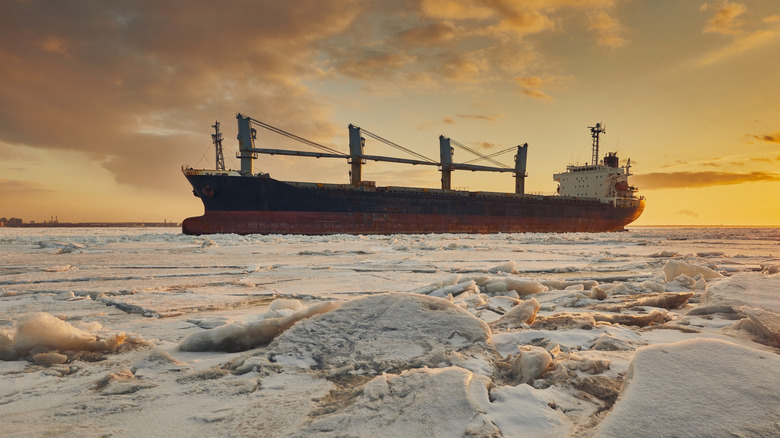
The world is basically on fire and falling apart, in no small part thanks to our continued ambivalence towards climate change. But fear not, as the U.S. government is doing everything it can to keep that global warming gravy train going while telling everyone those bad greenhouse gases aren't really that bad. One region that does stand to benefit from a warming planet is our controversial eastern-Asian neighbors, China, as well as Russia, who are now able to explore the Arctic as a potential, cheaper and faster shipping route to Europe — at least in the region's warmer months.
The Wall Street Journal reports that China expects to begin its advantageous sea route experiment along the Arctic this weekend to see just how feasible of a shipping route it could be. Although the country technically doesn't have any point that touches the Arctic Ocean, the northern route, now freed up even more by warming waters for a few months of the year, could be a potential economic boon for China's future, Marc Lanteign, professor at the Arctic University of Norway told NPR. It could save both time and money getting essential supplies to Europe.
But it's not a route for the faint of heart. The path China's ships are expected to route through the Bering Sea and along the Russian-controlled Northern Sea Route and southern side of the Arctic Ocean that for decades was mostly ice. However, Earth has seemingly warmed up just enough to allow some passage of ships, sometimes without an icebreaker container to accompany the journey through to Europe. If it were feasible, experts say liquified natural gas, for instance, could drop at least 30 percent in price. And Chinese shipments could take two weeks less to get from the far East to Europe and beyond.
What it'll take to make China's Polar Silk Road a viable sea route
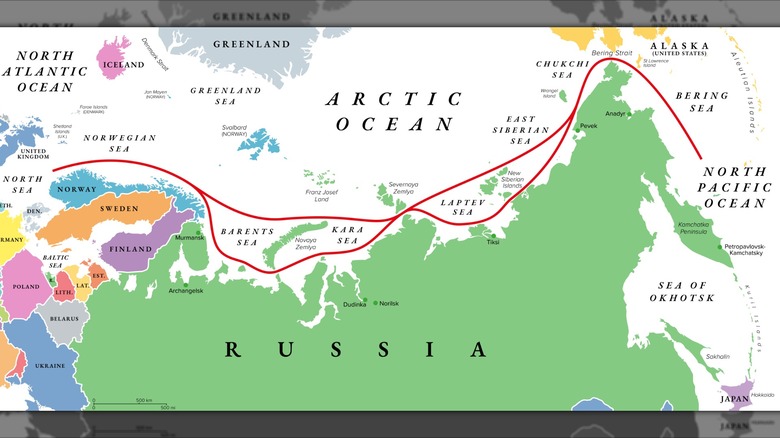
There are a litany of caveats that make this passage tricky for any country to navigate, let alone China. The "Polar Silk Road" as the Chinese have deemed it remains under the domain of Russia, who controls who is allowed to cross its waters. And it will be essential for China to stay within Russia's good graces to not only establish the trade route, but continue to use it.
As far as actual logistics, icebreakers are usual companions for the voyage, and even then that doesn't guarantee safe passage of any ship, no matter the size. For instance, a Russian tanker that attempted the pass with an icebreaking container ship leading the way still suffered over half a million dollars in damage to its hull in the Arctic's icy waters. That sort of unpredictability makes insurance costs considerably higher compared to say taking a route like the Cape of Good Hope, Jonathan Steenberg, an economist at credit insurer Coface told WSJ.
The upcoming expedition, headed by shipper Sea Legend, is expected to take this experimental route at least eight times over the next two months through October — before the route becomes an impassible icy mess. Lanteign told NPR that, "Even under the best conditions, you still have to worry about weather, sea, ice, many hazards." He added, "But China's looking ahead. They're looking ahead to the point where the Arctic becomes even more popular as a sea route." And it could be a pivotal finding when routes like the Strait of Hormuz are tied up and expected to remain tied up for some time, while crippling the world economy and shipping of goods. An extra route to ease some of that shipping pain, even for a few months of the year would be welcomed.