

How Stop Sticks Deflate Tires Slowly Instead Of Making Them Explode
Catching the bad guys is obviously an important part of every police department's job. Yet chasing them, especially at high speeds, can be dangerous to all — from bystanders to the police themselves. As just one example, pointless police chases were responsible for 10 deaths in a single week earlier this year. But the cops do have some less-lethal ways to bring pursuits to a halt, including Stop Sticks.
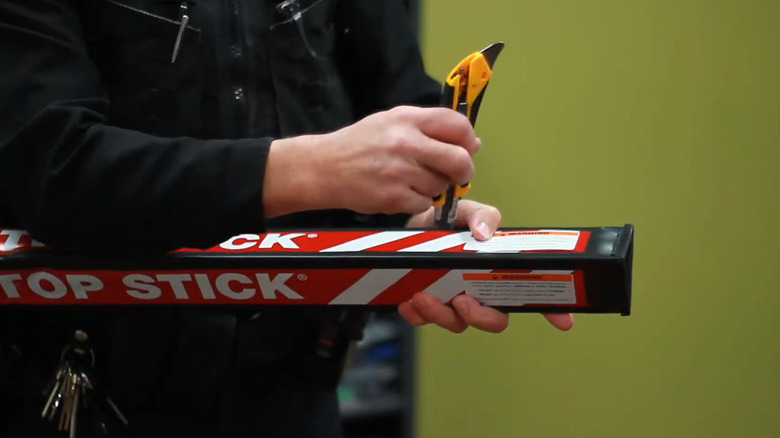
To be clear, "Stop Stick" is technically a brand name for a certain type of tire-deflation device. Each one can be imagined as a giant, three-foot-long Toblerone candy bar in its distinctive triangular cardboard box. Only instead of delicious chocolate and honey-almond nougat inside, there's an arrangement of 36 hollow, Teflon-coated steel quills capped at each end by detachable spiked tips. Those assemblies are 2.625 inches long and arranged in 12 triangles spaced out evenly along the Stop Stick's length — and supported by a collapsible polymer core. The whole thing is then wrapped in glass-filament tape and slipped into a polypropylene plastic sleeve.
When a car tire passes over the Stop Stick, its weight causes a quill assembly or two to puncture the rubber. Since the spike tips are detachable, one remains in the polymer core and the other falls off in the tire, leaving the quill in place. The air then flows through the hollow quill as if it were a relief valve. As a result, the air is released in a relatively slow, controlled manner specifically engineered to avoid blowouts. Just keep in mind that the hollow-quill business is not unique to Stop Sticks. It's a design feature also found on rival tire-deflation devices.
Are Stop Sticks safe to use?
As you'd expect, the company that makes Stop Sticks promotes them as a safe way to put an end to high-speed police chases. And fewer blowouts can mean fewer opportunities for a fleeing driver to lose control of a vehicle and crash. As it turns out, though, Stop Sticks can sometimes lead to more dangerous situations for the cops themselves.
The individual sticks, as mentioned, are 3 feet long, and up to four can be strung together for 12 feet of road coverage — with one end of the string of sticks attached with a cord to a fishing-reel-type device. The concept is to stand on one side of the road and then throw the Stop Stick across to the other side. Next, the reel is used to pull the Sticks back to the near side so they're spread out in a straight line. The cops have to quickly pull the sticks all the way off the road once the fleeing car passes, too — all while potentially dodging fast-moving traffic.
As a result, police officers working with the devices have been killed not only by fleeing suspects, sometimes intentionally, but also by other cops. In fact, according to the National Law Enforcement Officers Memorial Fund, 42 officers were killed in the line of duty while placing Stop Sticks between 1996 and 2022 alone, and many were injured.