

How Audi Dominated The 1988 SCCA Trans-Am Series With The Smallest Engine
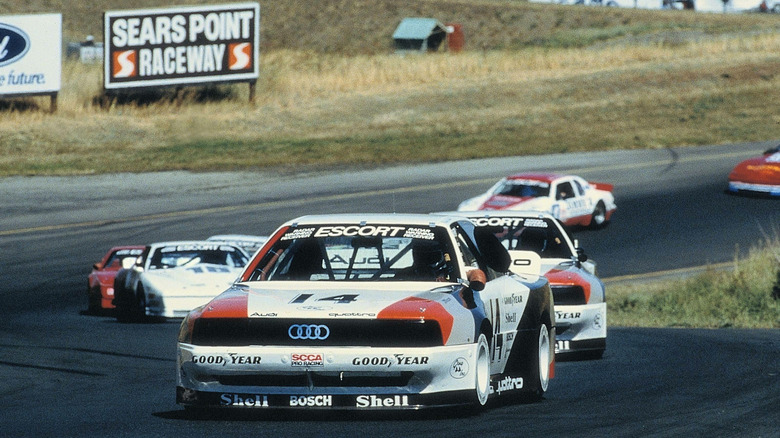
"Race on Sunday, sell on Monday" remains one of the greatest marketing strategies ever, but in the late 1980s, it was more like "Race on Sunday and really, really hope to sell on Monday" for German automaker Audi. That's because it had been embroiled in some very negative press in the US back in 1987, and desperately needed to dig its way out.
So, did it enter IndyCar, NASCAR, or the International Motor Sports Association (IMSA)? No. Instead, It jumped into the best form of "race on Sunday, sell on Monday", Sports Car Club of America (SCCA) Trans-Am, with a handful of otherwise everyday-looking sedans, and, with the help of Virginia's Group 44, beat so much of the living snot out of the competition that it was effectively banned. The heart of their effort: a small (by comparison to much of the competition) 2.1-liter inline-5 engine.
How did Audi dominate the 1988 SCCA Trans-Am with the smallest engine? It took a big turbocharger, Quattro all-wheel drive, and one heck of a driver lineup. Suffice to say, we enthusiasts remember the brand more for what it did in this arena than what was said of its alleged (later proven faked) faults.
Transmissions with a mind of their own
The scandal surrounding Audi's negative press in 1987 concerned its transmissions and how they magically jumped out of park and exhibited weird behavior, such as jerky throttle inputs. European car haters may take such reports at face value, but they were later proven rigged.
A lot of damage to the brand's reputation was done, so executives were scrambling for a way to claw back to the public's good graces. At the same time, Group 44 had lost its contract running Jaguar's IMSA GTP program to Tom Walkinshaw Racing, and was in need of a new program. The two came together and magic happened. The target: SCCA Trans-Am, where tube-frame silhouette cars (meaning, not production-based) with revvy V8s reigned supreme, albeit a Paul Newman-driven Nissan and some legitimately cool Merkurs also did battle, among others. Audi pulled a handful of four-door 200 sedans off the production line, then its racing division and Group 44 got to work.
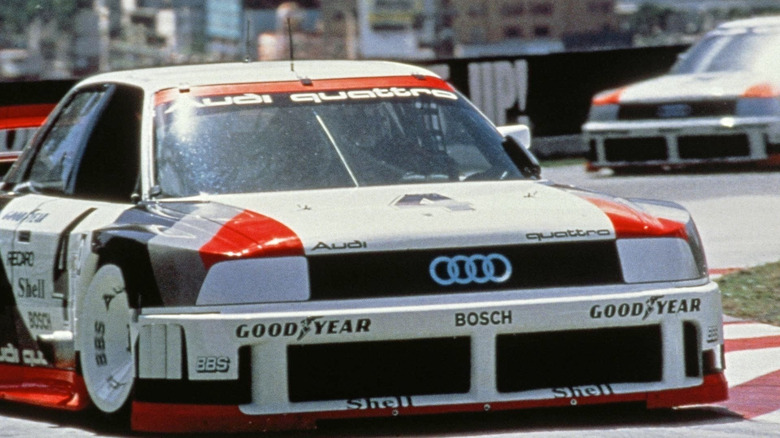
The end result was badass: ultra-wide fiberglass fenders, roll cage, extensive chassis reinforcement, big slicks, plus aerodynamic and cooling features throughout. The mighty lil' 2.1 five-cylinder made over 500 horsepower with the help of a massive turbo — fun quick fact, Audi and Porsche later utilized a potent turbo-five in the former's first RS model. Audi then added its rally-bred Quattro all-wheel drive system featuring a center Torsen and front/rear limited-slip differentials that could put the power down better than anything else in Trans-Am. Curb weight came in at around 2,600 pounds, and if it already wasn't production based enough, the factory MacPherson front and double-wishbone rear suspension was retained. Finally, Trans-Am disallowed six-speed transmissions, so Audi had to put a blank gear in its gearbox to fit the rulebook.
So good it got banned
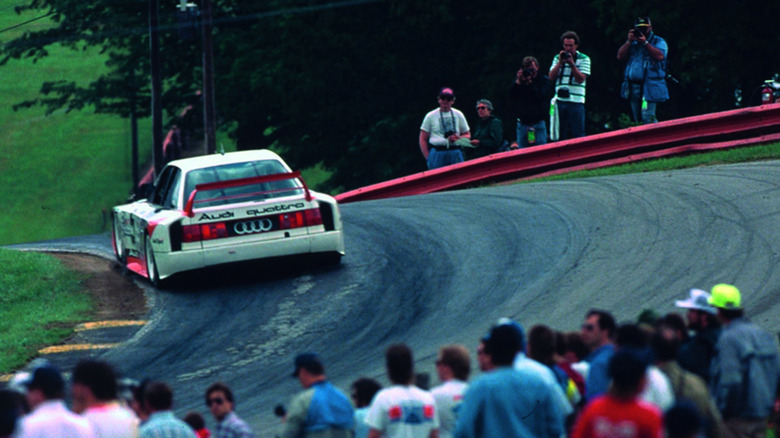
The talent was deep, too. Hurley Haywood, Walter Röhrl, and Hans Stuck were in the driver's seat, and the podiums piled on. In the first race of '88 at Long Beach, Stuck grabbed second place. The team won the following race in Dallas, but finished sixth at Sears Point Raceway (Now Sonoma Raceway). From there, the team won the next five races back-to-back, which caused the officials to give the Audis restrictor plates and a weight penalty. Its results were still pretty darn good, and by season's end it won eight of the 13 races, giving Audi the driver's and manufacturer's titles.
The SCCA banned all-wheel drive from Trans-Am for the 1989 season and thus Audi's program ceased. Though it lived on in IMSA with the Audi 90, where it kicked plenty of ass thereafter. Audi dominated the 1988 SCCA Trans-Am series with a production-based sedan — far from the exotic tube-frame fare that much of the competition was rocking — plus a little five-cylinder engine sporting a massive turbocharger and Quattro all-wheel drive. Throw in some top-notch pro drivers, and it made for one of the most impressive chapters in motorsports history. Not long after its efforts in creating a world rally monster, and far, far before Audi's plans for being a viable contender in F1.