

Only A Fraction Of 1964.5 Ford Mustangs Had The Goods To Reach Its Full Top Speed
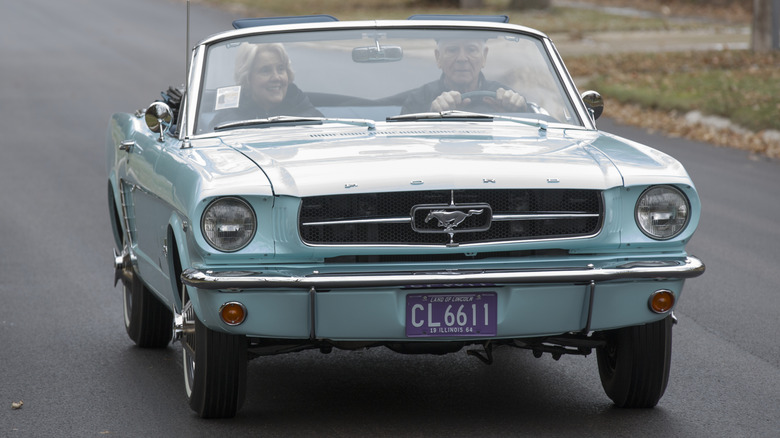
Ford had a real hit on its hands when the Mustang launched on April 17, 1964. Sharing lots of parts with the Falcon sedan, the original Mustang set records, clearing a million sold in 23 months. The Mustang was successful because it had an attractive design and an inexpensive starting price, and it could be optioned out pretty much however you wanted it. You could get an inline-6 Mustang outfitted with all the luxury bells and whistles, or you could buy a stripped-out speed-demon car with a V8, a manual transmission, and the right gearing for the Saturday night drags.
Let's say you wanted the fastest Mustang money could buy in 1964, in an effort to impress the young thing sitting next to you at the soda fountain. The Mustang was initially only available with the 104-horsepower "Thriftpower" inline-6 and the Falcon's 260-cubic-inch V8 making 164 horsepower. So if you were one of the first Mustang buyers in line, you definitely weren't getting the greatest and best. After a few months of production, Ford was ready to introduce the so-called C-code 200-horsepower 289-cubic-inch V8 and the A-code version of the same engine with a four-barrel carburetor and 225 ponies. But if you really wanted to go fast, you had to wait until June for the big boss of them all, the K-code "Hi-Po" 289 V8 rated at a pretty impressive 271 ponies and 312 lb⋅ft.
The K-code engine was able to create so much power as Ford designed it for the larger Fairlane with higher compression, different cylinder heads, and freer-flowing exhaust manifolds. The K-code even got a water pump with fewer vanes on it to reduce its power sapping and avoid cavitation at higher rpm.
Hi Po or no go
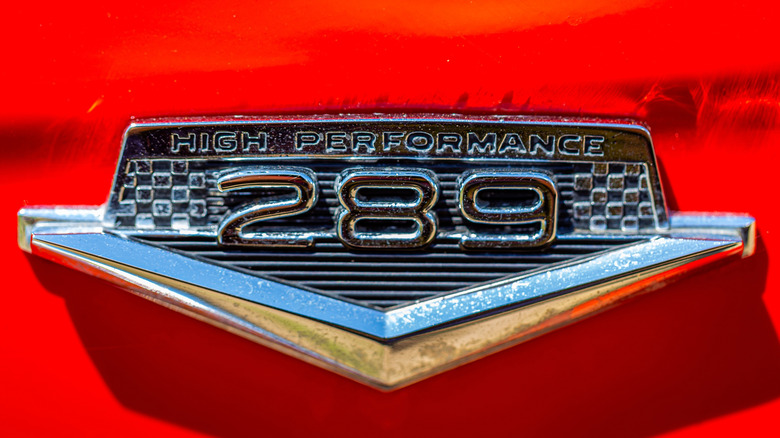
Only available with a four-speed manual transmission, the K-code Mustangs were easily the fastest of the bunch. The transmissions installed in those early Mustangs were built with a 1:1 fourth-gear ratio and the highest gear you could order in the rear differential was a 3.50:1 ring and pinion. Considering the Mustang would have had 24.7-inch tall tires, and the engine makes peak horsepower at 6,000 rpm, you should be able to rev it out out to 6,500 rpm, and it should have had a theoretical gearing top speed of about 135 miles per hour.
There's hardly a consensus on the car's actual real-world top speed, as most testers weren't brave enough to try. Car and Driver estimates the top speed at 110 miles per hour; others say 120. This certainly wouldn't have been a case of the Mustang being gear-limited, and artificial limiters didn't really exist like they do now. The Mustang, with its blunt nose and upright windshield, would have been aerodynamically limited, and would have needed a whole lot more power to reach that rpm limit.
How many K-code Mustangs are out there? Just a fraction of 1% of Mustang buyers opted for the K-code engine, meaning these things are as rare as a dry brow in a Midwest July cornfield. Just 7,273 were built in '64 and '65, and 5,469 more were assembled for 1966. K-code continued for 1967, but with a significantly changed look for the Mustang.
So what's the exact top speed of a 1964.5 Mustang? To get an accurate top speed for that car today, you'd have to find one still in its original condition and with an owner willing to let you take it for a top-speed run to boot. As the disembodied voice said in the Tootsie Pop commercials, the world may never know.