

5 Safety Tips To Keep In Mind As You Navigate School Zones
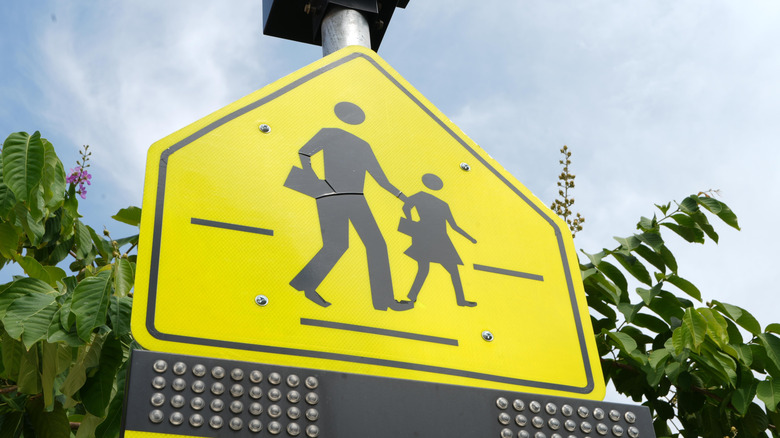
With some kids already back in class, now's a good time to remind folks to take it easy in school zones — which can be dangerous places. Now, finding hard data specifically on school-zone injuries/fatalities can be surprisingly difficult. But Safe Kids Worldwide, for one, does point out that 40 child-aged pedestrians are hit by cars every single day — that's more than 15,000 every year. We can also cherry-pick details from NHTSA's Traffic Safety Facts 2024 data for pedestrians (published in 2026). There, the numbers indicate 116 child pedestrians aged 5 to 14 were killed in traffic crashes for the year.
On the other hand, you can find some comprehensive information about the issue in Alarming Dangers of School Zones, also from Safe Kids. It's just that it was published a decade ago. Still, it tells a story of increasingly distracted walkers involved in relatively risky crossing-behavior situations, where only some 40% of the school zones had posted speed limits of 20 mph or lower. Moreover, 30% of the school zones were without marked cross walks. And don't forget about the one driver in Albany, NY, who was tagged with 29 school-zone tickets in a space of only 10 days. With drivers like that on the road, even signs with a specific loud, glowing, fluorescent yellow-green hue aren't going to be enough to protect people.
That's where you come in. You can do your part to improve school-zone safety by keeping at or below the speed limit, taking extra care where vehicles are double-parked, focusing on the road — not your phone — and watching for bicyclists and buses, too.
Do not speed in school zones
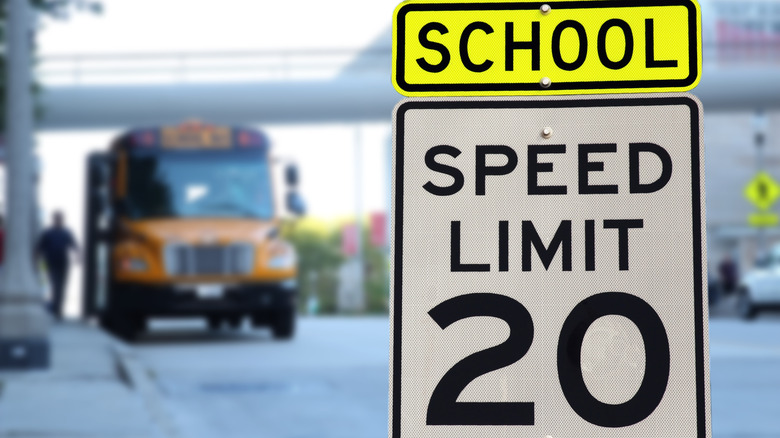
You can no doubt enjoy an adrenaline rush from the fastest street legal cars ever built. But the place to cash in on those thrills is the track — not public roads. After all, speeding is one of the biggest contributors to deaths and injuries in car crashes. The National Safety Council, for example, says that of all the traffic accident deaths in 2024, 29% came in crashes where speeding was a factor.
A key reason for this has to do with how much time it takes drivers to recognize and react to potential road hazards. According to the Human Performance Factors Attachment to the California Commercial Driver Handbook (clicking the link will prompt an NTSB PDF to download to your device), it first takes the typical person 1.75 seconds to merely notice a possible problem. Another .75 to 1.0 seconds will then pass before the driver can do something about it. A vehicle won't stop immediately either, so it can take a fairly significant amount of time between seeing a problem and stopping your car — even one traveling at the typical school-zone limit of between 15 mph and 25 mph. Moreover, the math says that if you're travelling at twice the posted limit — doing 40 mph in a 20-mph zone, for instance – the braking distance and impact forces can be four times higher.
Nor should you necessarily put your complete faith in automatic emergency technologies. For all their benefits, a study by the Partnership for Analytics Research in Traffic Safety says pedestrian automatic emergency braking (PAEB) cut crashes between vehicles and "non-motorists" by a mere 9%.
Don't double park, and be extra careful behind vehicles that do
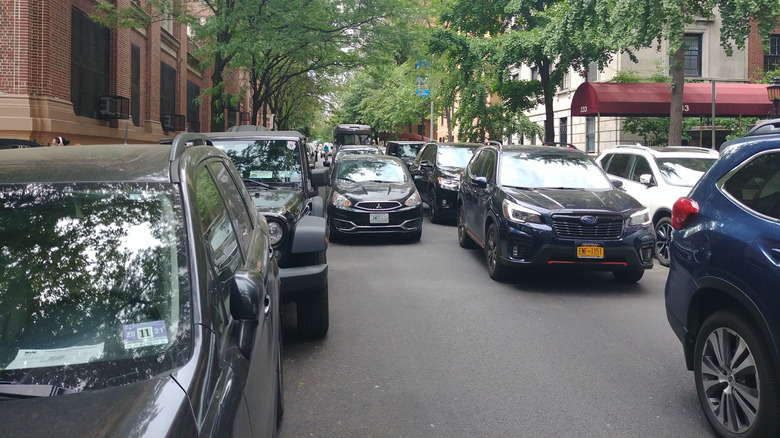
School zones can often run through residential areas with narrow streets, so — if the roads are also lined with parked cars — you may be tempted to double-park your own vehicle to let out or pick up your kids. Well, this is another bad idea. As mentioned above, it's not just bad driver behavior that can put pedestrians at risk. The pedestrians themselves can be part of the problem, especially if they're looking at their phones and/or have their headphones plugged in. FYI: Even if they are or you see them otherwise goofing around, you should give pedestrians the right of way, even if it's legally yours.
The concern here is that having any cars parked on the street can be bad enough for visibility. Just consider the classic case of a kid suddenly darting out from between a pair of bumpers and into a car's path. Stacking your car by parking it right next to another only makes things that much worse. Not only does this make it harder for drivers to see kids waiting to cross, it makes it more difficult for kids to see vehicles driving in the road.
You never know who's watching either. Some city buses have been known to snitch on parents when they're double-parked in the wrong lanes while dropping their kids off at school.
Be ready for bicyclists
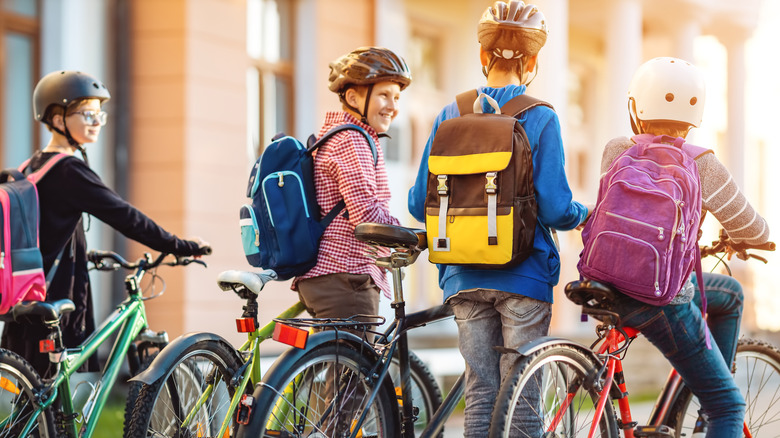
It isn't only pedestrians and other motor vehicles you have to watch out for. Plenty of kids ride their bikes to school, and bicycle-riding commuters may also pass through school zones. They're an added danger that requires extra attention.
For example, if you're trying to pass a bike travelling in the same direction as your car, slow down, and stay at least 3 feet away from the bicyclist. If you're preparing for a left turn and see a bike coming down the road from the other direction, let it pass before completing your turn. Additionally, you should follow the same basic principle if you want to turn right and you see a bike coming up from behind you. Again, give the bicyclist the right of way -– even if you think the rules are on your side. As for parking situations, always check your mirrors before getting out of your. This can be an easy solution to deadly dooring crashes.
Plus, there's a new reason to be worried about kids biking to school. A growing number of them may be on e-bikes that are faster and harder for them to control than typical bicycles. Some parents make things worse by purchasing electric motorcycles instead, and confusing those with e-bikes is more than merely semantics. As a result, some schools are even banning e-bikes.
Be aware of buses, too
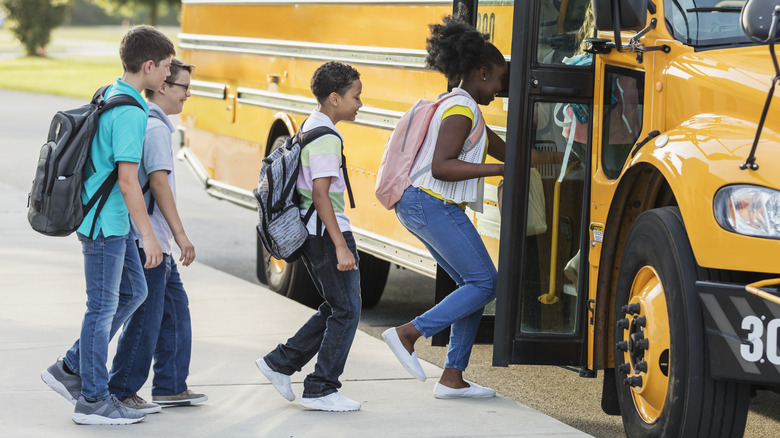
Along with the various cars, bicyclists, and pedestrians traversing the typical school zone, you're also likely to run into a fair number of buses. You should actually, of course, be even more vigilant around buses. For one thing, experts recommend that you give yourself a little extra room between your car and a bus you're following. That way, you'll have more time and space to stop if the bus is picking up or dropping off students. A good benchmark from the NSC is to remain at least 10 feet away from the bus when possible. Inside that perimeter is where most of the danger is for kids. Knowing that, some sources say you should stay a full 20 feet away from buses once their flashers are turned on.
Keeping your distance isn't only a recommendation. This is because it's illegal to pass a stopped bus with its lights flashing and stop-arm deployed in all 50 states — as well as Washington, D.C., Guam, Puerto Rico, and the U.S. Virgin Islands. And that's despite the fact that Waymo's Robotaxis keep blowing by buses anyway.
Put down the phone
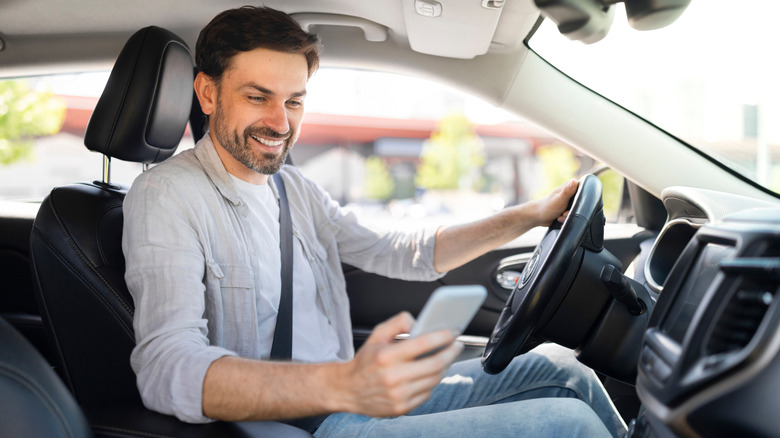
Do we really have to tell you to avoid distracted driving when you're in a school zone? Yes. Yes, we do. Even though texting and driving is against the law in Washington, D.C., and 49 states — all save Montana — people continue to do it. One recent survey from AAA showed that 37% of the folks surveyed had read a text or email in the past month, while 27% had sent one. Also, 36% of those surveyed said they'd had phone conversations with the phones in their hands during that time.
Not that that really matters, since hands-free calling and texting isn't safe either. Per the study Dangers of Distracted Driving, "Evidence suggests that hands-free phone use provides no safety benefit because it does not diminish cognitive distraction (ie, when the driver's attention remains diverted from the task of driving)." In other words, you're distracted by talking on the telephone, regardless of whether it's in your hands or not. Yet, data from the Governors Highway Safety Association, per the Vehicle Safety Organization, indicates distracted driving was reported as the cause of 39% of pedestrian fatalities in 2024. So you may want to stop wearing headphones while you drive, too.