

Being Less Dependent On GPS And Learning Your Surroundings Is Good For Your Brain
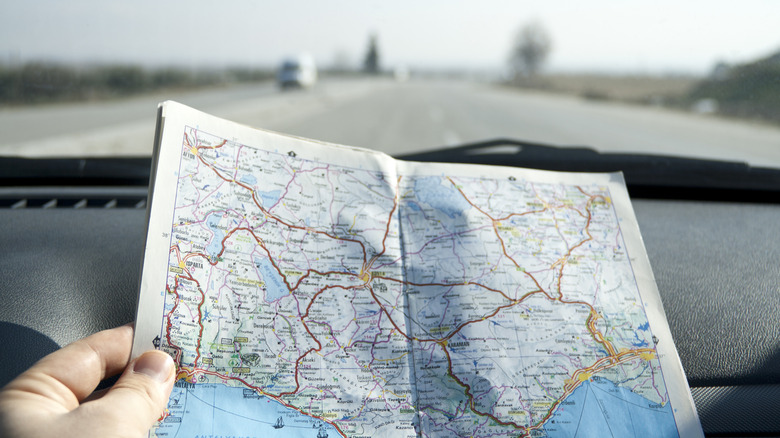
Much like a GPS system, your brain is capable of making its own maps to help you figure your way around the places you've been. The more you travel and pay attention to your surroundings, the better the map is. And according to a 2024 study, that kind of brain activity could be beneficial to your long-term health as well as reduce your likeliness of death from Alzheimer's disease. For car people, that's a win considering we're already losing to tire particles.
According to The Conversation, this research was inspired by an early landmark study looking at the hippocampal changes in London taxi drivers. London cabbies (at least the black cabs today) are required to pass a test called the Knowledge where they memorize more than 25,000 streets and 20,000 points of interest within a six mile radius of Charing Cross — the center of London where six of the city's major roads all meet. Scans performed on these drivers showed they had measurably "more gray matter in the posterior hippocampus." Researchers also found that the longer these drivers attended to these routes, the larger their hippocampus region would be.
That correlation was then further explored in the 2024 study by researchers at Harvard, Brigham and Women's Hospital, Massachusetts General and the National Bureau of Economic Research, all in Massachusetts. In this new study, researchers wanted to see if there was any benefit to occupations that rely on spatial and navigational processing and protection against Alzheimer's disease, which begins with atrophy in the same region of the brain that handles that kind of processing.
Expanding your mental map could help curb a terrible disease
To do that, researchers looked at the death certificates of individuals who had passed between the dates of January 2020 and December 2022. Of those, they sorted into categories any with listed occupations on their certificates, making for approximately 9 million individuals divided into 443 groups. The groups they focused on were ambulance and taxi drivers — both known occupations for their use of spatial and navigational processing. They also pulled a comparative group consisting of bus drivers, aircraft pilots, and ship captains who were also transportation-based occupations, but those jobs relied more on consistent, pre-determined routes.
What they found was a significant correlation and benefit to exercising the hippocampal region. Of the near 9 million individual death certificates considered in the study, 3.88 percent of those individuals (348,328) died of Alzheimer's disease. Now, setting aside the 16,658 of those near 9 million that were taxi drivers, only 171 — or about 1% — of those drivers died from Alzheimer's disease. For ambulance drivers, which accounted for 1,348 individuals, the death rate for Alzheimer's was less than 1%. Researchers indicated that the same trend was not observed for the comparative group that consisted of other transportation-based occupations.
The study is not suggesting you delete all of your GPS apps and go full paper map. But there is probabkly something beneficial to you learning the area of the places you frequent and visit, maybe even getting lost occasionally to find other routes to explore. Think of it like a Zelda map — the more of each area you fill, the larger your hippocampus could get. And in doing that, you may be helping protect your brain (and life) from deteriorating from the terrible disease that is Alzheimer's in your older years.