

Why Railroad Crossing Signs Are X-Shaped, And What The Crossbuck Actually Means
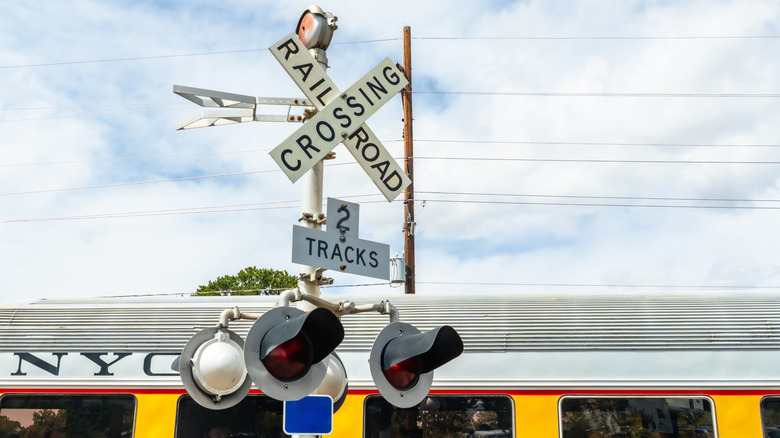
We in the U.S. may not be up to European levels of train travel for getting to your favorite spots, but we still depend on rail to move mass quantities of goods across the country. There are nearly 140,000 route miles in the U.S. freight rail system, after all. That's a whole lot of rail, and a whole lot of railroad crossings. The Federal Railroad Administration says there are approximately 212,000 highway-rail grade crossings dotting the United States. They can be dangerous, too. A freight train may require over a mile of space to come to a complete stop. Let's face it, the car never wins in a collision with a train on the tracks.
So, what to do about the danger of crossings and the threat they pose to inattentive or impatient motorists? Signage is a good start. Now, unless you're just not paying any attention, you've seen railroad crossing signs. In the United States, they're typically an X-shaped assembly, with two individual reflectorized panels forming the sign. One panel reads "Railroad," while the other spells out "Crossing." It's the "crossbuck," a mashup word representing an instantly recognizable addition to the nation's artery and nerve network of rail and street. Why an X shape? It boils down to the need for a simple, easy, and uniform way to warn drivers and, at earlier times, riders on horseback of potentially deadly railroad crossings.
X marks the railroad crossing
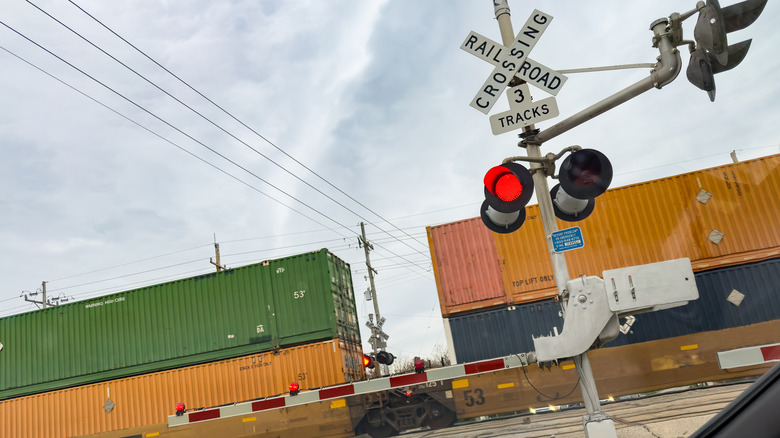
Every roadside sign serves a purpose. They deliver information to motorists, sometimes as drivers passes the signs at speed. It's precisely why American school zones rely on that specific loud, glowing, fluorescent yellow-green hue to caution drivers about the added risks present. Considering just how dangerous a railroad crossing can be, the signs warning drivers and passengers need to be instantly recognizable and beyond confusion. Sure, adventures like abandoned railroad e-bike camping may seem like a great idea, but you'll want to make sure you're nowhere near an active set of rails or a busy crossing.
At first, regulators tried solutions like stationing personnel at crossings with lanterns to warn early motorists of incoming trains. The idea proved spendy and ineffective. That's where the crossbuck comes in. Its name is a portmanteau consisting of "cross," as in railroad crossing, and "buck," as in a wooden sawbuck. More important than its name, you'll find the sign at most level railroad crossings, meaning where a roadway crosses a railroad at grade and poses a danger to passing vehicles.
The X-shape prevailed after regulators tested several different configurations, including a complicated graphic representation of a crossing and a diamond-shaped layout with text wrapping around the perimeter. Ultimately, the X-shaped crossbuck became the standard for American railway crossings.
Active and passive crossings
See a white X-shaped sign with black lettering? Ignore it, and you may get hit by a train. So, the U.S. chose to keep it simple for motorists — well, and for those riders on horseback. Early versions of the crossbuck were 9-feet tall to better grab the attention of horse riders as well as drivers. Unlike your pappy who used to ride his horse uphill both ways to get to the store, most travelers are vehicle bound these days, and the standard crossbuck height is more in line with that fact. That doesn't mean the X-shaped crossbuck is the lone option.
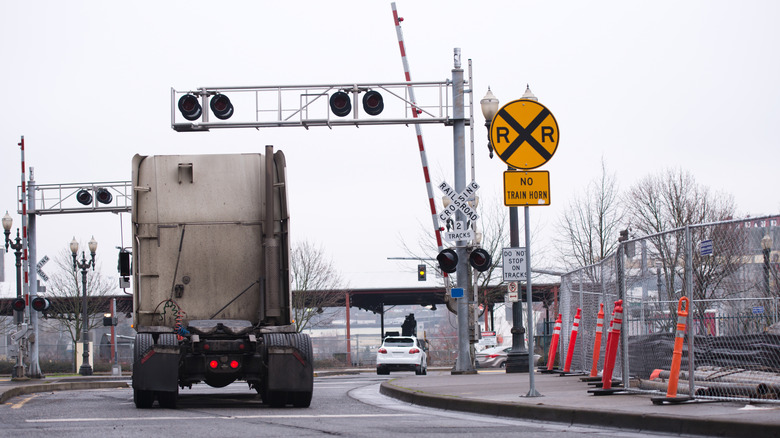
In addition to the traditional crossbuck sign, motorists may notice a round yellow sign featuring a black X spanning across the entire circle and an R on either side of the larger X. That's an advance warning sign, signaling drivers that the road they're currently on will have a railroad crossing. What's more, a crossing may include active or passive signage. With passive signage, like a static, standard crossbuck, the sign serves as the warning.
However, with active warning signs, a typical railroad crossing sign pairs up with electronic devices that warn or prevent motorists from driving onto the tracks as a train passes. Think flashing red lights and gates that lower to block the access to the tracks from the road. Those barriers are important, too. Far too many people and vehicles get struck by trains. Don't ignore them and become a statistic like the case of a freight train destroying a semi truck after it ignored the life-saving arms.