

Shelby Gave A Mustang Independent Rear Suspension And Fuel Injection Nearly 60 Years Ago
The 1999 Ford Mustang SVT Cobra wasn't without its problems, but it did mark a major change for pony-car fans: It was the first Mustang to ever reach dealerships with both fuel injection and an independent rear suspension. Now, Mustangs had actually begun moving to fuel injection in 1984, but adding the new suspension marked an important turn for the better — boosting the car's credibility as a true all-around performer.
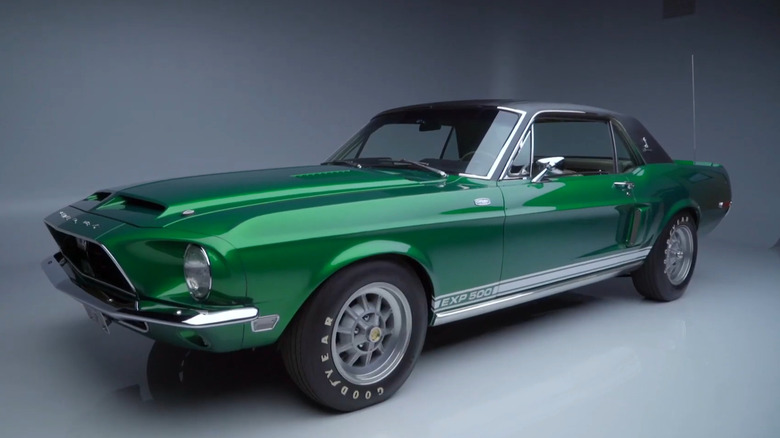
Yet while the 1999 SVT Cobra was the first production Mustang to combine those features, it wasn't the first Mustang ever to do so. That honor goes to the Shelby Mustang EXP 500 prototype that was put together in 1968 — and "put together" is unusually appropriate here. Also known as the "Green Hornet" for its striking exterior finish, the EXP 500 started life as a standard 1968 notchback. The car was then sent to Shelby, who would use it to test equipment for a proposed GT/Super Coupe model. When that project was shelved, Shelby then used the same car for the same reason as part of development for a Mustang California Special.
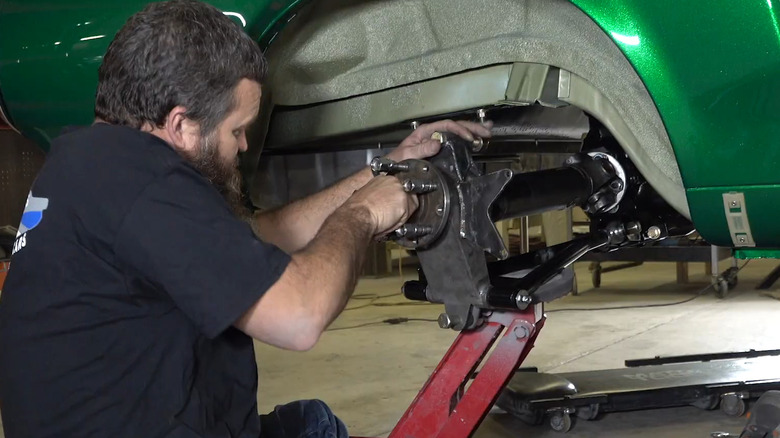
It next became a general test mule for potential Mustang equipment such as a prototype Conelec electronic fuel-injection system and a fully independent rear suspension. The icing on the cake, however, was a paint job worthy of a hot rod show. Going right over the original Lime Gold Metallic finish, the Green Hornet lived up to its name with three coats of Gold Luster Green, incorporating gold metallic mica flakes, as well as two clear coats and a custom white-and-gold EXP 500 striping package.
This Green Hornet could fly
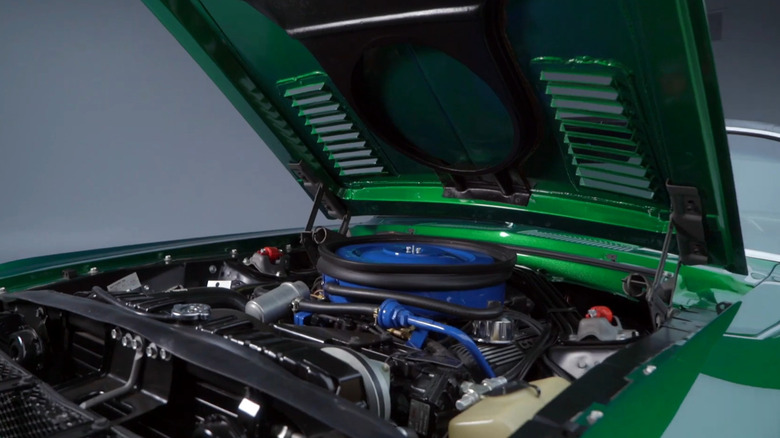
Another notable piece of hardware undergoing trials in the Green Hornet was its 428-cubic-inch V8 engine. It would go into production as the iconic Cobra Jet V8 and power some of the Blue Oval's hottest cars of the era. For the Green Hornet, that motor meant drivers could reach 60 mph in about 5.7 seconds and achieve 100 mph in 11.4 seconds. Keep your foot on the gas and the Green Hornet could hit 157 mph. Car and Driver provides some context. When editors tested a 1967 Mustang GT 500 — albeit with a carbureted 428 V8 — the tale of the tape included a 6.5-second 0 to 60 mark, a 16.6-second run to 100 mph, and an estimated top speed of 128 mph.
True, some of this may be explainable by differences in output — the trouble is, we don't know for sure. The GT 500 is listed at 355 horses and 420 pound-feet of torque, but the Green Hornet's output numbers aren't readily available. We can tell you the engine was paired with a truck-style three-speed automatic transmission, and the torque converter came from the Lincoln parts bin.
It's also worth pointing out that, even though this one-off Mustang had an advanced-for-its-time suspension, it retained the 9-inch center section/rear differential that had been around since 1957. The unit became legendary among tuners for the unique angle of its pinion gear's teeth. Apparently, it gave them a rewarding strength advantage on the drag strip. The diff was wrench-friendly, too, with only 10 bolts separating you from easy access to the gear set.
What happened to the Mustang Green Hornet?
Many car companies crush their perfectly good concept cars, and that likely would have been the case with the Green Hornet. But a Ford exec had other plans — which included diverting the special Mustang from the crusher and sending it to one of the company's holding lots instead. From there, the lot's supervisor purchased the Green Hornet to use as his family's daily driver. Many of its goodies were either missing or had been replaced by standard equipment, but the car was nonetheless too powerful and dangerous for hauling the fam around town.
The vehicle would eventually find its way to a Ford dealer, whose son realized it was something special. That turned into a multiyear restoration process involving multiple restorers. In the end, the Green Hornet was purchased by Craig Jackson, CEO of the Barrett-Jackson Auction Company. Only that really wasn't the end of the story.
It turns out that Carroll Shelby himself liked the Green Hornet so much that he had a second version created for his personal collection. It premiered at the 2008 SEMA show with plenty of period-correct parts — although not the fuel injection and independent suspension systems of its predecessor. On the plus side of the ledger, the Black Hornet was engineered from a surviving 1968 Mustang notchback and could belt out 400 horses from its appropriately sized 428-cubic-inch V8 enhanced by a high-volume Holley fuel pump, upgraded exhaust and intake manifolds, power brakes and steering, a Mallory ignition system, and more. The car entered the collector's market after Shelby died, most recently going for $451,000 at a Barrett-Jackson auction in 2023.